Biography · Chemist no. 48 of 350
Alfred Nobel: The Chemist Whose Explosives Funded the World's Greatest Prizes
Introduction
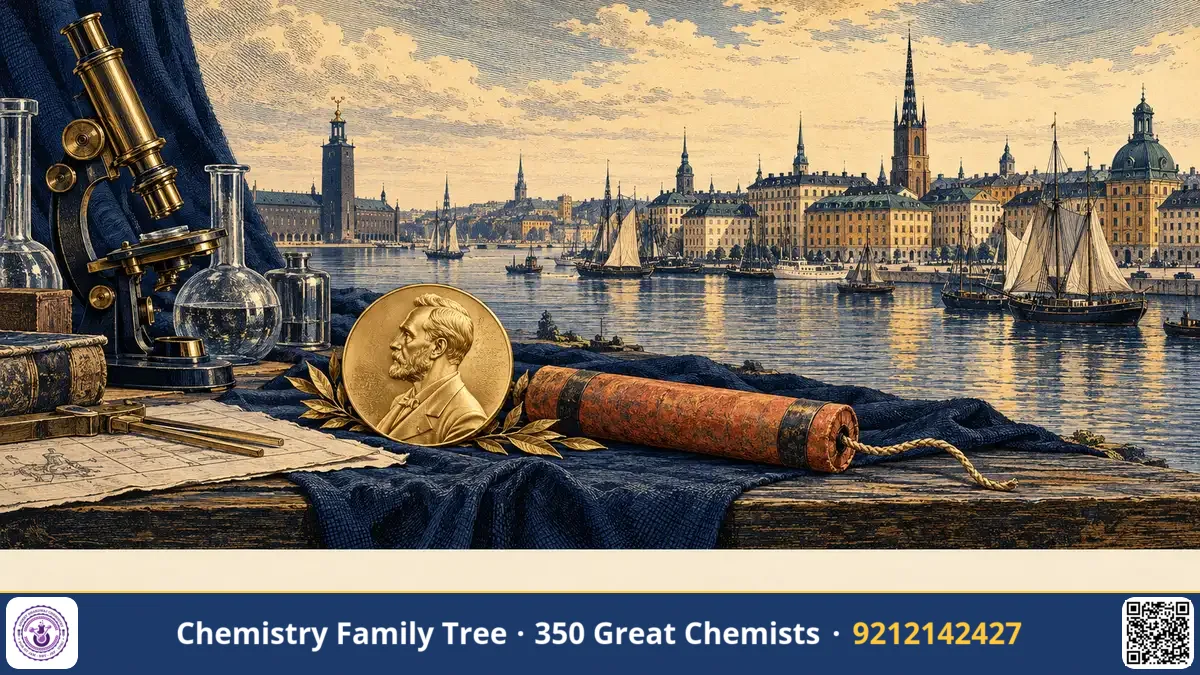
Alfred Bernhard Nobel (1833-1896) was a Swedish chemist, engineer and industrialist who invented dynamite and the blasting cap, and built a global business in explosives and oil. When he died, his will set aside most of his fortune for prizes in physics, chemistry, physiology or medicine, literature and peace. The Nobel Prizes, first awarded in 1901, are now the highest honour in science. Legacy in one line: the man who made powerful explosives created a prize to reward those who benefit humanity.
Early Life & Family
Alfred Nobel was born on 21 October 1833 in Stockholm, Sweden, the fourth of eight children, of whom only four survived to adulthood. His father, Immanuel Nobel, was an inventor and engineer who worked with explosives and underwater mines, but was often in debt. When Alfred was a child, his father's business failed, and in 1837 Immanuel went to Finland and then Russia to find work. In 1842 his family joined him in St Petersburg, where Immanuel prospered by manufacturing machinery and naval mines for the Russian government. Alfred's brothers Robert and Ludvig later became oil magnates in Baku. Alfred was a frail, often sick child with a love of literature and poetry, as well as chemistry.
Education & Mentors
In St Petersburg, the Nobel family hired private tutors for the boys, and Alfred learned several languages (Swedish, Russian, French, English and German). He studied chemistry under Professor Nikolai Zinin, a leading Russian organic chemist who is known for the Zinin reduction of nitro compounds. In 1850 Alfred travelled for two years to Sweden, Germany, France and the United States. In Paris he worked in the private laboratory of Théophile-Jules Pelouze, a chemist who had taught Ascanio Sobrero, the discoverer of nitroglycerine. In the United States he met the Swedish-American engineer John Ericsson. Nobel never had a formal university degree, and learnt largely through self-study and laboratory work.
Career Timeline
| Year | Event |
|---|---|
| 1833 | Born in Stockholm, Sweden |
| 1842 | Family moves to St Petersburg |
| 1850-1852 | Travels and studies in Europe and the United States |
| 1863 | Begins experiments leading to the blasting cap (detonator) |
| 1864 | Explosion at Heleneborg kills his younger brother Emil and others |
| 1865 | Sets up a nitroglycerine factory in Krümmel, near Hamburg; patents the blasting cap |
| 1867 | Patents dynamite |
| 1875 | Invents blasting gelatin (gelignite) |
| 1887 | Patents ballistite, an early smokeless powder |
| 1894 | Buys the Bofors ironworks in Sweden |
| 1895 | Signs his final will on 27 November in Paris |
| 1896 | Dies of a cerebral haemorrhage on 10 December in San Remo, Italy |
| 1901 | First Nobel Prizes awarded |
Major Scientific Contributions
- Dynamite: nitroglycerine absorbed in kieselguhr to make a handleable explosive. See our companion article on Alfred Nobel's dynamite for the chemistry.
- Blasting cap: a small detonator with mercury fulminate that reliably sets off the main charge.
- Blasting gelatin and ballistite: stronger, more stable explosives and propellants that opened the way for modern smokeless powders.
- Industry building: a network of about 90 explosives factories across many countries, and shares in the Baku oil industry through the family firm Branobel.
- Other work: experiments on synthetic rubber, artificial silk and leather, and improvements to various industrial products. He held about 355 patents in all.
Awards, Honours & Nobel Prize
Nobel was elected a member of the Royal Swedish Academy of Sciences in 1884, and received an honorary doctorate from Uppsala University in 1893. He did not win a Nobel Prize, as the prizes began after his death. Element 102, nobelium, was named in his honour, and so was a crater on the Moon. The Nobel Foundation was established in 1900, and the first prizes were presented on 10 December 1901, the fifth anniversary of his death.
Personality, Struggles & Lesser-Known Facts
- A lonely, thoughtful man. Nobel never married and was often described as lonely and melancholy in his letters. He called himself "the richest vagabond in Europe", moving among homes in Paris, San Remo and Sweden.
- Writer at heart. He wrote poetry and a play called Nemesis, and loved literature, which explains why one of his prizes is for literature.
- Tragedy and danger. The 1864 explosion that killed his brother Emil shook him deeply. After this, nitroglycerine was banned from the city of Stockholm and he had to move work to a barge on a lake.
- The obituary story. A popular story says that in 1888 a French newspaper mistakenly published his obituary when his brother Ludvig died, calling him a "merchant of death", and that this motivated his will. Historians debate how much this story shaped his decision.
- The will. His final will left about 94 per cent of his estate to establish the prizes. It was challenged by relatives and delayed by legal and practical problems, and the executors had to work hard to see it carried out.
- Heart medicine. Ironically, near the end of his life, his doctors prescribed nitroglycerine for his heart disease; he wrote about the irony himself.
Legacy & Influence on Modern Chemistry
Nobel's explosives transformed mining, tunnelling and construction, making possible the Alpine railway tunnels, canals and many modern roads. His detonator concept remains the core of modern blasting systems. In science, the Nobel Prize in Chemistry has recognised major discoveries from around the world, such as the 2009 prize shared by Indian-born Venkatraman Ramakrishnan for the structure of the ribosome. In the larger sense, his legacy is the prize system, which has shaped the culture of science for over a century. Students preparing for exams will find his name in the periodic table as nobelium, symbol No, atomic number 102.
Lessons for Students
- Safety first. His early accident reminds us that careful handling matters in a laboratory.
- Solve a practical problem. Dynamite succeeded because it made a dangerous substance usable.
- Think of your legacy. Nobel used his wealth to reward knowledge and peace.
- Broad interests help. Literature and languages were part of his life as much as chemistry.
Quick Facts Box
- Born: 21 October 1833, Stockholm, Sweden
- Died: 10 December 1896, San Remo, Italy
- Nationality: Swedish
- Field: Chemistry, engineering, explosives
- Famous for: Dynamite, blasting cap; founding the Nobel Prizes by his will
- Nobel: None (the prizes were created through his will)
FAQ
Did Alfred Nobel win a Nobel Prize?
No. The prizes were established after his death, and he is the founder rather than a laureate.
Which categories did he include in his will?
Physics, chemistry, physiology or medicine, literature and peace. The economics prize was added later, in 1968, by the Swedish central bank.
Did Nobel have a university degree?
No. He was educated by private tutors and learned chemistry by working in laboratories.
Which element is named after him?
Nobelium (No), atomic number 102.
Published by ABC Chemistry — IIT-JAM | CSIR-NET | GATE Chemistry Coaching. Visit abcchemistry.com
About the chemist
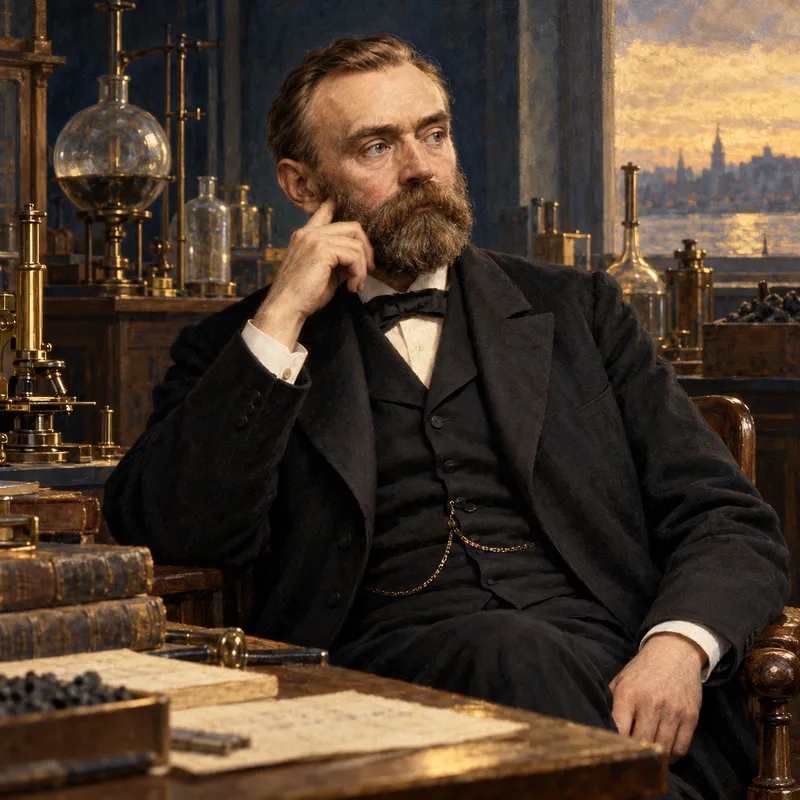
Alfred Nobel
1833-1896 · Sweden
Invented dynamite; founded Nobel Prizes