The discovery, explained · Chemist no. 48 of 350
Alfred Nobel and Dynamite: How a Dangerous Liquid Became a Controlled Tool
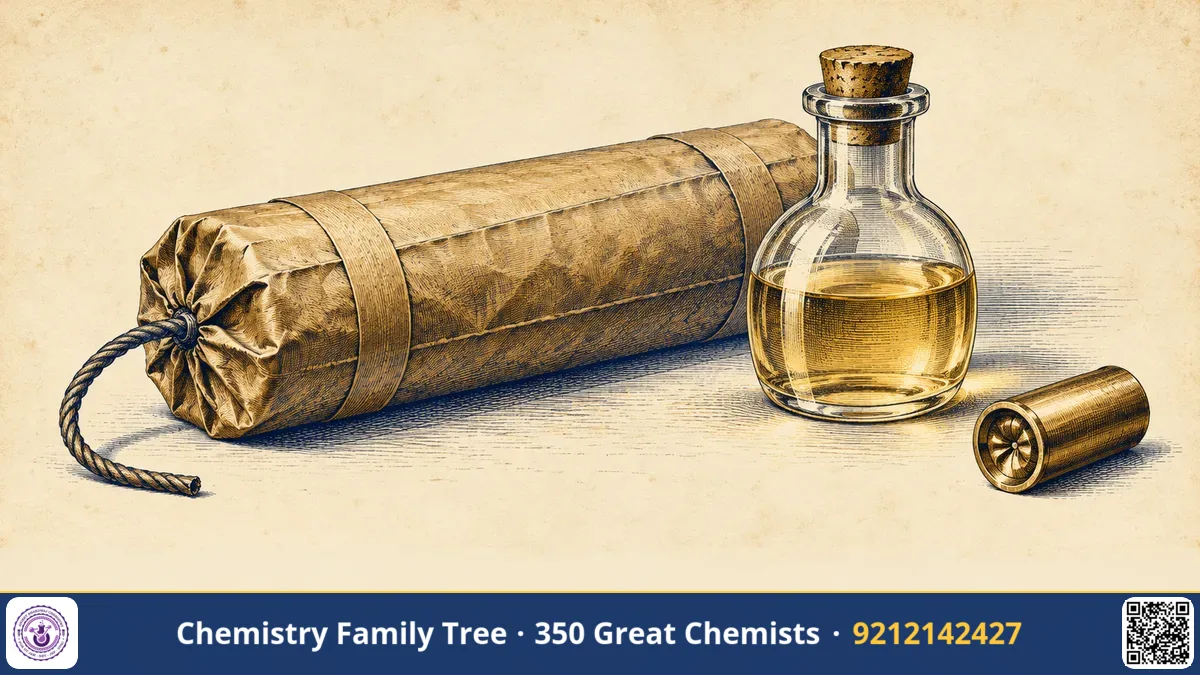
A single drop of pure nitroglycerine can explode if you jolt it. Yet in the 1860s mining, railways and canal builders around the world badly needed a powerful explosive to cut through rock. The Swedish chemist and engineer Alfred Nobel found a way to make nitroglycerine safe enough to transport and use. In 1867 he patented dynamite, a mixture of nitroglycerine absorbed in a porous earth, and earlier he had invented the blasting cap, which allows an explosive to be fired reliably at the right moment. These two ideas changed construction and mining, and made Nobel rich. His fortune later funded the Nobel Prizes. This article explains the chemistry and exam-relevant points for students of Class 12, B.Sc., IIT-JAM, CSIR-NET and GATE.
The Scientific Problem Before the Discovery
Nitroglycerine was first made in 1847 by the Italian chemist Ascanio Sobrero in Turin, who nitrated glycerol with a mixture of concentrated nitric and sulphuric acids. Sobrero was himself alarmed by its violent nature and warned others against using it. The problems were serious:
- It is a heavy, oily liquid that explodes by shock, friction or sudden heating.
- It could not be detonated reliably; simply lighting it often gave a slow burn, but sometimes it blew up unexpectedly.
- Transport and storage led to deadly accidents. In 1864, an explosion at Nobel's own factory at Heleneborg near Stockholm killed several people, including his younger brother Emil.
The Discovery: Step by Step
Step 1: Making nitroglycerine
Nitroglycerine (glyceryl trinitrate) is made by esterification of glycerol with nitric acid, with sulphuric acid acting as a dehydrating agent:
C₃H₅(OH)₃ + 3HNO₃ → C₃H₅(ONO₂)₃ + 3H₂O (conc. H₂SO₄, kept below about 30 °C)
The reaction is strongly exothermic, so the mixture must be cooled, otherwise it can run away.
Step 2: A reliable detonator (1863-1865)
Nobel discovered that nitroglycerine will explode fully if it is hit by a strong shock wave rather than simply heated. He designed a small charge of gunpowder, then a metal capsule filled with mercury fulminate, Hg(ONC)₂, placed inside the main charge. Firing the small charge produces a shock that sets off the bulk explosive. This is the blasting cap (detonator), patented in 1865. It is the basis of the "initiator–booster–main charge" explosive train still used today.
Step 3: Dynamite (1866-1867)
To make nitroglycerine safer, Nobel looked for a solid that could absorb it. By trying various materials, he found that kieselguhr (diatomaceous earth, a porous silica from the fossil shells of diatoms) soaked up about three times its weight of the liquid, giving a plastic paste that could be shaped into sticks wrapped in paper. It was much less sensitive to shock than the pure liquid but still exploded when fired with a blasting cap. He named it dynamite, from the Greek word dynamis, meaning power, and patented it in 1867.
Step 4: Later explosives
In 1875 Nobel invented blasting gelatin (gelignite) by dissolving nitrocellulose (guncotton) in nitroglycerine, giving a stronger, water-resistant jelly. In 1887 he patented ballistite, an early smokeless powder made from nitroglycerine and nitrocellulose, which later led to cordite. By the end of his life he held about 355 patents.
The Chemistry Behind It
Why does nitroglycerine explode?
The molecule contains both fuel (carbon and hydrogen) and oxidiser (nitro groups) in one compound. When it decomposes, it forms only gases, all at once:
4C₃H₅(ONO₂)₃ → 12CO₂ + 10H₂O + 6N₂ + O₂
Four moles of liquid produce 29 moles of gas, the reaction is highly exothermic (the gases reach temperatures of several thousand degrees), and the hot gases expand at great speed. This is a detonation, with a shock wave moving faster than the speed of sound in the material, as opposed to deflagration (burning), which is subsonic.
Oxygen balance
The reaction above releases extra O₂, so nitroglycerine has a positive oxygen balance. This is why it is often mixed with fuels such as wood pulp or nitrocellulose, to use all the oxygen.
Role of the carrier
Kieselguhr acts as an inert absorbent. It spreads the liquid in tiny pores, reduces the formation of "hot spots" under shock, and makes the material solid. The silica itself takes no part in the reaction but lowers the energy per kilogram a little.
Types of explosives
| Type | Examples | Use |
|---|---|---|
| Primary (initiating) | Mercury fulminate, lead azide | Detonators |
| Secondary (high explosives) | Nitroglycerine, TNT, RDX, PETN | Main charge |
| Low explosives (propellants) | Gunpowder, smokeless powder | Guns, rockets |
TNT (trinitrotoluene) is made by nitration of toluene, C₆H₅CH₃ + 3HNO₃ → C₆H₂(CH₃)(NO₂)₃ + 3H₂O, with H₂SO₄ as catalyst; it was discovered by Julius Wilbrand in 1863.
Applications Today
- Civil engineering and mining: modern explosives (ammonium nitrate fuel oil, emulsion explosives and dynamite-type products) are used for tunnels, roads, dams and coal and metal mines, including projects in India such as hill tunnels and open-cast coal mining.
- Medicine: nitroglycerine is also a heart medicine. Under the tongue, small doses release nitric oxide, which widens blood vessels and relieves angina. Nobel himself was prescribed it near the end of his life.
- Safety science: the idea of stabilising a dangerous compound by absorption or desensitisation is used in explosives handling and in safe storage of chemicals such as picric acid wetted with water.
- Demolition and defence: controlled detonation and explosive trains with detonator, booster and main charge.
Exam Corner
- Nitroglycerine = glyceryl trinitrate, C₃H₅(ONO₂)₃, an ester (not a nitro compound), formed from glycerol and conc. HNO₃/H₂SO₄.
- Dynamite = nitroglycerine absorbed in kieselguhr (diatomaceous earth) (Nobel, 1867).
- Decomposition: 4C₃H₅(ONO₂)₃ → 12CO₂ + 10H₂O + 6N₂ + O₂.
- Detonator: mercury fulminate or lead azide; Hg(ONC)₂ is a primary explosive.
- Element 102 is named nobelium (No) after Alfred Nobel.
Common Misconceptions
- "Nitroglycerine is a nitro compound." It is a nitrate ester, R–O–NO₂, not R–NO₂. TNT is a true nitro compound.
- "Nobel invented nitroglycerine." Sobrero did, in 1847; Nobel made it usable.
- "Dynamite explodes easily by shock." That is the very problem he solved; dynamite is much safer than the pure liquid and needs a detonator.
Quick Revision Box
- Nitroglycerine: Sobrero (1847); Nobel made it practical.
- Blasting cap (1865) uses mercury fulminate.
- Dynamite (1867) = nitroglycerine + kieselguhr, wrapped in paper sticks.
- Gelignite (1875) = nitroglycerine + nitrocellulose.
- Ballistite (1887) = early smokeless powder.
- Nobel held about 355 patents; nobelium (No, Z = 102) honours him.
FAQ
What is kieselguhr?
A soft, porous sedimentary rock made of the silica shells of tiny algae called diatoms, also called diatomaceous earth.
Why is a blasting cap necessary?
Dynamite is stable against ordinary shocks; a small primary explosive creates the shock wave needed to detonate it.
Is nitroglycerine used in medicine?
Yes, glyceryl trinitrate tablets relieve angina pectoris by releasing nitric oxide and dilating blood vessels.
What is the difference between detonation and deflagration?
Detonation travels as a supersonic shock wave through the explosive; deflagration is a fast but subsonic burn.
Published by ABC Chemistry — IIT-JAM | CSIR-NET | GATE Chemistry Coaching. Visit abcchemistry.com
About the chemist
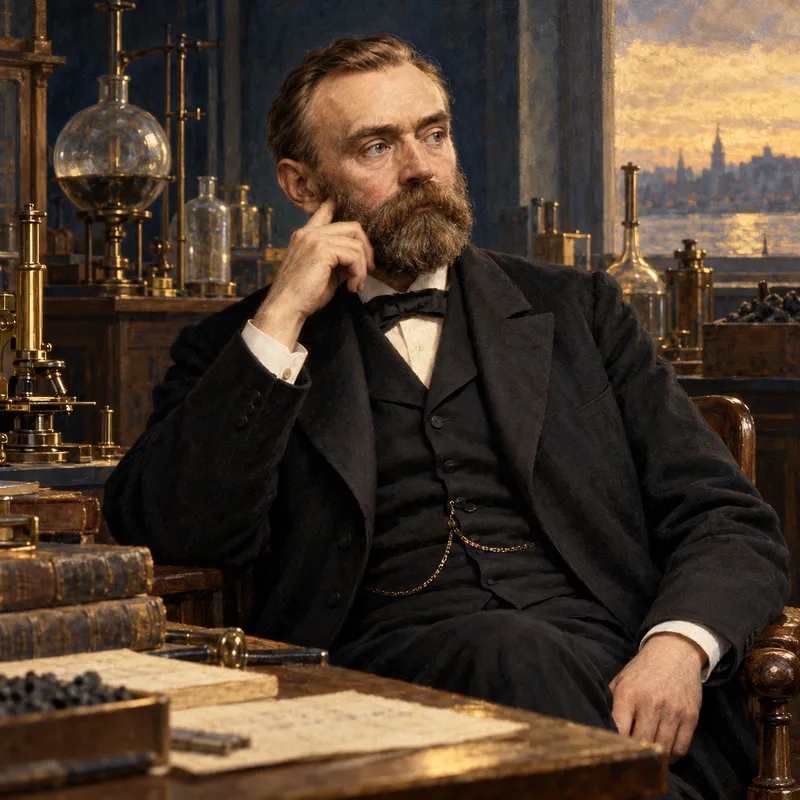
Alfred Nobel
1833-1896 · Sweden
Invented dynamite; founded Nobel Prizes