Biography · Chemist no. 47 of 350
Alfred Werner: The Young Chemist Who Gave Metal Complexes a Shape
Introduction
Alfred Werner (1866-1919) was a Swiss chemist, born in Alsace, who founded coordination chemistry. At just 26 he proposed that metal ions are surrounded by ligands in definite geometric arrangements, an idea so far ahead of its time that it took two decades to be fully accepted. In 1913 he became the first inorganic chemist to win the Nobel Prize in Chemistry. Legacy in one line: he showed that inorganic compounds have three-dimensional structure, as organic ones do.
Early Life & Family
Werner was born on 12 December 1866 in Mulhouse, then in Alsace, France. After the Franco-Prussian War of 1870-71, Alsace passed to Germany, and the family's surroundings changed politically. His father, Jean-Adam Werner, worked as an ironworker, and his mother, Salomé Jeanette Tesche, came from a family of Alsace. Alfred showed an early interest in chemistry and carried out experiments as a boy. He later chose to be a Swiss citizen, becoming one in 1894.
Education & Mentors
Werner began chemistry at the technical school of Mulhouse and then moved to the Technical Institute (Polytechnic) at Karlsruhe, where he did his military service during a year. In 1888 he moved to Zurich and joined the Polytechnic, now ETH Zurich, where he studied under the organic chemist Arthur Hantzsch, famous for the Hantzsch pyridine synthesis and for stereochemistry of nitrogen compounds. Together, Hantzsch and Werner developed the Hantzsch-Werner theory of the stereochemistry of nitrogen compounds such as oximes. Werner received his doctorate at the University of Zurich in 1890. He spent the next year in Paris working with Marcellin Berthelot at the Collège de France on thermochemistry, before returning to Zurich in 1892.
Career Timeline
| Year | Event |
|---|---|
| 1866 | Born in Mulhouse, Alsace |
| 1890 | Doctorate in Zurich under Hantzsch |
| 1891 | Studies with Berthelot in Paris |
| 1892 | Becomes Privatdozent at the University of Zurich |
| 1893 | Publishes the coordination theory in Zeitschrift für anorganische Chemie |
| 1894 | Becomes a Swiss citizen; marries Emma Giesker |
| 1895 | Appointed full professor of chemistry at Zurich |
| 1900s | Prepares hundreds of cobalt, chromium and platinum complexes with his students |
| 1911 | Resolves the first optically active coordination compounds with Victor King |
| 1913 | Awarded the Nobel Prize in Chemistry |
| 1914 | Resolves the carbon-free hexol complex |
| 1919 | Dies in Zurich on 15 November |
Major Scientific Contributions
- Coordination theory (1893): primary and secondary valences, coordination number and geometry. For the full chemistry, see our companion article on Werner's coordination theory.
- Octahedral geometry: demonstrated by counting isomers of cobalt, chromium and platinum complexes, and square-planar geometry for four-coordinate platinum(II).
- Stereochemistry of nitrogen: with Hantzsch, he explained isomerism of oximes through the spatial arrangement around the C=N bond.
- Optical activity in inorganic compounds: resolution of cis-[CoCl(NH₃)(en)₂]²⁺ and the carbon-free hexol.
- Nomenclature and classification: his ideas became the basis of IUPAC naming of coordination compounds, such as hexaamminecobalt(III) chloride.
- Book: Neuere Anschauungen auf dem Gebiete der anorganischen Chemie (1905), which explained his ideas to the wider chemical community.
Awards, Honours & Nobel Prize
Werner was awarded the Nobel Prize in Chemistry in 1913 "in recognition of his work on the linkage of atoms in molecules by which he has thrown new light on earlier investigations and opened up new fields of research especially in inorganic chemistry." He was the first Swiss chemist to receive the prize in chemistry. He also received honorary degrees from several universities and was a member of scientific societies in Europe.
Personality, Struggles & Lesser-Known Facts
- Youth. He published his great theory at 26 and was a full professor by 28, rare achievements in the 1890s.
- Years of controversy. For nearly twenty years Jørgensen and others challenged his ideas. Jørgensen, a skilled experimenter, eventually repeated experiments that supported Werner, and accepted his theory.
- The proof from carbon-free complexes. Critics said optical activity needed carbon. Werner answered in 1914 by resolving hexol, a metal complex with no carbon at all.
- A crowded laboratory. His Zurich laboratory attracted students from many countries, including women researchers at a time when few universities welcomed them. Together they prepared hundreds of new complexes, and many of these samples were kept and later re-examined with modern methods.
- Illness. From about 1915, Werner suffered from arteriosclerosis and a progressive neurological decline. He had to give up teaching and was hospitalised, and he died at the age of 52.
Legacy & Influence on Modern Chemistry
Werner's theory is the starting point for all coordination chemistry. Crystal field theory, ligand field theory, organometallic chemistry, bio-inorganic chemistry and many industrial catalysts depend on it. It later received strong confirmation from X-ray crystallography, when the structures of complexes proved his geometries. The Nobel Prizes given to Ziegler and Natta, Wilkinson and Fischer, and Taube all built on his foundation. The Swiss Chemical Society honours his name with the Alfred Werner Prize for young chemists. Indian textbooks give his theory an entire section, and questions on it appear every year.
Lessons for Students
- Trust well-designed experiments. He used simple precipitation and conductivity data to support a bold idea.
- Be patient with criticism. It took years to win acceptance.
- Design the decisive test. The hexol experiment answered the strongest objection.
- Value a team. His students prepared and characterised hundreds of compounds.
Quick Facts Box
- Born: 12 December 1866, Mulhouse, Alsace
- Died: 15 November 1919, Zurich, Switzerland
- Nationality: Swiss (born in Alsace, then France)
- Field: Inorganic chemistry; coordination chemistry
- Famous for: Coordination theory (1893); primary and secondary valence
- Nobel: Chemistry, 1913
FAQ
Why is Werner called the father of coordination chemistry?
Because his 1893 theory explained the structure, bonding and isomerism of complex compounds for the first time.
Was Werner a Swiss or a French chemist?
He was born in Alsace and became a Swiss citizen; he is described as Swiss.
How old was Werner when he died?
He was 52 years old.
Which prize did he win?
The Nobel Prize in Chemistry in 1913.
Published by ABC Chemistry — IIT-JAM | CSIR-NET | GATE Chemistry Coaching. Visit abcchemistry.com
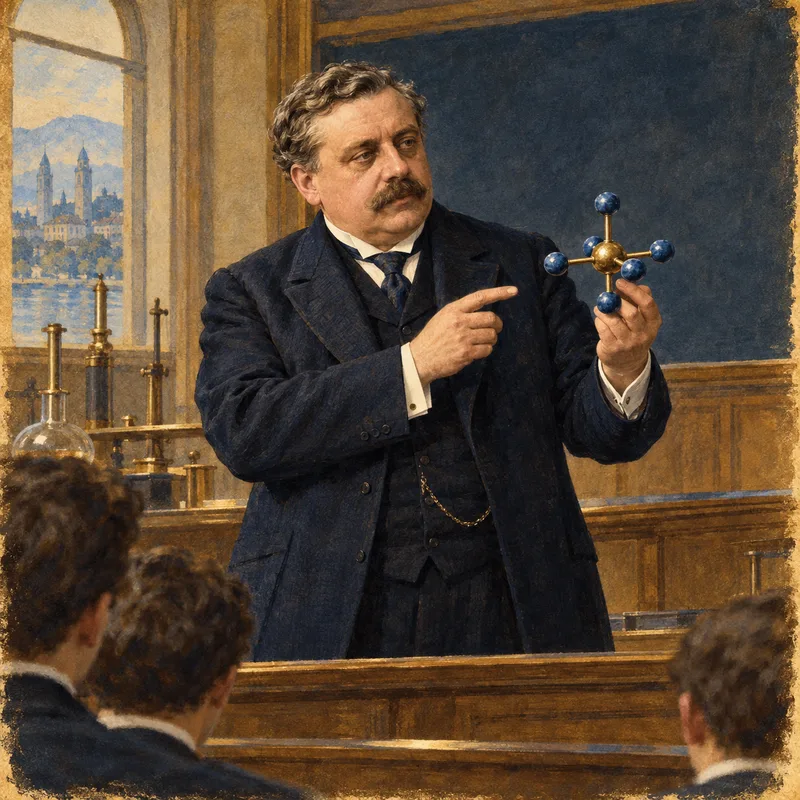
About the chemist
Alfred Werner
1866-1919 · Switzerland · Nobel Chemistry 1913
Coordination chemistry