The discovery, explained · Chemist no. 47 of 350
Werner's Coordination Theory: How Metal Ions Hold Their Ligands
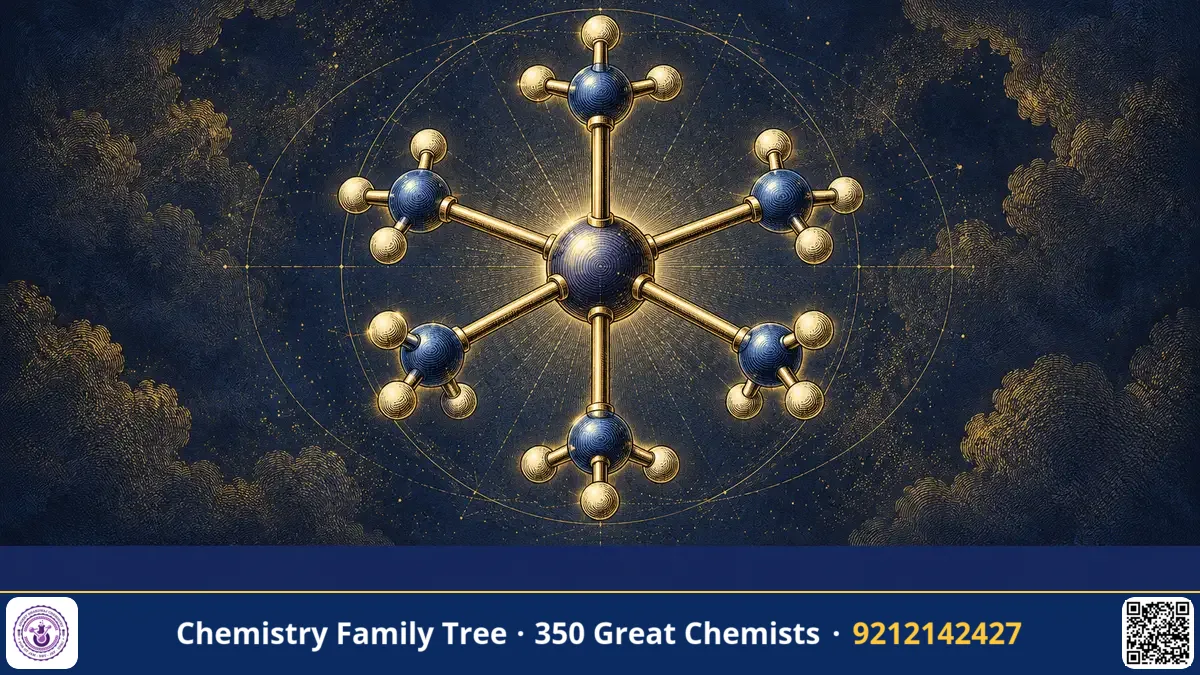
Why does CoCl₃·6NH₃ give three chloride ions in solution with silver nitrate, but CoCl₃·4NH₃ gives only one? Why are some of these compounds yellow, others purple, green or violet, although they contain only cobalt, chlorine and ammonia? In 1893, a 26-year-old chemist at the University of Zurich, Alfred Werner, answered with a bold theory: metals have two kinds of valence, a primary valence and a secondary valence, and the groups attached by secondary valence are arranged in definite geometry around the metal. This is the foundation of coordination chemistry and one of the highest-weightage topics in IIT-JAM, CSIR-NET and GATE. Werner received the Nobel Prize in Chemistry in 1913, the first inorganic chemist to win it.
The Scientific Problem Before the Discovery
By the 1880s, chemists had prepared hundreds of "molecular compounds" such as CoCl₃·6NH₃, PtCl₄·2NH₃ and CuSO₄·4NH₃. Normal valence rules say that cobalt(III) chloride CoCl₃ is already saturated, so why should it add six ammonia molecules?
- The Swedish chemist Christian Blomstrand and the Danish chemist Sophus Mads Jørgensen proposed the chain theory: ammonia molecules form chains like –NH₃–NH₃–, and chlorine atoms attached to the chain are ionisable, while those directly bonded to the metal are not.
- This could not explain why the number of ionisable chlorides did not match the chain length, and it gave no account of colours or isomers.
The Discovery: Step by Step
Experiment 1: Counting ionisable chlorides
Werner examined four known orange, purple, green and violet cobalt(III) ammine chloride complexes. He added excess silver nitrate and weighed the AgCl precipitated, and also measured their molar conductivity in solution.
| Formula (old) | Colour | Common name | AgCl per mole | Modern formula |
|---|---|---|---|---|
| CoCl₃·6NH₃ | Yellow-orange | Luteo | 3 | [Co(NH₃)₆]Cl₃ |
| CoCl₃·5NH₃ | Purple | Purpureo | 2 | [CoCl(NH₃)₅]Cl₂ |
| CoCl₃·4NH₃ | Green | Praseo | 1 | trans-[CoCl₂(NH₃)₄]Cl |
| CoCl₃·4NH₃ | Violet | Violeo | 1 | cis-[CoCl₂(NH₃)₄]Cl |
The number of free chloride ions fell as ammonia was replaced by chloride in the inner part of the compound. Conductivity data (with his student Arturo Miolati) confirmed the number of ions: 4 ions for the first, 3 for the second, and 2 for the green and violet ones.
The postulates of Werner's theory
- A metal in a complex shows two types of valence: primary (ionisable, equal to oxidation state, satisfied by negative ions) and secondary (non-ionisable, equal to the coordination number, satisfied by ligands, which can be neutral molecules or anions).
- Every metal tends to satisfy both its primary and secondary valences.
- The secondary valences are directed in space, so a complex has a definite geometry: coordination number 6 gives octahedral, 4 gives tetrahedral or square planar.
In modern notation, the groups inside the square bracket form the coordination sphere (secondary valence); those outside are counter ions (primary valence).
[Co(NH₃)₆]³⁺ + 3Cl⁻            primary valence = 3, secondary valence = 6
[CoCl(NH₃)₅]²⁺ + 2Cl⁻          one Cl⁻ serves both valences
Experiment 2: Isomers prove the geometry
For [Co(NH₃)₄Cl₂]⁺, an octahedron predicts two isomers (cis and trans). A planar hexagon or a trigonal prism would predict three. Werner found exactly two, the green praseo (trans) and the violet violeo (cis) salts. Similarly, [Co(NH₃)₃Cl₃] has two isomers (fac and mer), and so on. The number of isomers matched octahedral geometry.
Experiment 3: Optical activity without carbon (1911-1914)
Critics argued that Werner's geometric structures were speculation. In 1911, with his student Victor King, Werner resolved the cis form of [CoCl(NH₃)(en)₂]²⁺ (en = ethylenediamine) into optical isomers. In 1914 he went further and resolved the completely carbon-free hexol complex, [Co{(μ-OH)₂Co(NH₃)₄}₃]⁶⁺. Since only a three-dimensional octahedral arrangement can produce optical activity in such complexes, the theory was proved.
The Chemistry Behind It
Key terms
- Ligand: ion or molecule donating electron pairs to the metal (NH₃, Cl⁻, H₂O, CN⁻, en, EDTA).
- Coordination number (CN): number of donor atoms attached to the metal (Werner's secondary valence).
- Oxidation state: charge on the metal if ligands are removed (Werner's primary valence).
Types of isomerism that Werner's theory explains
| Type | Example |
|---|---|
| Geometrical (cis-trans) | [Pt(NH₃)₂Cl₂] square planar; [Co(NH₃)₄Cl₂]⁺ |
| Optical | [Co(en)₃]³⁺ (Δ and Λ) |
| Ionisation | [Co(NH₃)₅Br]SO₄ and [Co(NH₃)₅SO₄]Br |
| Hydrate | [Cr(H₂O)₆]Cl₃ and [CrCl(H₂O)₅]Cl₂·H₂O |
| Linkage | [Co(NH₃)₅(NO₂)]²⁺ and [Co(NH₃)₅(ONO)]²⁺ |
| Coordination | [Co(NH₃)₆][Cr(CN)₆] and [Cr(NH₃)₆][Co(CN)₆] |
Limitations and later development
Werner's theory did not explain why some complexes are coloured, why they are magnetic, or why ligands bond. These gaps were filled by Valence Bond Theory (Pauling), Crystal Field Theory (Bethe and Van Vleck), and Ligand Field/Molecular Orbital theory. Also, Werner used the words "valence" and "affinity" without electron pairs; G. N. Lewis and Sidgwick later described the ligand-metal bond as a coordinate (dative) bond.
Applications Today
- Medicine: cisplatin, cis-[Pt(NH₃)₂Cl₂], is an anticancer drug; the trans isomer is inactive, a striking demonstration of Werner's geometrical isomerism.
- Biology: haemoglobin (Fe-porphyrin), chlorophyll (Mg) and vitamin B₁₂ (Co) are coordination compounds.
- Water treatment and analysis: EDTA titration for hardness of water, and DMG test for Ni²⁺ in laboratory practicals.
- Metallurgy: extraction of gold and silver by the cyanide process forms [Au(CN)₂]⁻ and [Ag(CN)₂]⁻.
- Catalysis and materials: Wilkinson's catalyst, Ziegler-Natta catalysts, metal-organic frameworks and colour pigments such as Prussian blue.
Exam Corner
- Primary valence = oxidation state (ionisable); secondary valence = coordination number (non-ionisable).
- Number of moles of AgCl formed equals the number of free (outer-sphere) Cl⁻ ions: [Co(NH₃)₅Cl]Cl₂ gives 2.
- Octahedral [MA₄B₂] has 2 geometrical isomers; [MA₃B₃] has 2 (fac, mer); [M(AA)₃] has 2 optical isomers.
- Werner won the Nobel Prize in Chemistry in 1913; first Swiss and first inorganic chemist to win.
- Hexol was the first carbon-free optically active complex, resolved in 1914.
Common Misconceptions
- "Coordination number equals oxidation state." No. In [Co(NH₃)₆]³⁺ the oxidation state is +3 and the coordination number is 6.
- "Optical activity requires carbon." Werner's hexol proved otherwise.
- "Werner explained colour." His theory did not; crystal field theory did.
Quick Revision Box
- Werner's theory (1893): primary valence (ionisable) and secondary valence (fixed, directional).
- Silver nitrate test shows the free chloride count: 3, 2, 1, 1.
- CN 6 = octahedral; two isomers for [MA₄B₂] proved octahedral geometry.
- Resolved optical isomers of carbon-free hexol in 1914.
- Replaced the chain theory of Blomstrand and Jørgensen.
- Nobel Prize in Chemistry 1913.
FAQ
What is the difference between primary and secondary valence?
Primary valence is the ionisable oxidation state of the metal; secondary valence is the number of ligand atoms directly attached, the coordination number.
Why did Werner use silver nitrate?
Only chloride ions outside the coordination sphere precipitate as AgCl, so it counts the ionisable chlorides.
How did Werner prove octahedral geometry?
By showing that the number of isomers observed matched the number predicted for an octahedron, and later by resolving optical isomers.
Who opposed Werner's theory?
S. M. Jørgensen, a supporter of the chain theory, argued against him for years until his own experiments supported Werner.
Published by ABC Chemistry — IIT-JAM | CSIR-NET | GATE Chemistry Coaching. Visit abcchemistry.com
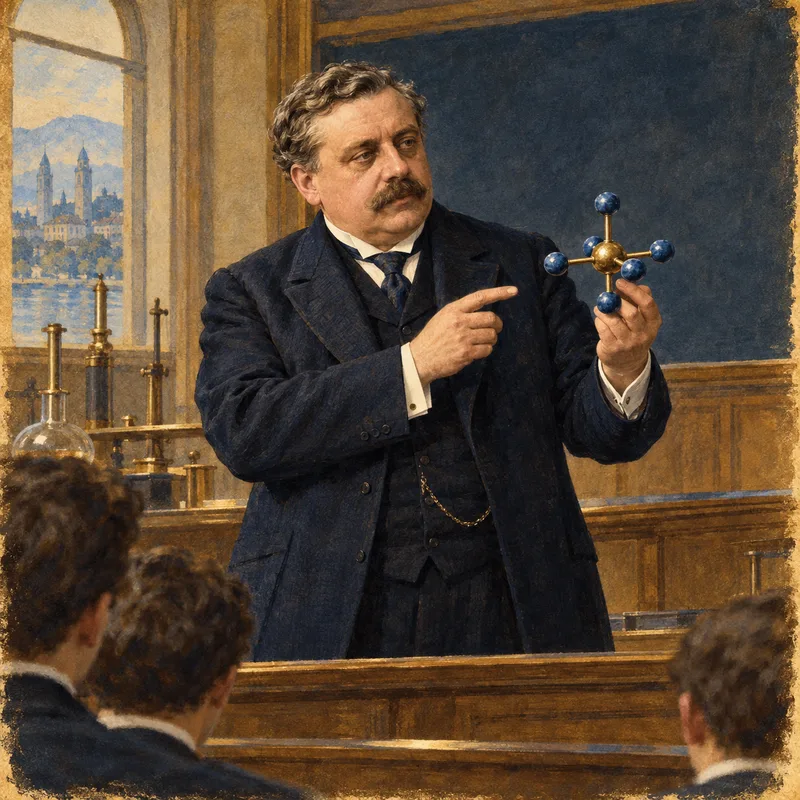
About the chemist
Alfred Werner
1866-1919 · Switzerland · Nobel Chemistry 1913
Coordination chemistry