The discovery, explained · Chemist no. 350 of 350
Alice Ball and the Ball Method: Making Chaulmoogra Oil Injectable
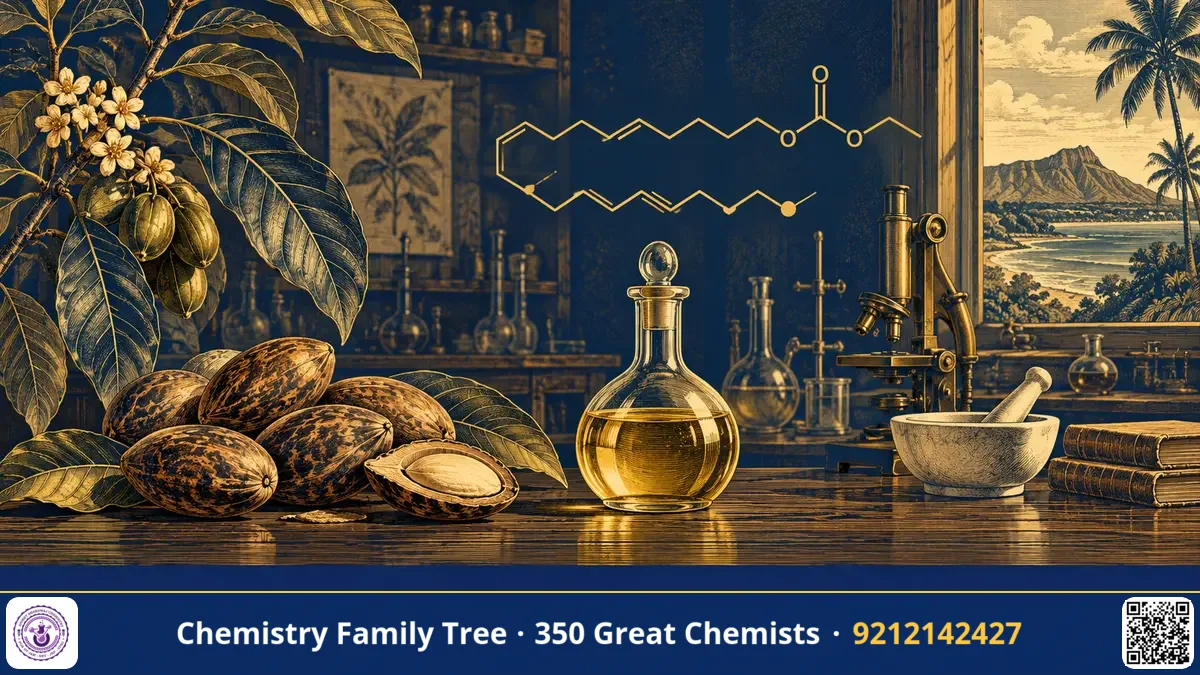
For thousands of years, leprosy (now called Hansen's disease) carried terror and stigma. Patients were driven out of communities and sent to isolated settlements. One of the few substances used against it was chaulmoogra oil, from the seeds of trees in the genus Hydnocarpus, long known in Indian and Chinese traditional medicine. But the oil was almost impossible to use. It was thick, sticky and bad-tasting, patients often vomited after swallowing it, and when injected it formed painful lumps under the skin. In 1915, a 23-year-old chemist in Hawaii named Alice Ball found a way to convert the active acids in the oil into a form that could be injected into the body. Her technique, the Ball Method, became the most effective treatment for leprosy for about three decades, until sulphone drugs arrived in the 1940s. This article explains her chemistry.
The Scientific Problem Before the Discovery
Leprosy is a chronic infection caused by the bacterium Mycobacterium leprae, identified by Gerhard Armauer Hansen in 1873. It affects the skin and nerves. In the early 1900s there was no cure. In Hawaii, thousands of patients were isolated at the settlement at Kalaupapa on the island of Molokai.
Doctors had observed that chaulmoogra oil gave some improvement to patients. The oil is a triglyceride, an ester of glycerol with fatty acids. Unlike most vegetable oils, chaulmoogra oil contains unusual fatty acids with a ring: hydnocarpic acid (C₁₆H₂₈O₂) and chaulmoogric acid (C₁₈H₃₂O₂), both of which have a five-membered cyclopentene ring at the end of a long chain. These acids were believed to be the active components. The challenge was to deliver them to the body in a usable form, since the crude oil was too viscous for injection and irritating to swallow.
The Discovery: Step by Step
- Starting point. At the College of Hawaii (now the University of Hawaii), Ball began a research project for her master's degree, under the guidance of Dr Harry Hollmann, a physician at the leprosy hospital, who needed an injectable preparation.
- Hydrolysis. The oil was first treated with a base (saponification) to break the triglyceride ester bonds and free the fatty acids as salts, and glycerol was removed.
- Release of the free acids. Acidifying the soap gave the free fatty acids, hydnocarpic acid and chaulmoogric acid, together with related ones.
- Esterification. Ball converted these acids into their ethyl esters by reacting them with ethanol in the presence of an acid catalyst. The resulting ethyl esters were far less viscous and could be injected without forming lumps.
- Clinical use. The injectable ester mixture was used to treat patients at the Kalihi Hospital in Honolulu, and improvement was seen so much that many patients were allowed to go home.
The Chemistry Behind It
Structure of the oil
Natural oils are triglycerides: glycerol joined to three fatty acid chains by ester links, R–COO–CH₂ and so on. Chaulmoogra oil is rich in chains such as hydnocarpic acid, whose structure is a cyclopentenyl ring joined to a straight carbon chain ending in –COOH.
Saponification
(RCOO)₃C₃H₅ + 3 NaOH  →  3 RCOONa + C₃H₅(OH)₃
 triglyceride            soap          glycerol
This is an irreversible base-catalysed hydrolysis, the same reaction used in soap making. Treatment of the sodium salt with a strong acid releases the free acid: RCOONa + HCl → RCOOH + NaCl.
Fischer esterification
RCOOH + C₂H₅OH ⇌ RCOOC₂H₅ + H₂O (H₂SO₄ or HCl catalyst)
This is a reversible reaction, and its equilibrium can be pushed towards the ester by using excess ethanol or by removing water. The mechanism involves protonation of the carbonyl oxygen, nucleophilic attack by ethanol on the carbonyl carbon, proton transfer, and loss of water (PADPED: protonation, addition, deprotonation, protonation, elimination, deprotonation).
Alternative path: transesterification
Triglyceride + 3 C₂H₅OH → 3 RCOOC₂H₅ + glycerol (acid or base catalyst)
This direct route is the same reaction used to make biodiesel today.
Why are the esters better?
- The ethyl esters have lower molecular weight and lower viscosity than the triglyceride, and they are easily absorbed and distributed.
- The free acid group, which is irritating, is masked as an ester.
- Within the body, enzymes (esterases) can slowly hydrolyse the esters back to the active acids.
| Form | Property | Use |
|---|---|---|
| Crude chaulmoogra oil | Thick, irritating, bitter | Oral or crude injection, poorly tolerated |
| Free fatty acids | Acidic, irritating | Not convenient |
| Ethyl esters (Ball Method) | Fluid, absorbable | Injection |
Applications Today
- Leprosy history: the Ball Method was used worldwide, including in India, until dapsone and later multidrug therapy (dapsone, rifampicin, clofazimine) became standard. Leprosy is now curable.
- Biodiesel: the same transesterification of oil with alcohol produces fatty acid esters used as fuel.
- Drug formulation: esterification is used to make prodrugs that are better absorbed or less irritating.
- Soap and cosmetics: saponification is the basis of the soap industry.
- India: Hydnocarpus trees (known locally as chaulmoogra or tuvaraka) grow in the forests of the Western Ghats and north-east India, and the oil is still used in some traditional medicines.
Exam Corner
- Saponification: base hydrolysis of an ester or fat gives glycerol and a salt of fatty acid (soap).
- Fischer esterification: acid + alcohol ⇌ ester + water; acid catalysed, reversible.
- Transesterification: ester + alcohol → new ester + new alcohol; used in biodiesel.
- Saponification value is mg of KOH needed to saponify 1 g of fat; iodine value measures unsaturation.
- Chaulmoogric acid contains a cyclopentene ring; most natural fatty acids are straight-chain.
Common Misconceptions
- "Chaulmoogra oil cured leprosy." It helped many patients but was not a perfect cure; modern drugs have replaced it.
- "Esterification is irreversible." Fischer esterification is reversible; saponification is irreversible because the carboxylate is stabilised.
- "Ball's work was always credited to her." After her death, the method was published by others without proper credit for several years, and she was later recognised.
Quick Revision Box
- Alice Ball made chaulmoogra oil injectable in 1915 using ethyl esters.
- Active acids: hydnocarpic (C16) and chaulmoogric (C18), both with a cyclopentene ring.
- Steps: saponification, acidification, Fischer esterification with ethanol.
- Esterification is reversible; saponification is irreversible.
- Same chemistry as biodiesel production.
- Leprosy is caused by Mycobacterium leprae.
FAQ
Why could the crude oil not be injected?
It was very viscous and irritating, and it formed painful lumps and could not be absorbed well.
What is the role of the acid catalyst in esterification?
It protonates the carbonyl oxygen, making the carbon more electrophilic for attack by the alcohol.
How is the Ball Method related to biodiesel?
Both convert oil-derived fatty acid chains to alkyl esters by reaction with an alcohol.
What treats leprosy now?
Multidrug therapy with dapsone, rifampicin and clofazimine, provided free by the WHO.
Published by ABC Chemistry — IIT-JAM | CSIR-NET | GATE Chemistry Coaching. Visit abcchemistry.com

About the chemist
Alice Ball
1892-1916 · United States
Ball method for leprosy treatment