Biography · Chemist no. 10 of 350
Amedeo Avogadro: The Life of the Scientist Behind the Mole
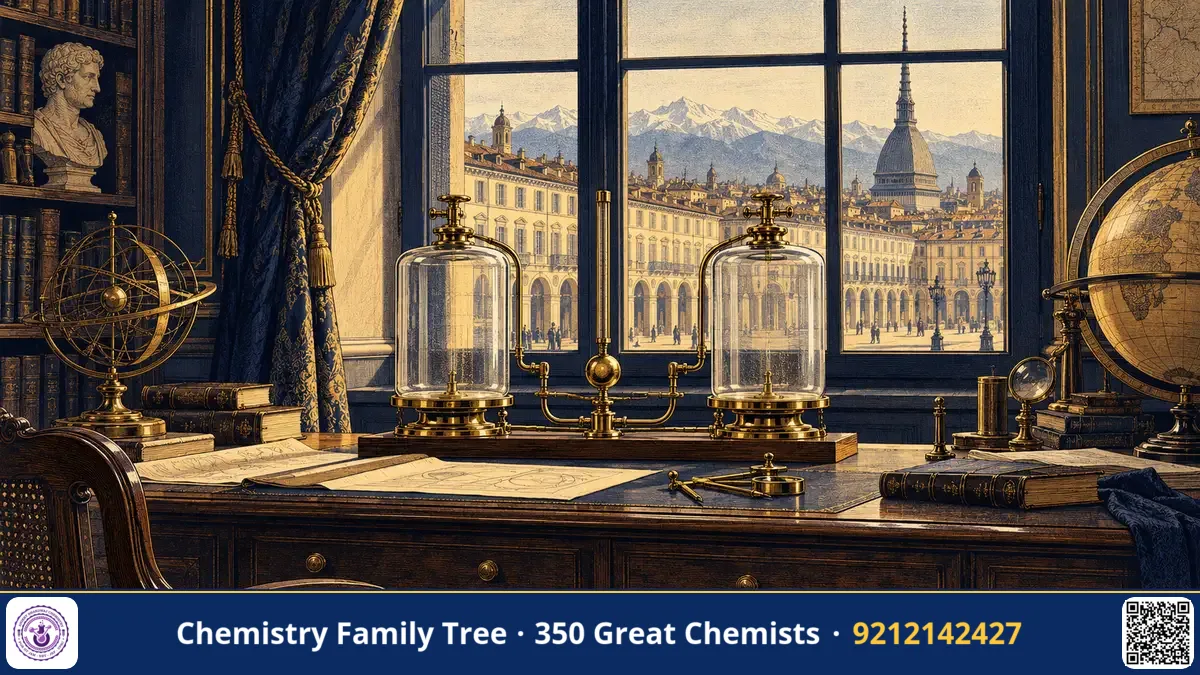
Lorenzo Romano Amedeo Carlo Avogadro, Count of Quaregna and Cerreto (1776-1856), was an Italian physicist and chemist from Turin. In 1811, he suggested that equal volumes of all gases at the same temperature and pressure contain the same number of molecules. His idea was largely overlooked for about half a century, but it is now at the centre of chemistry, because the Avogadro constant defines the mole. His legacy in one line: a quiet professor whose simple hypothesis gave chemistry the ability to count atoms by weighing.
Early Life and Family
Avogadro was born on 9 August 1776 in Turin, then the capital of the Kingdom of Sardinia (Piedmont-Savoy), now in northern Italy. His father, Filippo Avogadro, was a lawyer and a senior official in the government of the kingdom, and the family belonged to the minor nobility of Piedmont. Following family tradition, Amedeo was expected to follow a career in law. In 1815 he married Felicita Mazzé, and they had six children. He was known as a modest, religious and family-oriented man, and he was also a public servant who took part in civic and educational duties.
Education and Mentors
Avogadro studied ecclesiastical law at the University of Turin. He received his degree in 1795 and a doctorate in 1796, and for a few years practised as a lawyer. Around 1800, he turned to the study of mathematics and physics privately, since these subjects interested him more. Little is documented about his individual teachers; he was largely a self-motivated learner who studied the works of Volta, Lavoisier, Dalton and Gay-Lussac. In 1809 he became a teacher of natural philosophy at the Royal College of Vercelli, a post which gave him the time to work on gases.
Career Timeline
| Year | Event |
|---|---|
| 1776 | Born in Turin on 9 August |
| 1796 | Receives a doctorate in ecclesiastical law |
| 1800 | Begins private study of science and mathematics |
| 1809 | Teaches physics at the Royal College of Vercelli |
| 1811 | Publishes his hypothesis about equal volumes of gases |
| 1814 | Publishes a second long paper on the relative masses of molecules |
| 1820 | Becomes professor of mathematical physics at the University of Turin |
| 1821-1823 | Loses his position for a time due to political events in Piedmont |
| 1834 | Returns to the chair of physics at Turin and teaches until 1850 |
| 1856 | Dies in Turin on 9 July |
| 1860 | Cannizzaro revives his hypothesis at the Karlsruhe Congress |
Major Scientific Contributions
Avogadro's hypothesis. He proposed that equal volumes of gases at the same T and P contain equal numbers of molecules, and he distinguished between atoms and molecules. For full details, see our discovery post on Avogadro.
V ∝ n (constant T, P)
Diatomic molecules. He reasoned that gaseous elements such as hydrogen, oxygen and nitrogen exist as molecules of two atoms, which solved the conflict between Dalton's atomic theory and Gay-Lussac's combining volumes.
Method for molecular masses. He showed how to compare molecular masses by comparing the densities of gases at the same temperature and pressure.
Correct formulae. His reasoning supported correct formulae such as H₂O for water and NH₃ for ammonia, in place of Dalton's HO and NH.
Other work. He worked on electricity, specific heats, and the study of the volumes of liquids and solids, and wrote a large work on the physics of "weighable bodies" in four volumes, published around 1837-1841. These works were less influential than his early paper.
Awards, Honours and Nobel Prize
Avogadro lived long before the Nobel Prize was created, so he never received it. In his lifetime he was recognised only modestly. He became a member of the Turin Academy of Sciences, and in 1848 he was appointed to the Superior Council on Public Instruction. His real recognition came after his death. The Avogadro constant is named in his honour, and the Italian town of Quaregna in Piedmont was part of his noble title. A crater on the Moon bears his name as well. The fixing of the Avogadro constant as an exact value in the 2019 redefinition of SI units is a modern tribute to his legacy.
Personality, Struggles and Lesser-Known Facts
- He never computed his number. The constant carrying his name was named by Jean Perrin in the early 1900s. Avogadro had no way of knowing its value.
- Language and style. His 1811 paper was written in French, but its long and difficult style may have made it harder to read.
- Neglect by contemporaries. Berzelius, Dumas and Dalton were influential, but they did not accept the idea of diatomic molecules made of identical atoms. The strong electrochemical theory of Berzelius said that atoms of the same element should repel each other, so H₂ could not exist.
- A parallel idea. André-Marie Ampère in France proposed a similar idea in 1814, independently, but it also failed to attract attention.
- Politics. In 1821, Piedmont experienced a liberal revolt against the monarchy. Avogadro was reported to have supported the liberal cause, and after the revolt failed, his chair at Turin was withdrawn for some time. He returned to the University later.
- Cannizzaro's tribute. At the Karlsruhe Congress of 1860, his colleague Stanislao Cannizzaro distributed a pamphlet that showed how Avogadro's ideas could clear up the confusion about atomic weights. Lothar Meyer later wrote that it was as if scales fell from his eyes. Avogadro, however, had died four years earlier and never saw the vindication.
Legacy and Influence on Modern Chemistry
Avogadro's hypothesis allowed chemists to separate the concepts of atom and molecule and to calculate consistent atomic weights. Without this clarity, Mendeleev's periodic table would not have been possible. Later developments, such as the kinetic theory of gases, the ideal gas law, and Perrin's experiments proving the existence of atoms, supported his idea. Today, the mole is one of the seven SI base units, and the Avogadro constant links the microscopic world of atoms to the macroscopic world of grams and litres that students use in every laboratory. Every time you convert grams to moles or moles to molecules, you are using Avogadro's insight.
Lessons for Students
- A good idea may need time. His hypothesis was correct in 1811 and accepted in 1860.
- Make a clear distinction between concepts. Separating atoms from molecules removed the confusion.
- Communicate clearly. A clear explanation, like Cannizzaro's, can help people understand important ideas.
- Do not give up on solid reasoning. He continued to teach and write despite limited recognition.
- Change career when your interest changes. Avogadro moved from law to science at the age of about 24.
Quick Facts Box
- Born: 9 August 1776, Turin, Kingdom of Sardinia (now Italy)
- Died: 9 July 1856, Turin, Kingdom of Sardinia
- Nationality: Italian (Piedmontese)
- Field: Physics and chemistry
- Famous for: Avogadro's hypothesis; the Avogadro constant is named after him
- Nobel Prize: None (lived before 1901)
FAQ
Was Avogadro a lawyer?
Yes. He studied law and worked as a lawyer before turning to science around 1800.
Why is Avogadro's number named after him if he did not calculate it?
The number of particles in a mole follows directly from his hypothesis, and the French physicist Jean Perrin proposed naming it in his honour in the early twentieth century.
Who revived Avogadro's ideas?
Stanislao Cannizzaro, who presented them at the Karlsruhe Congress in 1860.
What is the SI definition of the mole today?
One mole contains exactly 6.02214076 × 10²³ elementary entities, a value fixed in the 2019 SI revision.
Published by ABC Chemistry — IIT-JAM | CSIR-NET | GATE Chemistry Coaching. Visit abcchemistry.com
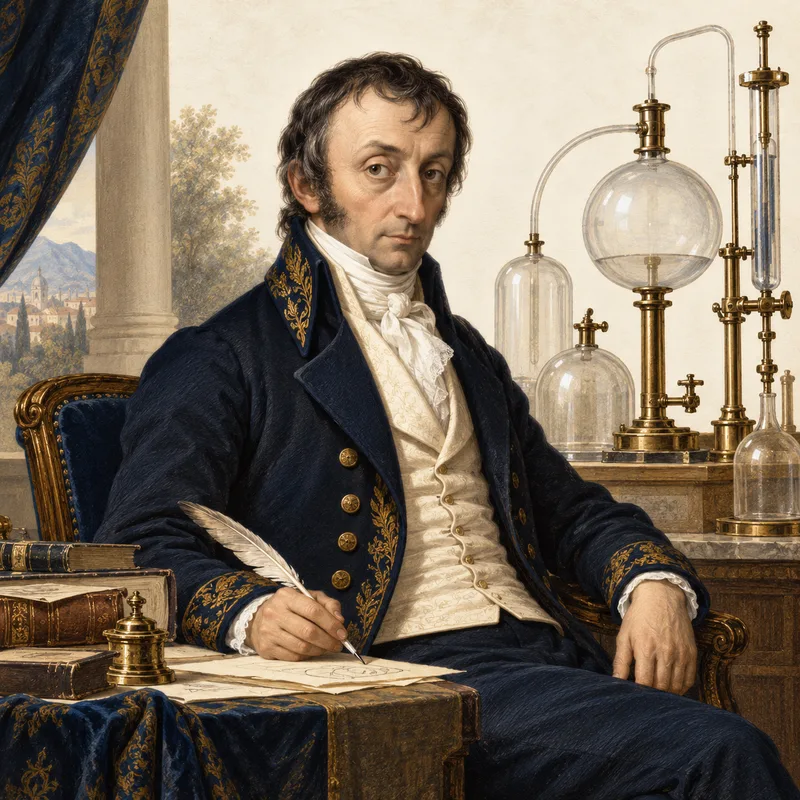
About the chemist
Amedeo Avogadro
1776-1856 · Italy
Avogadro's law; molecular hypothesis