The discovery, explained · Chemist no. 10 of 350
Avogadro's Hypothesis: How Equal Volumes of Gases Led to the Mole
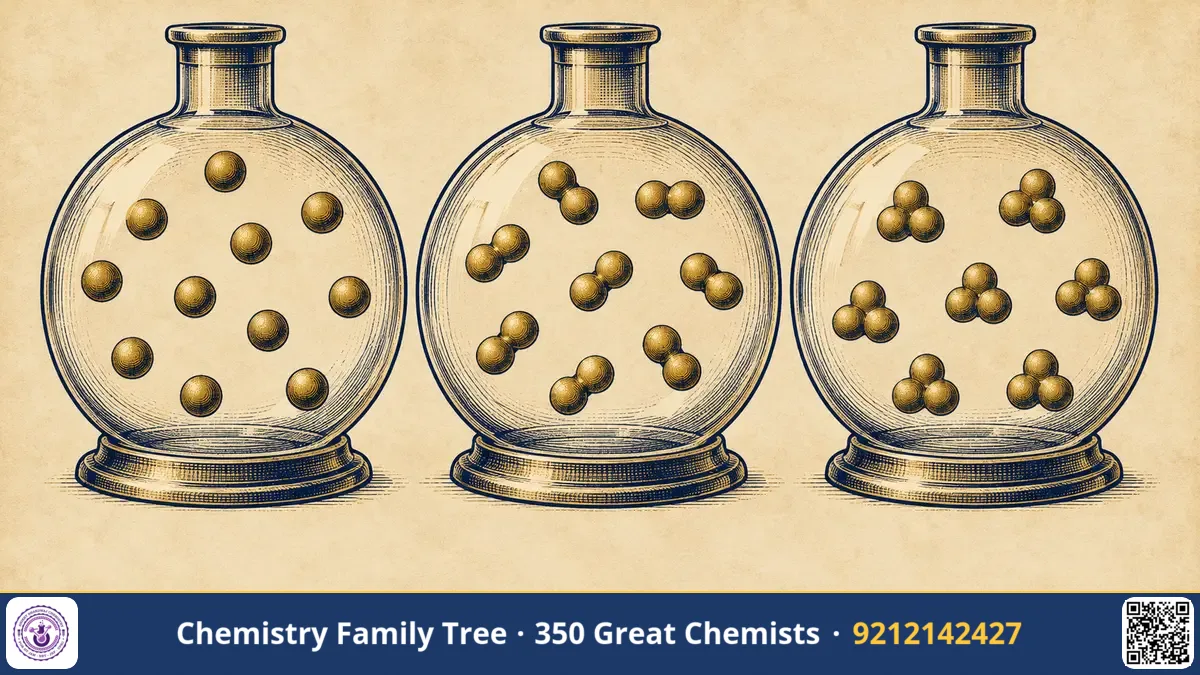
The number 6.022 × 10²³ is probably the most famous number in chemistry. It is named after Amedeo Avogadro, an Italian scientist who never knew its value. In 1811, Avogadro proposed that equal volumes of all gases, under the same conditions of temperature and pressure, contain the same number of molecules. This simple idea cleared up a deep confusion between atoms and molecules, made it possible to find correct atomic masses and later led to the concept of the mole. It was ignored for almost fifty years, but today it is a foundation of Class 11 chemistry and of every stoichiometry question in JAM, NET and GATE.
The Scientific Problem Before the Discovery
Two important facts about gases were known around 1808-1811, but they seemed to conflict:
- Dalton's atomic theory: compounds are formed by atoms combining in simple ratios, and atoms are indivisible.
- Gay-Lussac's law of combining volumes (1808): gases react in volumes that bear simple whole-number ratios to each other, and to the volumes of gaseous products, when measured at the same temperature and pressure.
Consider the reaction of hydrogen with chlorine: 1 volume of hydrogen plus 1 volume of chlorine gives 2 volumes of hydrogen chloride. Dalton thought that equal volumes of different gases could not contain the same number of particles. He also believed that the elements are made of single atoms. If so, 1 volume of H and 1 volume of Cl would produce only 1 volume of HCl, which is not what experiments showed. Dalton even doubted Gay-Lussac's measurements. There was a need for a new idea to remove this contradiction.
The Discovery: Avogadro's Reasoning Step by Step
- The hypothesis. In 1811, in the French journal Journal de Physique, Avogadro suggested that equal volumes of gases at the same temperature and pressure contain equal numbers of "molecules".
- Two kinds of particles. He distinguished between the "integral molecule" (the smallest particle of a compound or element that exists freely, what we call a molecule) and the "elementary molecule" (what we call an atom).
- Diatomic elements. He proposed that the molecules of elements such as hydrogen, oxygen and nitrogen are made up of two atoms each and can be split during a reaction.
- Applying the idea to reactions. With these two assumptions, Gay-Lussac's results could be explained without contradiction.
H₂ + Cl₂ → 2HCl
1 volume + 1 volume → 2 volumes

2H₂ + O₂ → 2H₂O
2 volumes + 1 volume → 2 volumes (steam)

N₂ + 3H₂ → 2NH₃
1 volume + 3 volumes → 2 volumes
In the formation of water, 2 volumes of hydrogen combine with 1 volume of oxygen to give 2 volumes of water vapour. Since each volume has the same number of molecules, one oxygen molecule must make two water molecules. So each water molecule contains one oxygen atom, and the oxygen molecule must be divisible into at least two parts. This gives the formula H₂O and not HO, which Dalton had assumed.
- Relative molecular masses. Because equal volumes contain equal numbers of molecules, the ratio of masses of equal volumes of two gases equals the ratio of their molecular masses. This allows the molecular mass of a gas to be determined by weighing a known volume.
The Chemistry Behind It
Statement of Avogadro's law
At constant temperature and pressure, the volume of a gas is directly proportional to the number of moles of gas.
V ∝ n   (T and P constant)
V₁/n₁ = V₂/n₂
Molar volume
One mole of any ideal gas occupies the same volume under the same conditions:
- 22.4 L at STP (0 °C and 1 atm).
- 22.7 L at STP as per the newer IUPAC definition (0 °C and 1 bar).
- About 24.5 L at 25 °C and 1 atm.
Relation to the ideal gas equation
Combining Boyle's law (V ∝ 1/P), Charles's law (V ∝ T) and Avogadro's law (V ∝ n) gives:
PV = nRT (R = 0.0821 L atm K⁻¹ mol⁻¹ = 8.314 J K⁻¹ mol⁻¹)
The Avogadro constant
Avogadro himself never calculated the number of molecules in a given volume. The number was first estimated by Josef Loschmidt in 1865 and later determined with greater accuracy through many methods, including Jean Perrin's experiments on Brownian motion. Perrin proposed the name "Avogadro's number". Since 2019, the SI defines the mole by fixing the Avogadro constant exactly at N_A = 6.02214076 × 10²³ mol⁻¹.
Worked numericals
1. What volume do 8.0 g of oxygen gas occupy at STP (0 °C, 1 atm)? Moles = 8.0/32 = 0.25 mol; volume = 0.25 × 22.4 = 5.6 L.
2. How many molecules are in 1.8 g of water? Moles = 1.8/18 = 0.1 mol; molecules = 0.1 × 6.022 × 10²³ = 6.022 × 10²² molecules.
3. Vapour density and molecular mass: molecular mass = 2 × vapour density, because the vapour density is the mass of a gas relative to hydrogen gas (M = 2).
| Gas (STP) | Molar mass (g/mol) | Volume of 1 mol | Molecules in 1 mol |
|---|---|---|---|
| H₂ | 2 | 22.4 L | 6.022 × 10²³ |
| O₂ | 32 | 22.4 L | 6.022 × 10²³ |
| CO₂ | 44 | 22.4 L (nearly) | 6.022 × 10²³ |
Applications Today
- Stoichiometry in industry. From making ammonia for fertilisers to burning LPG in kitchens, gas volumes are directly related to moles of reactants and products.
- Molecular mass determination. Methods such as Victor Meyer's method for volatile liquids use the volume of vapour to find the molecular mass.
- Cannizzaro's atomic weights. At the 1860 Karlsruhe Congress, Stanislao Cannizzaro used Avogadro's hypothesis to fix the atomic weights, which then enabled Mendeleev to develop the periodic table.
- Environmental measurements. Concentrations of pollutant gases are often reported in ppm by volume, which is also a mole fraction by Avogadro's law.
- Medicine and gases. Gas mixtures used by anaesthetists and respiratory therapists are calculated in moles and volumes.
Exam Corner
- Avogadro's law: equal volumes of all gases under the same T and P contain equal number of molecules. N_A = 6.022 × 10²³ mol⁻¹.
- At STP (0 °C, 1 atm), molar volume = 22.4 L/mol. At 0 °C and 1 bar, it is 22.7 L/mol.
- Monatomic noble gases have atomicity 1, so the volume statement applies to atoms for them.
- Gay-Lussac's law of combining volumes is explained by Avogadro's hypothesis, which assumes diatomic molecules.
- The ratio of volumes in a gaseous reaction equals the ratio of moles in the balanced equation, only if all species are gases at the same T and P.
Common Misconceptions
- "Avogadro calculated 6.022 × 10²³." No. He never knew the number. It was named in his honour later.
- "Equal volumes of gases have equal masses." They have equal numbers of molecules, but different masses unless the molar masses are equal.
- "22.4 L is the volume of a mole of any substance." It applies only to ideal gases at STP, not to liquids or solids.
Quick Revision Box
- Avogadro's hypothesis (1811): equal volumes of gases at the same T and P contain equal numbers of molecules.
- V ∝ n at constant T and P.
- Molar volume: 22.4 L at 0 °C and 1 atm.
- N_A = 6.02214076 × 10²³ mol⁻¹ (exact, SI 2019).
- Cannizzaro revived the idea at Karlsruhe, 1860.
- Elements like H₂, O₂, N₂, Cl₂ are diatomic molecules.
FAQ
What does Avogadro's law say?
At the same temperature and pressure, equal volumes of different gases contain the same number of molecules.
Why was Avogadro's hypothesis ignored for so long?
Chemists did not distinguish clearly between atoms and molecules, and many, including Dalton, found the idea of diatomic elemental molecules hard to accept. Cannizzaro's talk in 1860 changed this.
What is the value of Avogadro's number?
6.022 × 10²³ per mole, which is exactly 6.02214076 × 10²³ mol⁻¹ in the SI system since 2019.
How is Avogadro's law related to the ideal gas equation?
Adding V ∝ n to Boyle's and Charles's laws gives PV = nRT.
Published by ABC Chemistry — IIT-JAM | CSIR-NET | GATE Chemistry Coaching. Visit abcchemistry.com
About the chemist
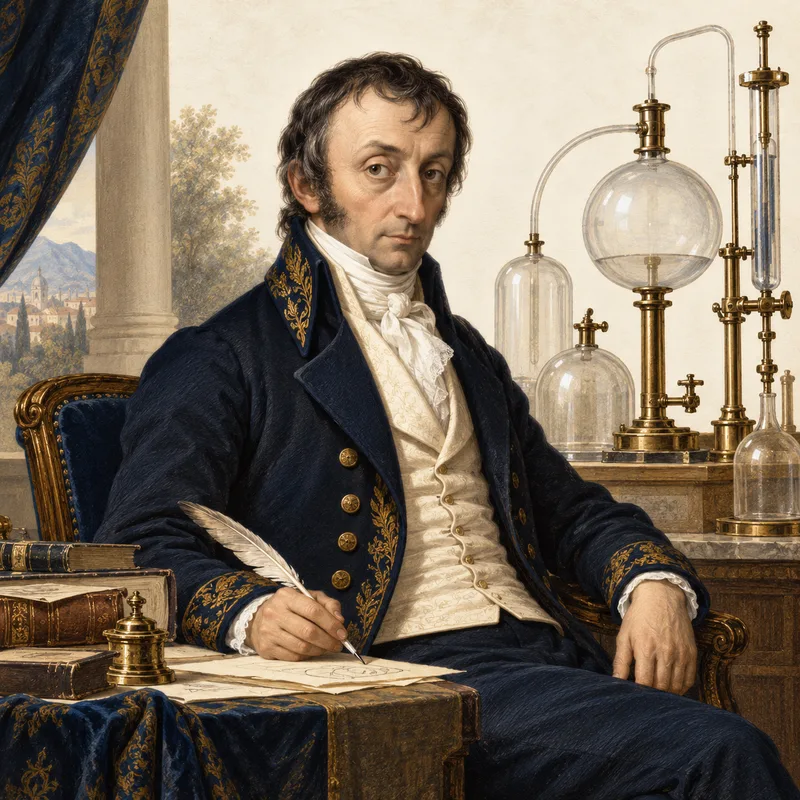
Amedeo Avogadro
1776-1856 · Italy
Avogadro's law; molecular hypothesis