Biography · Chemist no. 1 of 350
Antoine Lavoisier: The Life and Legacy of the Father of Modern Chemistry
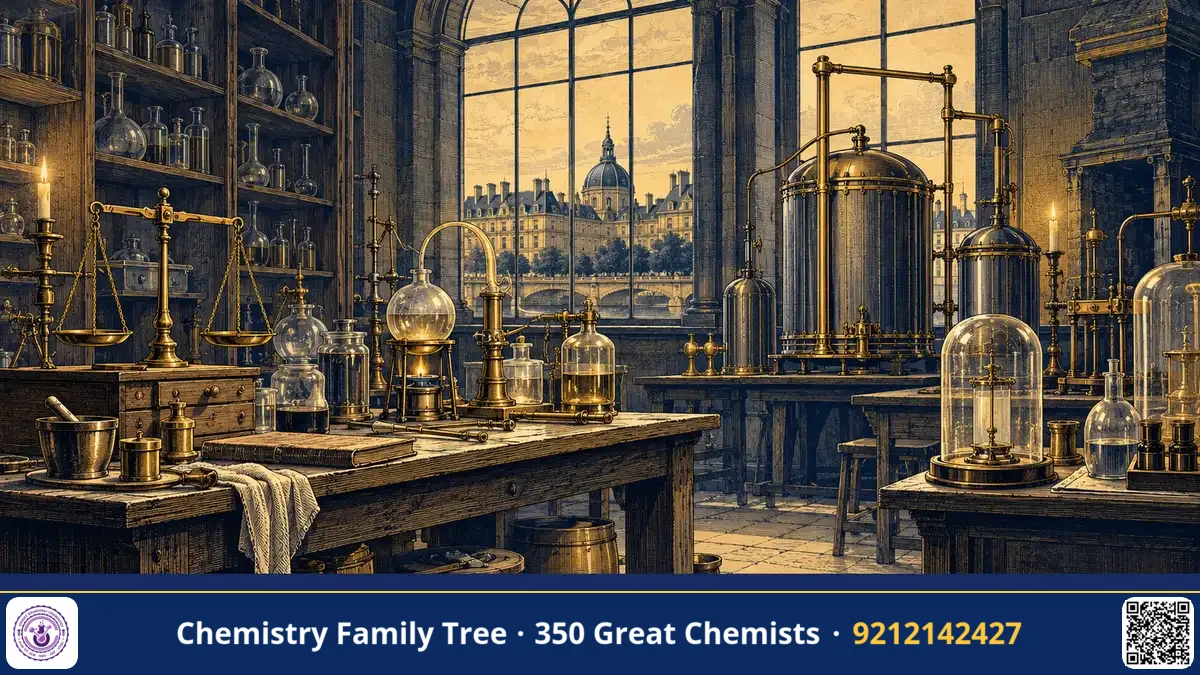
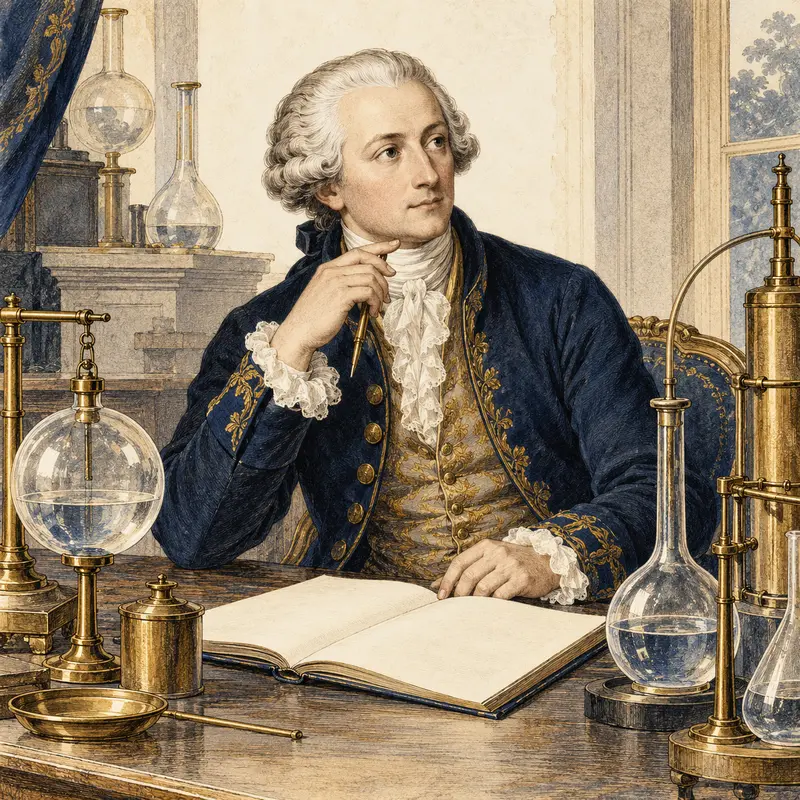
Antoine-Laurent de Lavoisier (1743-1794) was a French chemist, economist and public servant who changed chemistry from a collection of recipes into a science built on measurement. He overthrew the phlogiston theory, explained combustion as combination with oxygen, helped create the modern system of chemical names, and showed that mass is conserved in chemical reactions. His life ended on the guillotine during the French Revolution, which makes his story both inspiring and tragic. He is rightly called the "father of modern chemistry".
Early Life and Family
Lavoisier was born on 26 August 1743 in Paris into a wealthy and educated family. His father, Jean-Antoine Lavoisier, was a lawyer at the Parlement of Paris, and his mother, Émilie Punctis, came from a well-off family as well. His mother died when he was about five years old, and he was raised with great care by his father, his aunt and his younger sister, who sadly died young. The family wealth gave him the freedom to study widely and to build a very well-equipped private laboratory later in life.
Education and Mentors
He studied at the Collège Mazarin in Paris, where he received a strong education in classics and also in mathematics, astronomy, botany and chemistry. Following his father's wishes, he studied law and qualified as a lawyer in 1763, but he never made law his career. Science attracted him more.
- Jean-Étienne Guettard, a geologist, took him on field trips and introduced him to mineralogy and the mapping of France's rocks.
- Nicolas Louis de Lacaille, an astronomer, helped his training in observation and mathematics.
- Guillaume-François Rouelle, a well-known Paris chemistry teacher, gave him practical lessons in chemistry.
His early work on gypsum (calcium sulphate dihydrate) and a prize essay on street lighting for Paris brought him to the attention of the Académie des Sciences, which admitted him as a junior member in 1768.
Career Timeline
| Year | Event |
|---|---|
| 1743 | Born in Paris on 26 August |
| 1763 | Qualifies in law |
| 1768 | Elected to the Académie des Sciences; joins the Ferme générale, the private tax-collecting company |
| 1771 | Marries Marie-Anne Pierrette Paulze |
| 1772-1774 | Experiments on combustion of diamond, sulphur, phosphorus and metals; sealed-vessel tin experiments |
| 1775 | Appointed to the gunpowder administration and moves to the Arsenal in Paris, where he sets up his laboratory |
| 1777-1783 | Develops oxygen theory of combustion and respiration |
| 1783-1785 | Shows that water is a compound of hydrogen and oxygen |
| 1787 | Co-authors Méthode de nomenclature chimique |
| 1789 | Publishes Traité élémentaire de chimie; helps found the journal Annales de chimie |
| 1790s | Serves on the commission that prepares the metric system of weights and measures |
| 1794 | Arrested with other tax farmers, tried and guillotined on 8 May |
Major Scientific Contributions
Oxygen theory of combustion. By weighing substances before and after burning in closed vessels, he proved that burning is a reaction with a part of the air, which he named oxygen. This ended the phlogiston theory. Read more about this in our discovery post on the law of conservation of mass.
Metal + O₂ → Metal oxide
S + O₂ → SO₂
C + O₂ → CO₂
Conservation of mass. He treated the balance as the key instrument of chemistry and stated that matter is neither created nor destroyed in chemical changes.
Composition of water. He showed that water is not an element, as the ancient Greeks believed, but a compound of hydrogen and oxygen: 2H₂ + O₂ → 2H₂O.
Burning of diamond. In 1772 he, along with other French scientists, heated diamond in a closed container with air and showed that it produced "fixed air" (carbon dioxide), showing that diamond is a form of carbon, a point that Smithson Tennant later confirmed more fully in 1797.
Chemical nomenclature and the list of elements. The names we use for acids, bases and salts follow the logic set up in 1787. His Traité listed about 33 simple substances and is often called the first modern chemistry textbook.
Respiration. With Laplace he measured the heat of animal respiration and compared it with combustion, laying the foundation of biochemistry and thermochemistry.
Awards, Honours and Nobel Prize
The Nobel Prize began only in 1901, so Lavoisier could not receive one. In his own time he was honoured with membership of the Académie des Sciences, rising to senior positions, and he was appointed to important state commissions for gunpowder, agriculture and weights and measures. In later years the French nation and the scientific world have recognised him by naming institutions, streets and prizes after him, and his portrait with his wife by the painter Jacques-Louis David is one of the best-known images in the history of science.
Personality, Struggles and Lesser-Known Facts
- A scientific partnership. His wife Marie-Anne Paulze Lavoisier was only in her early teens when they married in 1771. She learnt English and Latin, translated scientific papers for him (including Richard Kirwan's essay on phlogiston), drew the diagrams for his Traité and kept careful laboratory notes. Many historians regard her as his true scientific collaborator.
- Working before sunrise. He is known to have worked in his laboratory for several hours early in the morning and in the evening, while spending his daytime on his administrative duties.
- Gunpowder reform. As a gunpowder administrator, he improved the supply of saltpetre (potassium nitrate) and the quality of French gunpowder, which helped France in later wars, including the American War of Independence.
- The tax farm. His membership in the Ferme générale gave him money for research, but it made him a target when the Revolution turned against tax farmers, whom the public blamed for oppressing the poor.
- A swift and unjust end. After his arrest in late 1793, he and the other tax farmers were tried in a single day. He was guillotined on 8 May 1794 together with them, including his father-in-law Jacques Paulze, even though his scientific and public service to France had been great.
- Rehabilitation. About two years later, in 1796, a memorial for him was held, and his reputation was restored. His wife later arranged for his scientific papers to be published.
Legacy and Influence on Modern Chemistry
Almost every part of the chemistry curriculum has his stamp. Balanced equations, stoichiometry, gravimetric analysis and the idea of an element all trace back to him. Later chemists such as Dalton used his quantitative method to build atomic theory, and Berzelius and others developed his nomenclature into the language that we use today. The metric system, to which he contributed, is now the base of the SI units that Indian students use in every laboratory practical. His example showed that precise measurement, careful records and willingness to challenge accepted ideas are the strongest tools of a scientist.
Lessons for Students
- Measure carefully. A good balance and honest data defeated a popular theory.
- Question accepted ideas politely but firmly. Phlogiston was widely believed, yet it failed the weighing test.
- Build on others' work. He used Priestley's and Scheele's gas, but explained it better. Always credit your sources.
- Work as a team. His wife's translating and drawing skills made his books possible.
- Remember the world beyond the lab. Science and society are connected, and political change can affect scientists too.
Quick Facts Box
- Born: 26 August 1743, Paris, France
- Died: 8 May 1794, Paris (guillotine)
- Nationality: French
- Field: Chemistry; also economics and public administration
- Famous for: Oxygen theory of combustion, conservation of mass, chemical nomenclature
- Nobel Prize: None (died before the prizes began in 1901)
FAQ
Why is Lavoisier called the father of modern chemistry?
He introduced quantitative methods, disproved the phlogiston theory, explained combustion correctly, helped create modern chemical names and wrote the first modern chemistry textbook.
Did Lavoisier discover oxygen?
Scheele and Priestley prepared oxygen first. Lavoisier explained its role in combustion and respiration, and gave it its name.
Why was Lavoisier executed?
He was a member of the Ferme générale, the private tax-collecting body that was hated by the public. During the Terror of the French Revolution, its members were arrested and condemned.
Who helped Lavoisier in his work?
His wife, Marie-Anne Paulze Lavoisier, translated papers, illustrated his experiments and kept records. He also worked with scientists such as Laplace, Berthollet and de Morveau.
Published by ABC Chemistry — IIT-JAM | CSIR-NET | GATE Chemistry Coaching. Visit abcchemistry.com
About the chemist
Antoine Lavoisier
1743-1794 · France
Law of conservation of mass; oxygen