The discovery, explained · Chemist no. 1 of 350
Lavoisier and the Law of Conservation of Mass: How Combustion Was Finally Explained
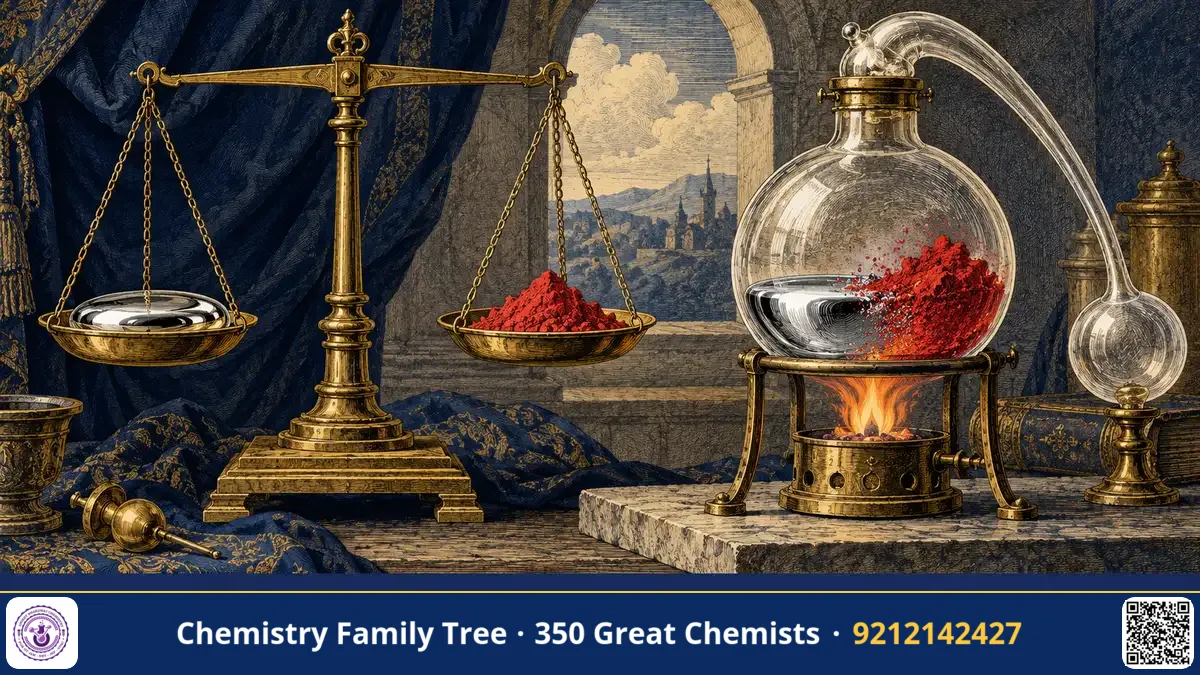
Every time you balance a chemical equation in class, you are using an idea that Antoine Lavoisier made central to chemistry in the 1770s and 1780s: matter is not created or destroyed in a chemical reaction. Before him, burning, rusting and breathing were explained by a mysterious substance called phlogiston. After him, they were explained by a real gas, oxygen, and by careful weighing on a balance. This single change of method, putting the balance at the centre of chemistry, turned an old craft of alchemists and apothecaries into a quantitative science. In this post we follow the problem, the experiments, the chemistry and the exam points that come from Lavoisier's work.
The Scientific Problem Before the Discovery
In the early 1700s, the dominant explanation of burning was the phlogiston theory, associated with Georg Ernst Stahl. It said that every combustible material contains a fire-like principle called phlogiston. When a substance burns, it releases phlogiston into the air. A metal, in this view, was a compound of a "calx" (what we now call the metal oxide) and phlogiston. Heating the metal drove out phlogiston and left the calx.
The theory had a serious weakness. When metals such as tin or lead were heated in air, the calx that formed was heavier than the original metal. If phlogiston was leaving, the product should have been lighter. Some supporters suggested phlogiston had "negative weight", but this was an awkward patch rather than a real explanation. Also, a candle burning in a closed jar goes out after some time, and a mouse in a closed jar dies. The phlogiston theory said the air became "saturated" with phlogiston, but it could not explain the weight gain of calxes.
The Discovery: Experiments Step by Step
Lavoisier, trained as a lawyer but deeply interested in science, decided to test combustion with a balance and sealed vessels. His method was simple: weigh everything before and after.
- Heating tin in a sealed flask (around 1772-1774). He sealed a known mass of tin in a glass retort with air and weighed the whole system. After heating, the tin partly turned to calx, but the total weight of the sealed retort did not change. When he opened the retort, air rushed in and the weight increased. The gain in the metal's mass was therefore equal to the mass of air that had been taken up. Air itself, not a departing phlogiston, was involved.
- Learning of "dephlogisticated air". In 1774, Joseph Priestley told Lavoisier in Paris that heating mercury calx (red mercuric oxide) released a gas in which a candle burned very brightly. Carl Wilhelm Scheele had also obtained a similar gas independently.
- The mercury experiment. Lavoisier heated mercury in a closed volume of air for many days. Red mercury calx formed on the surface, and about one-fifth of the air volume disappeared. The remaining gas would not support life or burning. He then heated the red calx strongly and recovered the metal and a gas which was the missing portion of air. He named it oxygen (from Greek words meaning "acid former"), because he thought it was present in all acids. That idea was later shown to be wrong, but the name stayed.
- Water and hydrogen. In 1783-1785 he showed that burning "inflammable air" with oxygen gives water, and he named the gas hydrogen ("water former"). He also decomposed water by passing steam over red-hot iron.
2Hg + O₂ → 2HgO   (heating mercury in air, about 350 °C)
2HgO → 2Hg + O₂   (stronger heating, decomposition)
2H₂ + O₂ → 2H₂O
The Chemistry Behind It
Law of conservation of mass. In a closed system, the total mass of the reactants equals the total mass of the products. Lavoisier stated the idea clearly in his 1789 book Traité élémentaire de chimie: nothing is created in the operations of art or nature, and the quantity of matter is the same before and after an experiment. This is why chemical equations must be balanced: the number of atoms of each element on the left must equal that on the right.
Oxidation as combination with oxygen. Lavoisier's theory defined combustion as the combination of a substance with oxygen. Today we define oxidation more broadly as loss of electrons or increase in oxidation number, but the old definition still works for many school-level reactions.
| Feature | Phlogiston theory | Lavoisier's oxygen theory |
|---|---|---|
| During burning | Phlogiston is lost | Oxygen is gained |
| Metal to calx | Metal = calx + phlogiston | Metal + oxygen = oxide |
| Mass of product | Unexplained increase | Increase equals oxygen taken up |
| Role of air | Only carries away phlogiston | Active reactant |
Elements and nomenclature. Lavoisier, with Guyton de Morveau, Berthollet and Fourcroy, published a new system of chemical names in 1787. Names like "sulphate" and "sulphite" now told you what a compound contained. He also gave a list of simple substances, which can be seen as an early list of elements, though it wrongly included light and caloric (heat). His working definition, that an element is a substance that cannot be broken down further by chemical analysis, was a practical step towards modern ideas.
Respiration. With Pierre-Simon Laplace, he used an ice calorimeter to compare the heat produced by a guinea pig with the heat from burning carbon, and concluded that respiration is a slow form of combustion.
Applications Today
- Stoichiometry. Every industrial calculation, from how much limestone is needed to make cement to how much ammonia a fertiliser plant yields, uses mass balance based on Lavoisier's law.
- Analytical chemistry. Gravimetric analysis, where an ion is precipitated and weighed, depends on the idea that mass is conserved.
- Combustion analysis. The carbon and hydrogen percentage of an organic compound is found by burning it and weighing the CO₂ and H₂O produced. This is a standard topic in Class 11 and in organic chemistry for JAM.
- Environment and energy. Understanding fuel combustion helps in studying air pollution, engine efficiency and carbon accounting in India's power plants.
- Medicine. The understanding of respiration as oxidation underlies oxygen therapy and metabolic studies.
Exam Corner
- The law of conservation of mass is credited to Lavoisier, and the law of definite proportions to Proust. Do not mix them up.
- Oxygen was named by Lavoisier; it was discovered independently by Scheele and Priestley.
- Calx = metal oxide in old language. Heating HgO gives Hg and O₂.
- In a closed system, the mass is conserved; in an open system, a gas may escape or enter, so the apparent mass can change.
- Very small mass changes in nuclear reactions follow E = mc², so the law is strictly "conservation of mass-energy", but in ordinary chemical reactions the change is far too small to measure.
Common Misconceptions
- "Lavoisier discovered oxygen." Not alone. Scheele and Priestley prepared it first. Lavoisier's great contribution was to interpret its role correctly and to name it.
- "Oxygen is in all acids." This was Lavoisier's belief, but HCl contains no oxygen. Humphry Davy later showed this.
- "Mass is always conserved when a candle burns." A burning candle seems to lose mass because the CO₂ and water vapour escape. In a closed system the total mass stays the same.
Quick Revision Box
- Law of conservation of mass: total mass of reactants = total mass of products (closed system).
- Phlogiston theory was replaced by the oxygen theory of combustion.
- Key experiment: heating mercury in air gives red HgO; strong heating gives back Hg and O₂.
- Lavoisier named oxygen and hydrogen.
- Main book: Traité élémentaire de chimie (1789).
- Respiration is a slow combustion process.
FAQ
What is the law of conservation of mass in simple words?
Matter cannot be created or destroyed in a chemical reaction. The atoms are only rearranged, so the total mass before and after is the same.
Why did metals gain mass on heating in air?
The metal combines with oxygen from the air to form an oxide. The added mass is the mass of oxygen taken up, which is why the calx is heavier than the metal.
Is the law of conservation of mass always true?
For chemical reactions it holds to very high precision. In nuclear reactions, a tiny part of mass is converted into energy, so mass and energy are conserved together.
How is this topic asked in exams?
Common questions include balancing equations, mass-based stoichiometry, naming the scientist for each law, and conceptual questions on the phlogiston theory versus the oxygen theory.
Published by ABC Chemistry — IIT-JAM | CSIR-NET | GATE Chemistry Coaching. Visit abcchemistry.com
About the chemist
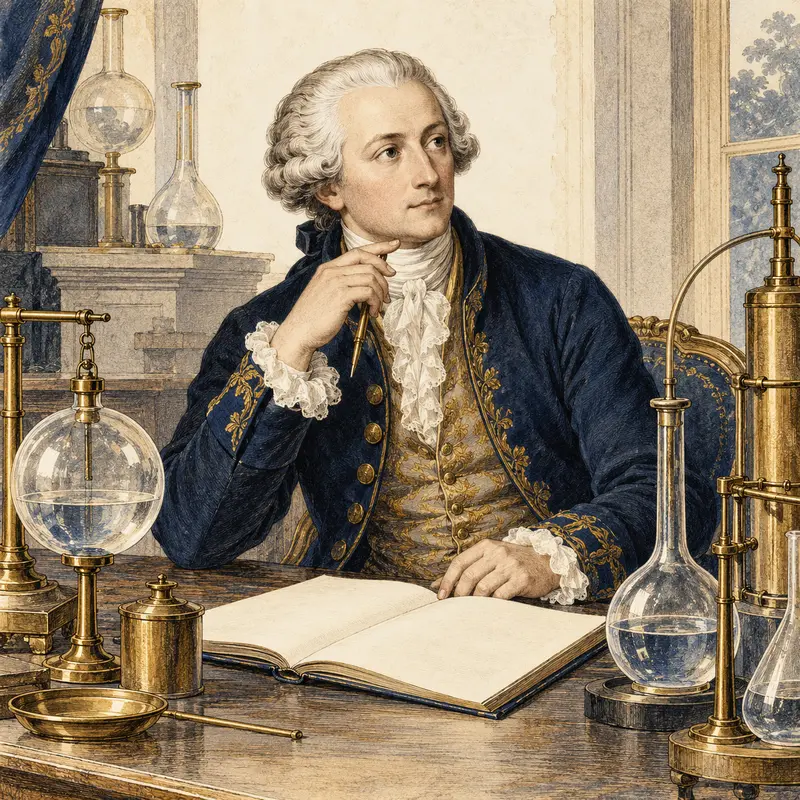
Antoine Lavoisier
1743-1794 · France
Law of conservation of mass; oxygen