Biography · Chemist no. 128 of 350
Archer John Porter Martin (1910-2002): The Chemist Who Built His Own Instruments and Changed Separation Science
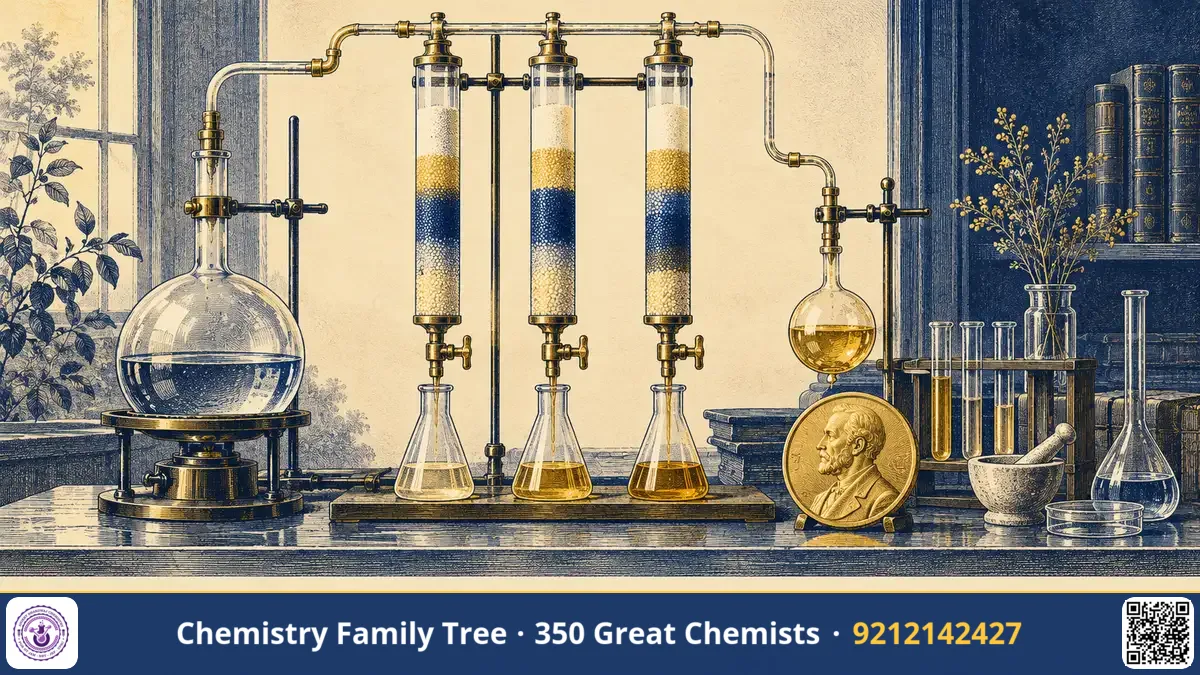
Archer John Porter Martin was a British biochemist and physical chemist who shared the 1952 Nobel Prize in Chemistry with Richard Synge for the invention of partition chromatography. He was also the co-inventor of paper chromatography and gas-liquid chromatography. Martin was a gifted builder of apparatus, and many of his breakthroughs came from simple glass tubes, filter paper and clever ideas. His one-line legacy: he gave chemists the tool that separates almost any mixture.
Early Life and Family
Martin was born in London on 1 March 1910. His father was a general practitioner, and his mother had trained as a nurse. He grew up in a household where science and medicine were respected. As a schoolboy he developed a taste for making things with his hands, and he is remembered for building laboratory equipment at home. He attended Bedford School, which had a good science tradition.
Education and Mentors
Martin studied at Peterhouse, Cambridge, and graduated in chemistry and physics with the natural sciences tripos. At Cambridge he worked in the Dunn Nutritional Laboratory and in the biochemistry department under the influence of Sir Frederick Gowland Hopkins's school and of J. B. S. Haldane, the famous biologist, whose lab gave him a freer, more open way of thinking. He did early research on vitamin E and on the counter-current extraction of vitamins. This apprenticeship in separating small amounts of biological chemicals was the starting point for chromatography.
Career Timeline
| Year | Event |
|---|---|
| 1910 | Born in London |
| 1930s | Research at Cambridge (Dunn Nutritional Laboratory) on vitamins and extraction methods |
| 1938 | Joins the Wool Industries Research Association, Leeds, where he meets Richard Synge |
| 1941 | Martin and Synge publish partition chromatography on silica columns |
| 1944 | Paper chromatography with Consden and Gordon |
| 1946-1948 | Works at the Lister Institute and then the Medical Research Council in London |
| 1950 | Elected Fellow of the Royal Society |
| 1952 | Gas-liquid chromatography with A. T. James; shares the Nobel Prize in Chemistry |
| 2002 | Dies in Llangarron, Herefordshire |
Major Scientific Contributions
Partition chromatography (1941). By holding water on silica gel and passing chloroform past it, Martin and Synge separated acetylated amino acids. The partition coefficient K = Cs / Cm controls how fast each compound moves.
Paper chromatography (1944). A strip of filter paper replaced the column. A drop of amino acid mixture was placed near one end and a solvent travelled up by capillary action. The ratio Rf = distance of spot / distance of solvent front became a standard identification tool. Two-dimensional runs and spraying with ninhydrin allowed all the amino acids of a protein hydrolysate to be seen on one sheet.
Gas-liquid chromatography (1952). With Anthony T. James, Martin separated volatile fatty acids using a column coated with a non-volatile liquid and nitrogen as the carrier gas. The method was later made far more sensitive by detectors developed by others, including his friend James Lovelock, who built the electron capture detector.
Theory. He and Synge developed plate theory, in which a column behaves as a series of equilibrium stages. This is the basis of the concepts of theoretical plates and HETP that you meet in analytical chemistry. In their 1941 paper they also anticipated that a gas could be the mobile phase and that very fine particles and high pressure would make separations faster, an idea that came true as HPLC.
Awards, Honours and Nobel Prize
Martin and Synge shared the 1952 Nobel Prize in Chemistry "for their invention of partition chromatography". Martin became a Fellow of the Royal Society in 1950, and he received numerous other honours from scientific societies. The Nobel committee noted that the method had opened new routes for biochemistry, in particular the study of proteins.
Personality, Struggles and Lesser-Known Facts
- Martin liked to build his own apparatus rather than buy it. The early chromatography columns and sheets were home-made, simple and very effective.
- The first idea for chromatography came to him when counter-current extraction machines were too complicated; he said in effect that a simpler design was needed, so he held one liquid still.
- Paper chromatography was developed because the researchers needed to analyse very small amounts of wool protein hydrolysate, and filter paper is cheap, flat and holds water in its cellulose fibres.
- He moved between several institutions and industrial laboratories during his career and is remembered as an independent thinker who preferred ideas to administration.
- Frederick Sanger acknowledged that chromatographic separations were essential for his work on insulin, for which Sanger received his first Nobel Prize in 1958.
Legacy and Influence on Modern Chemistry
Chromatography is today the most widely used separation technique in chemistry. Without Martin's work there would be no GC-MS in forensic laboratories, no LC-MS in drug discovery, no routine HPLC in the pharmaceutical industry, and no easy amino acid analysis. The Human Genome Project and modern proteomics use descendants of his ideas. In India, chromatography appears in every B.Sc. practical syllabus and every instrumental analysis paper for IIT-JAM, CSIR-NET and GATE. The Rf value, the theoretical plate and the partition coefficient are all part of his legacy.
Lessons for Students
- A simple idea, such as keeping one phase still, can be more powerful than a complicated machine.
- Learn to build and repair your own equipment; practical skill leads to discovery.
- Look ahead. Martin and Synge predicted gas and high-pressure chromatography in the same paper that announced partition chromatography.
- Good theory (plate theory) turns a clever trick into a general method.
Quick Facts Box
- Born: 1 March 1910, London, England
- Died: 28 July 2002, Llangarron, Herefordshire, England
- Nationality: British
- Field: Biochemistry, analytical and physical chemistry
- Famous for: Partition, paper and gas-liquid chromatography
- Nobel Prize: Chemistry, 1952 (shared with Richard Synge)
FAQ
Did Archer Martin work alone?
No. Partition chromatography was a joint invention with Richard Synge, paper chromatography included Consden and Gordon, and gas chromatography was developed with A. T. James.
Why is Martin important for biochemistry?
His methods made it possible to separate amino acids and peptides from tiny samples, which led to protein sequencing.
Was the Nobel Prize in Chemistry or in Medicine?
It was in Chemistry, even though the methods were very important for biology and medicine.
What should I remember for exams?
Partition chromatography, 1952 Nobel Prize, K = Cs/Cm, Rf value, and the fact that paper chromatography is mainly a partition method.
Published by ABC Chemistry — IIT-JAM | CSIR-NET | GATE Chemistry Coaching. Visit abcchemistry.com
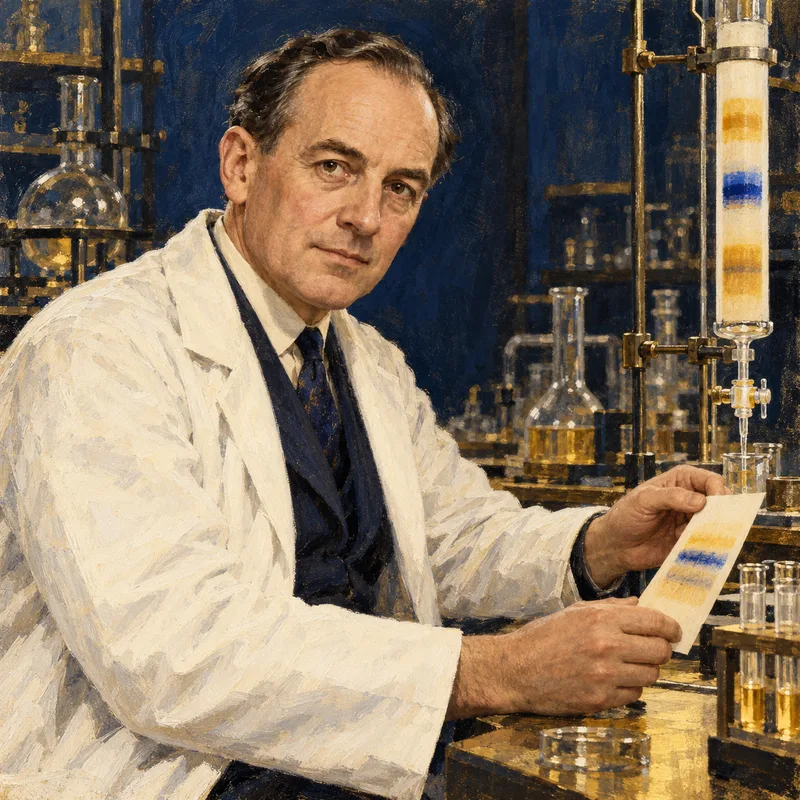
About the chemist
Archer Martin
1910-2002 · United Kingdom · Nobel Chemistry 1952
Partition chromatography