The discovery, explained · Chemist no. 128 of 350
Archer Martin and Partition Chromatography: The Method That Taught Chemists to Separate Anything
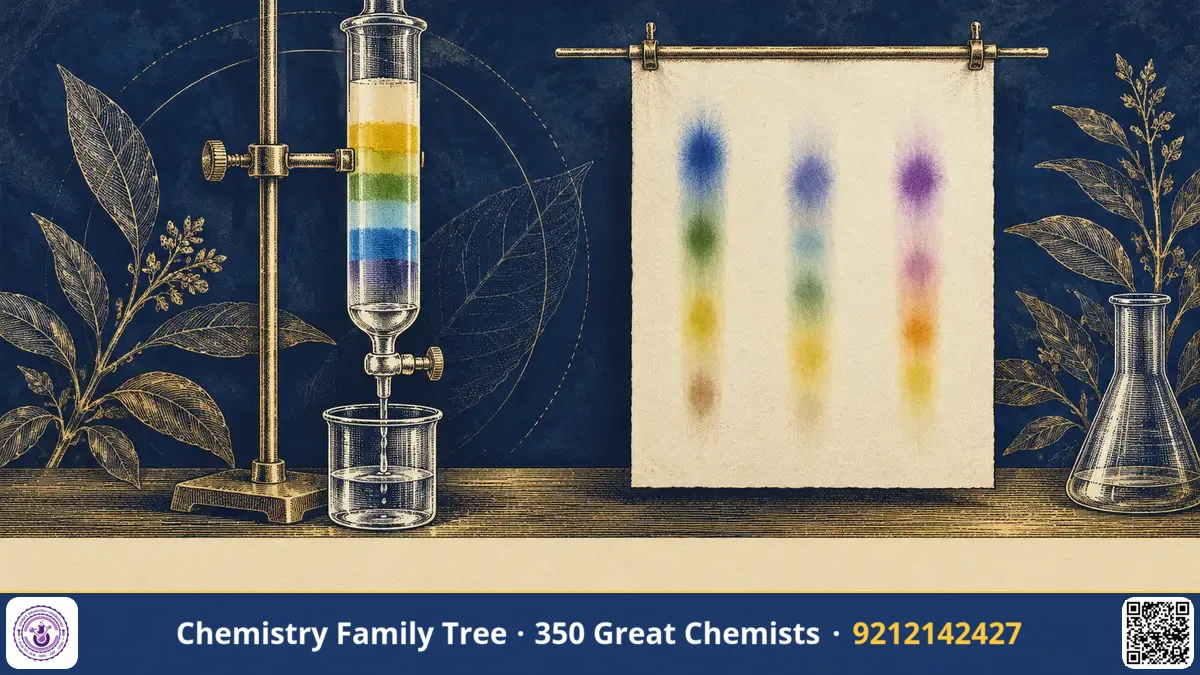
Walk into any chemistry laboratory in India, from a school practical to a pharmaceutical quality control unit, and you will find chromatography. A drop of ink on filter paper that splits into colours, a GC-MS testing pesticide residues in tea, an HPLC checking the purity of a tablet: all of them descend from work done in the early 1940s by two young British biochemists, Archer John Porter Martin and Richard Laurence Millington Synge. They invented partition chromatography, and soon afterwards Martin and his colleagues developed paper chromatography and gas-liquid chromatography. For this the two men shared the 1952 Nobel Prize in Chemistry. In this post we explain how it worked and what you must remember for exams.
The Scientific Problem Before the Discovery
In the 1930s, biochemists wanted to know the exact amino acid composition of proteins such as wool keratin. The available methods were slow and wasteful. Fractional crystallisation and distillation of derivatives needed large amounts of material and gave poor separation of very similar compounds. Mikhail Tswett had already shown in 1906 that plant pigments could be separated on a column of calcium carbonate by adsorption chromatography, but this worked best for coloured compounds with different adsorption strengths. Colourless, water-soluble, closely related substances like amino acids simply streaked or stayed together.
Martin and Synge were working at the wool research laboratories in Leeds. They needed a way to separate tiny amounts of amino acids that differ only slightly in polarity.
The Discovery: Step by Step
They first thought of counter-current liquid-liquid extraction, in which two immiscible solvents move past each other in a long series of tubes. A solute with a higher affinity for one solvent moves along faster in that direction. Building hundreds of such tubes was impractical. Their key insight was to keep one liquid still by holding it on a solid support, and let the second liquid flow through.
- Stationary phase. They packed a glass tube with finely powdered silica gel that held about half its weight of water. The water, held on the silica, was the stationary liquid phase.
- Sample. A mixture of acetylated amino acids (derivatives soluble in organic solvents) was placed at the top.
- Mobile phase. A water-immiscible solvent, chloroform (with a little butanol), was passed slowly through the column.
- Partition. Each amino acid derivative distributed itself between the water on the silica and the moving solvent. Those that preferred the solvent moved faster; those that preferred water lagged behind. Distinct bands formed and were collected as fractions.
They published this in 1941. In the same paper they pointed out that the moving phase could be a gas, and that the method could in principle be made very fast with fine particles under pressure. This predicted gas chromatography and HPLC years in advance.
Paper chromatography (1944). With Consden and Gordon, Martin replaced the silica column by a sheet of filter paper. The cellulose of paper holds adsorbed water, which acts as the stationary phase. A spot of amino acid mixture is placed near the bottom edge, the paper is dipped in a solvent such as butanol-acetic acid-water, and the solvent rises by capillary action. After drying, the paper is sprayed with ninhydrin and the amino acids appear as purple spots. In a refinement, the paper was turned through 90 degrees and run again in a second solvent, which gave two-dimensional chromatography of very complex mixtures.
Gas-liquid chromatography (1952). Martin and A. T. James used a column packed with an inert solid coated with a non-volatile liquid, with nitrogen as carrier gas, to separate volatile fatty acids. The eluted acids were detected by titration of the effluent. This quickly grew into the modern GC.
The Chemistry Behind It
The central concept is the partition coefficient:
K = C(stationary phase) / C(mobile phase)
A compound with a large K spends more time in the stationary phase and moves slowly. In paper chromatography we describe movement by the retardation factor:
Rf = distance moved by solute / distance moved by solvent front
Rf is always between 0 and 1, and for a given solvent and paper it is characteristic of the substance. Martin and Synge also gave a mathematical model, the plate theory, in which the column is imagined as a series of thin layers (theoretical plates), each reaching equilibrium. The more plates, and the smaller the height equivalent to a theoretical plate (HETP), the sharper the separation. Later the van Deemter equation extended this idea: H = A + B/u + C·u, linking plate height to flow speed.
The difference between types is important:
- Adsorption chromatography: the solid surface itself holds the solute.
- Partition chromatography: the solute dissolves in a liquid held on a solid support; separation is by relative solubility.
Applications Today
- Proteomics and biochemistry. Amino acid analysis, peptide mapping, and Frederick Sanger's sequencing of insulin all depended on paper chromatography.
- Pharmaceuticals. HPLC and GC check drug purity, assay active ingredients and detect impurities in medicines made across India.
- Food and environment. GC and GC-MS detect pesticides in food, solvents in water, and alcohol in blood.
- Forensics and sport. Dope testing and toxicology use chromatography coupled with mass spectrometry.
- Teaching. Paper chromatography of inks and leaf pigments is a standard school experiment.
Exam Corner
- Martin and Synge received the 1952 Nobel Prize in Chemistry for the invention of partition chromatography.
- Rf = (distance moved by solute) / (distance moved by solvent), and 0 < Rf < 1.
- In paper chromatography the stationary phase is water bound to cellulose, not the paper fibre itself.
- Amino acids on paper are detected by spraying with ninhydrin, which gives purple colour (Ruhemann's purple).
- In gas chromatography the mobile phase is an inert gas (N₂, He or H₂) and separation depends on volatility and interaction with the liquid stationary phase.
Common Misconceptions
- "Paper chromatography is adsorption chromatography." Mostly not. It is a partition technique, with water held on cellulose as stationary phase.
- "Tswett invented partition chromatography." No, Tswett (1906) introduced adsorption column chromatography; partition chromatography came from Martin and Synge in 1941.
- "A higher Rf means a more strongly retained compound." It is the opposite: higher Rf means the compound moves faster and is less retained.
Quick Revision Box
- Partition chromatography: 1941, Martin and Synge, silica gel holding water, chloroform as mobile phase.
- Paper chromatography: 1944, Consden, Gordon and Martin; ninhydrin detection.
- Gas-liquid chromatography: 1952, Martin and James.
- Key formulas: K = Cs/Cm and Rf = ds/df.
- Plate theory and HETP explain column efficiency.
- Nobel Prize in Chemistry 1952 (shared with Richard Synge).
FAQ
What did Archer Martin win the Nobel Prize for?
For the invention of partition chromatography, shared with Richard Synge, in 1952.
What is the stationary phase in paper chromatography?
It is the water held in the cellulose fibres of the paper; the solvent that climbs the paper is the mobile phase.
Why is ninhydrin used?
Ninhydrin reacts with the free amino group of amino acids and gives a purple coloured product, making colourless spots visible.
Who invented gas chromatography?
Martin and A. T. James developed gas-liquid chromatography in 1952, after Martin and Synge had predicted the possibility in 1941.
Published by ABC Chemistry — IIT-JAM | CSIR-NET | GATE Chemistry Coaching. Visit abcchemistry.com
About the chemist
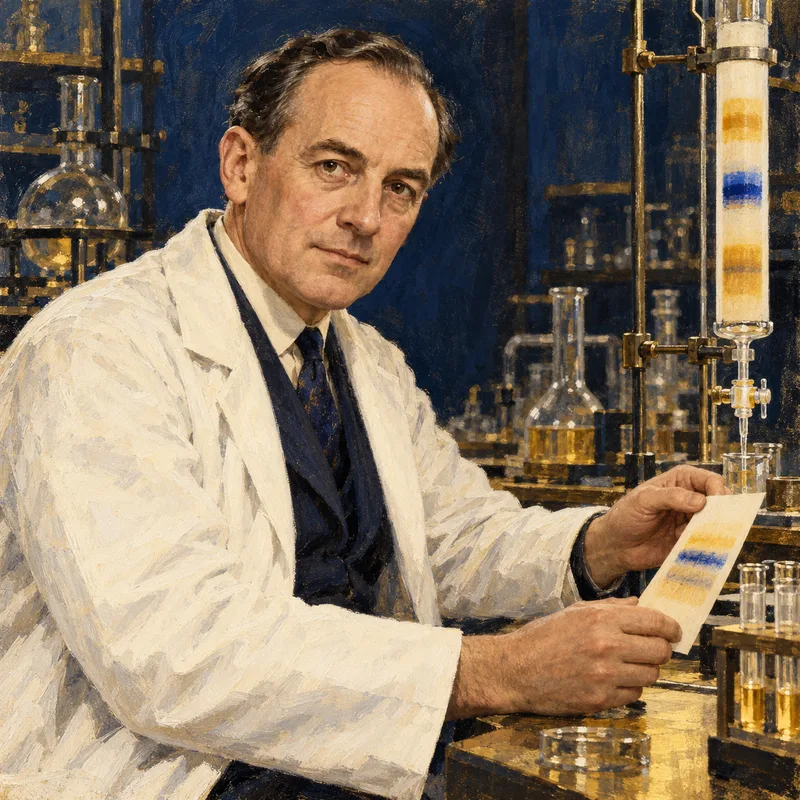
Archer Martin
1910-2002 · United Kingdom · Nobel Chemistry 1952
Partition chromatography