Biography · Chemist no. 110 of 350
Arthur Harden: Complete Life and Legacy
Introduction
Sir Arthur Harden (1865–1940) was an English biochemist who worked out the chemistry of how yeast ferments sugar. With William John Young he discovered that phosphate is essential to fermentation, that sugars are converted into phosphate esters during the process, and that yeast juice contains a small coenzyme without which its enzymes are inactive. These findings are the roots of glycolysis and of the whole idea of coenzymes. He shared the 1929 Nobel Prize in Chemistry with Hans von Euler-Chelpin. He was also a founding figure of British biochemistry, and a long-time editor of the Biochemical Journal.
Early Life and Family
Arthur Harden was born on 12 October 1865 in Manchester, England. He came from a family that encouraged education. Arthur grew up in the industrial city of Manchester, a leading centre of science and chemical industry in Victorian England.
He entered Owens College in Manchester, the institution that later became the Victoria University of Manchester. Manchester at that time had a great tradition in chemistry, from John Dalton to Henry Roscoe, and Harden benefited from this atmosphere.
Education and Mentors
At Owens College Harden studied chemistry and graduated in 1885. He then went to Germany for his doctoral work, at the University of Erlangen under Otto Fischer, where he received his PhD in 1888.
After returning to Manchester, Harden worked as a demonstrator and lecturer in chemistry at Owens College. In these years he did research in organic and physical chemistry. The skills of precise measurement and the habit of looking for quantitative relationships remained with him when he moved to biochemistry.
Career Timeline
| Year | Event |
|---|---|
| 1865 | Born in Manchester on 12 October. |
| 1885 | Graduates from Owens College, Manchester. |
| 1888 | PhD at Erlangen under Otto Fischer. |
| 1890s | Lecturer in chemistry at Owens College, Manchester. |
| 1897 | Joins the British Institute of Preventive Medicine (later the Lister Institute) in London as chemist. |
| 1905–1906 | With W. J. Young, discovers the role of phosphate and the coferment in fermentation. |
| 1909 | Elected Fellow of the Royal Society. |
| 1912 | Appointed Professor of Biochemistry at the University of London and head of the biochemical department at the Lister Institute. |
| 1914–1918 | Works on vitamins and on nutritional problems during the First World War. |
| 1929 | Shares the Nobel Prize in Chemistry. |
| 1936 | Knighted. |
| 1940 | Dies at Bourne End, Buckinghamshire, on 17 June. |
Major Scientific Contributions
- Role of phosphate in fermentation: discovered the formation of hexose diphosphate (the Harden–Young ester) during yeast fermentation. See our discovery post.
- Coenzyme concept: showed by dialysis that yeast juice has a non-dialysable enzyme fraction and a dialysable, heat-stable coferment.
- Alcoholic fermentation monograph: wrote the book Alcoholic Fermentation (1911), an influential summary of the subject, which went through several editions.
- Bacterial fermentation: studied the fermentation of sugars by bacteria such as Escherichia coli, and the products formed, which was relevant to the identification of bacteria.
- Vitamins: worked on the antineuritic vitamin (B) and the antiscorbutic vitamin (C), contributing to nutritional studies; with S. S. Zilva he studied the antiscorbutic factor in foods.
- Editor: as editor of the Biochemical Journal for many years, helped to set the standard for biochemical publication in Britain.
Awards, Honours and Nobel Prize
The Nobel Prize in Chemistry for 1929 was shared between Arthur Harden and Hans von Euler-Chelpin "for their investigations on the fermentation of sugar and of fermentative enzymes". The two men worked in different countries, England and Sweden, but their studies were closely linked. Euler-Chelpin concentrated on the structure and function of the coenzymes, especially cozymase (NAD+), while Harden showed the importance of phosphate esters.
He was elected a Fellow of the Royal Society in 1909 and was knighted in 1936.
Personality, Struggles and Lesser-Known Facts
- From organic chemist to biochemist. Harden started with organic and physical chemistry, and moved to biochemistry at the age of about thirty-two when he joined the Institute in London. It shows that one can start a new field mid-career.
- Collaboration with a younger colleague. William John Young was his assistant, and their joint papers are classic. Harden gave Young full credit, which is why the discoveries carry both names.
- Wartime service. During the First World War, he worked on nutrition problems, including food shortages and the vitamin content of foods, important for public health.
- Later years. He died in 1940, during the Second World War, at the age of seventy-four.
Legacy and Influence on Modern Chemistry
The chain of discoveries that began with Buchner and continued with Harden led to the full glycolytic pathway, worked out by Gustav Embden, Otto Meyerhof, Jakub Parnas, Carl and Gerty Cori and many others by about 1940. Meyerhof and Warburg, among others, built on the idea of coenzymes that Harden had introduced. The discovery of NAD+, ATP and coenzyme A all follow from the concept that enzymes need helper molecules.
Harden's work also helped chemists to appreciate that the chemistry of life depends on phosphate esters. ATP, DNA, RNA, phospholipids and many metabolic intermediates are phosphates. Today a school student learns that glycolysis begins with two phosphorylations, an idea first revealed by the "Harden–Young ester".
Lessons for Students
- Pay attention to when a reaction stops. Harden's key discovery came from asking why fermentation slows down.
- Separate a complex mixture into parts, then recombine them. Dialysis taught him that two factors were needed.
- Measure things quantitatively. Balancing the amounts of phosphate, CO2 and alcohol revealed the hidden ester.
- Change fields when a better problem appears.
- Credit your collaborators; shared credit makes science stronger.
Quick Facts Box
- Born: 12 October 1865, Manchester, England.
- Died: 17 June 1940, Bourne End, Buckinghamshire, England.
- Nationality: British (English).
- Field: Biochemistry.
- Famous for: Role of phosphate and coenzymes in fermentation; Harden–Young ester.
- Nobel: Chemistry, 1929 (shared with Hans von Euler-Chelpin).
FAQ
With whom did Harden share the Nobel Prize?
With Hans von Euler-Chelpin of Sweden, in 1929, for investigations on the fermentation of sugar and fermentative enzymes.
Who was William John Young?
Young was Harden's collaborator at the Lister Institute and co-author of the classic 1905–1906 papers on phosphate and the coferment in fermentation.
Where did Harden work?
He worked first at Owens College in Manchester, and from 1897 at the Lister Institute in London, where he also held a professorship in the University of London.
Why is he important for exams?
Questions on coenzymes, glycolysis intermediates and the history of fermentation often refer to Buchner, Harden and Young, and Embden–Meyerhof–Parnas.
Published by ABC Chemistry — IIT-JAM | CSIR-NET | GATE Chemistry Coaching. Visit abcchemistry.com
About the chemist
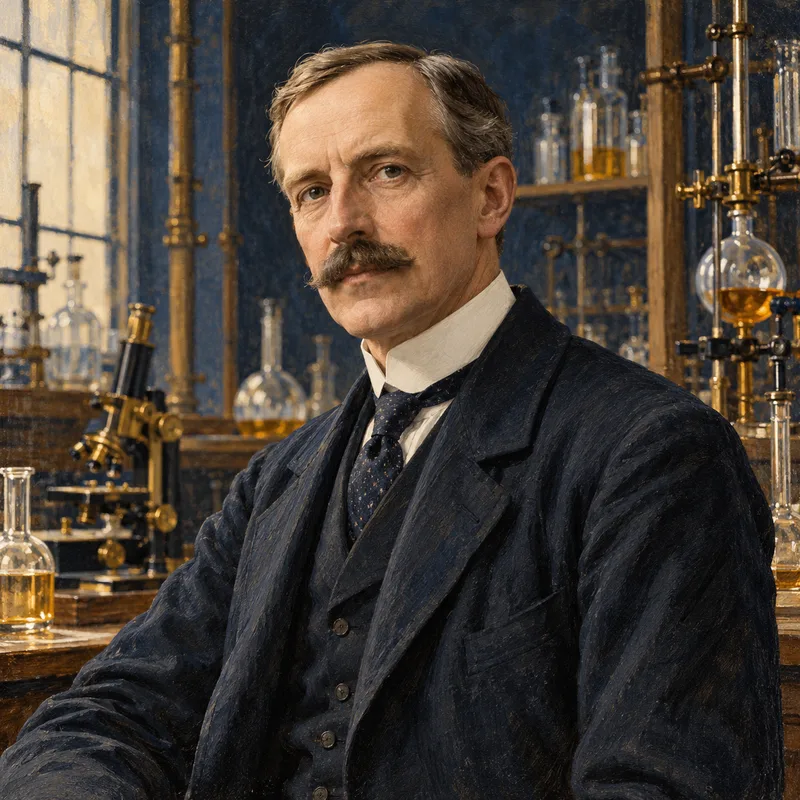
Arthur Harden
1865-1940 · United Kingdom · Nobel Chemistry 1929
Fermentation of sugars and coenzymes