The discovery, explained · Chemist no. 110 of 350
Arthur Harden: Phosphate, Coenzymes and the Chemistry of Fermentation
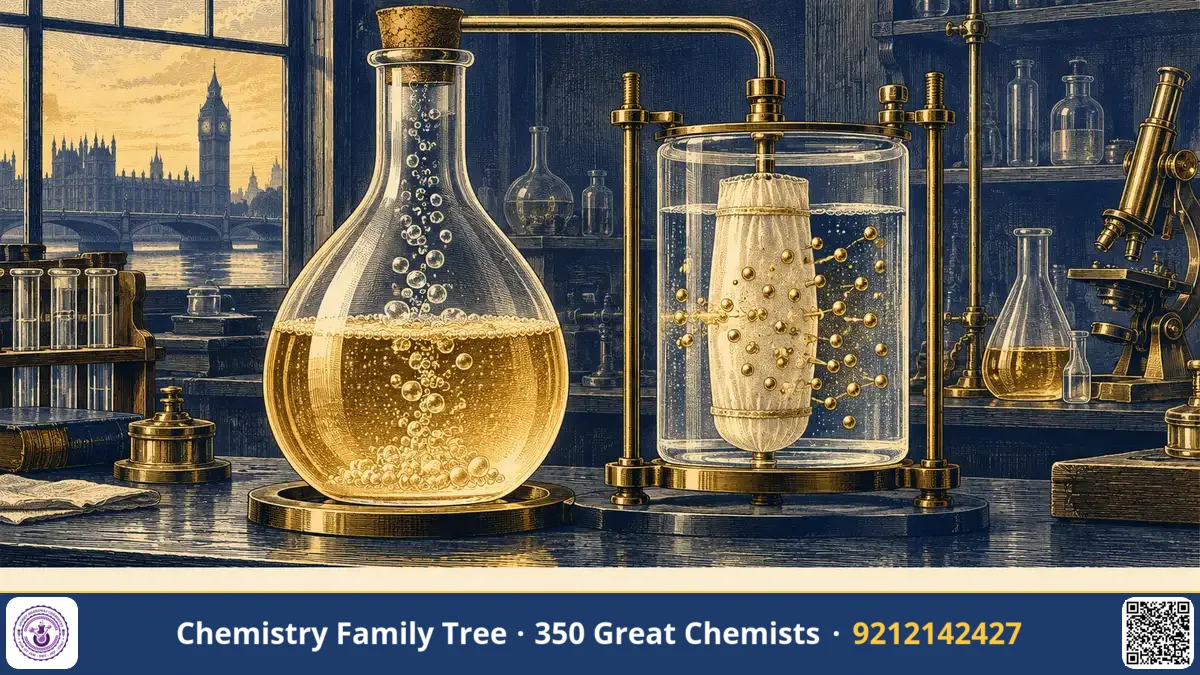
In 1897 Eduard Buchner showed that juice pressed from yeast could ferment sugar without any living cell. That result opened the door, but it left a huge question: what exactly is in the juice, and how does it work? The English biochemist Arthur Harden, working with his young assistant William John Young at the Lister Institute in London, walked through that door. In 1905–1906 they found two surprising things. First, fermentation by yeast juice needs inorganic phosphate, which becomes attached to sugar to form a new compound, hexose diphosphate. Second, the juice contains a small, heat-stable molecule, a coenzyme, that can be separated from the enzymes by dialysis, and without which the enzymes do nothing. These discoveries became the base of glycolysis. Harden shared the 1929 Nobel Prize in Chemistry with Hans von Euler-Chelpin for investigations of the fermentation of sugar and of fermentative enzymes.
The Scientific Problem Before the Discovery
Louis Pasteur had written the overall fermentation equation, and Buchner had shown that the enzymes can work outside cells. But when chemists tried to study yeast juice, the fermentation behaved strangely. It began briskly, then slowed down and stopped within an hour or so, even though plenty of sugar was still present. Adding fresh yeast juice did not always restart it. Chemists had no good explanation. Was the enzyme being destroyed? Was a poison building up? Were the enzymes being used up?
Another puzzle was that in the living yeast cell, fermentation can continue for days. Why should the cell-free juice be so short-lived? Harden suspected that something was being consumed during the reaction, and that the cell supplied this missing component. He decided to look for what the juice was running out of, and he also thought about what happens to the sugar, since it was already known that the amount of carbon dioxide produced seemed to be governed by something other than the sugar.
The Discovery: Step by Step
- Observation of the slowing. Harden and Young prepared yeast juice by Buchner's method (grinding and pressing) and measured fermentation by the carbon dioxide evolved from added glucose. The evolution of gas was rapid at first and then declined.
- The phosphate experiment (1905). They added a soluble phosphate, such as sodium or potassium phosphate. The rate of fermentation rose sharply again. Strikingly, the added phosphate disappeared from the solution as inorganic phosphate: it had been converted into an organic form that could not be precipitated by magnesium mixture.
- Isolation of the ester. From the solution they isolated an organic phosphate compound, which they identified as a hexose diphosphate, a sugar carrying two phosphate groups. It is now known as fructose 1,6-bisphosphate and is called the Harden–Young ester.
- The balanced equation. They showed that the amount of CO2 and alcohol produced was linked to the phosphate used, in a fixed ratio.
- Dialysis (1906). Next they took yeast juice and placed it in a bag of parchment or collodion membrane in water, a process called dialysis. Small molecules passed out, while large enzymes stayed inside. Neither the retained portion nor the dialysate alone could ferment sugar. But when they were mixed again, fermentation was restored.
- Heat test. Boiling the dialysate did not destroy its activity, while boiling the retained fraction did. So the juice contained a heat-stable, dialysable component (the coferment) and a heat-labile, non-dialysable component (the enzymes).
The Chemistry Behind It
The overall equation they established for fermentation in the presence of phosphate is:
2 C6H12O6 + 2 HPO4²⁻  →  2 C2H5OH + 2 CO2 + C6H10O4(OPO3²⁻)2 + 2 H2O
glucose      phosphate      ethanol    carbon     hexose diphosphate
                                      dioxide
Here, two of the sugar molecules are fermented to ethanol and carbon dioxide, and the energy and phosphate are used to make one molecule of hexose diphosphate from another. The ester then is slowly broken down by an enzyme, a phosphatase, which releases the phosphate again so that fermentation can continue:
Hexose diphosphate + 2 H2O → Hexose + 2 HPO4²⁻
The point is that phosphate acts like a catalyst: it is used up in forming the ester and released later. The stopping of the juice's activity happens when the phosphate is tied up in the ester and the phosphatase is too slow to return it.
We now know why. The first steps of glycolysis are:
- Glucose + ATP → glucose 6-phosphate + ADP (hexokinase).
- Glucose 6-phosphate → fructose 6-phosphate (isomerase).
- Fructose 6-phosphate + ATP → fructose 1,6-bisphosphate + ADP (phosphofructokinase).
Harden and Young's hexose diphosphate is the fructose 1,6-bisphosphate of this scheme. Later, the "coferment" was shown to be a mixture of molecules, including NAD+ (once called cozymase, and studied by Hans von Euler-Chelpin and by Otto Warburg), together with ATP, ADP and magnesium ions. NAD+ is needed in the oxidation of glyceraldehyde 3-phosphate and is regenerated when acetaldehyde is reduced to ethanol by alcohol dehydrogenase.
Harden's work was the first demonstration that:
- Phosphorylation of sugars is a necessary early step of fermentation.
- Enzymes can need a small, dissociable helper molecule (a coenzyme), a concept central to biochemistry and vitamin research, since many vitamins are coenzyme precursors (niacin gives NAD+; thiamine gives TPP).
Applications Today
- Understanding metabolism: glycolysis, the starting point of cellular energy production, is taught from this foundation.
- Nutrition and vitamins: the coenzyme concept explains why deficiencies of B vitamins (niacin, thiamine, riboflavin) cause disease. Harden himself later worked on vitamin B and vitamin C.
- Clinical biochemistry: enzyme assays often use NAD+/NADH absorbance at 340 nm to follow reactions, the basis of many tests for liver enzymes and glucose.
- Bioethanol and brewing: control of phosphate and nutrients in industrial fermentation; India's sugar mills produce ethanol from molasses.
- Dialysis: the same separation by membrane is used in kidney dialysis machines and in protein purification.
Exam Corner
- Arthur Harden shared the 1929 Nobel Prize in Chemistry with Hans von Euler-Chelpin for investigations on the fermentation of sugar and of fermentative enzymes.
- Harden–Young ester: fructose 1,6-bisphosphate (hexose diphosphate); formed during alcoholic fermentation in presence of inorganic phosphate.
- Coenzyme: a small, heat-stable, dialysable organic molecule needed by an enzyme (apoenzyme + coenzyme = holoenzyme).
- Examples: NAD+, FAD, coenzyme A, TPP, pyridoxal phosphate; many derive from vitamins.
- Net glycolysis: glucose + 2 NAD+ + 2 ADP + 2 Pi → 2 pyruvate + 2 NADH + 2 ATP + 2 H2O + 2 H+.
Common Misconceptions
- "A coenzyme is a type of enzyme." It is a small organic cofactor, not a protein.
- "Phosphate is consumed permanently." It is incorporated into intermediates and later released.
- "Harden discovered glycolysis." He discovered key steps; the full pathway was completed by Embden, Meyerhof, Parnas and others.
Quick Revision Box
- Harden and Young: 1905–1906, Lister Institute, London.
- Phosphate is needed for fermentation; hexose diphosphate (fructose 1,6-bisphosphate) is formed.
- Dialysis separates juice into a dialysable coferment and non-dialysable enzymes.
- Coferment later identified as NAD+ and related cofactors.
- Shared 1929 Nobel Prize in Chemistry with Euler-Chelpin.
- Built on Buchner's cell-free fermentation (1897).
FAQ
What is dialysis and why was it important here?
Dialysis separates small molecules from large ones through a semi-permeable membrane. It allowed Harden and Young to split yeast juice into enzyme and coenzyme parts.
What is a coferment?
It is the early name of a coenzyme. Harden used it for the heat-stable, dialysable factor required by yeast juice.
Why is phosphorylation of sugars necessary?
It traps the sugar inside the cell as a charged molecule, activates it for further reactions and later helps to make ATP.
How are Harden and Buchner related?
Buchner showed that cell-free juice ferments. Harden showed what the juice needs to do so, thereby turning a discovery into a chemical mechanism.
Published by ABC Chemistry — IIT-JAM | CSIR-NET | GATE Chemistry Coaching. Visit abcchemistry.com
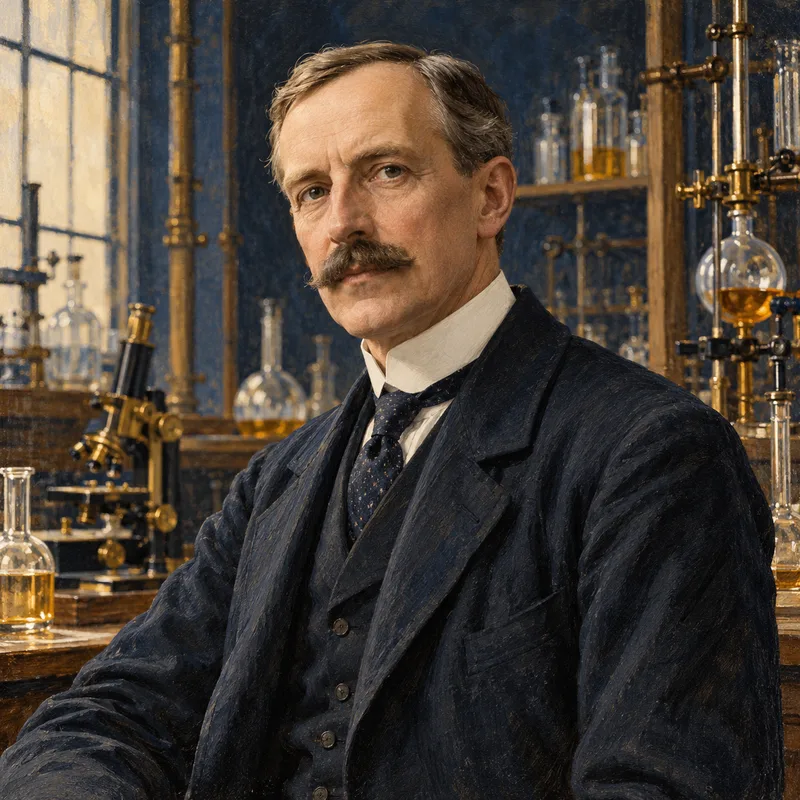
About the chemist
Arthur Harden
1865-1940 · United Kingdom · Nobel Chemistry 1929
Fermentation of sugars and coenzymes