Biography · Chemist no. 318 of 350
Arthur Kornberg: Complete Life and Legacy of the DNA Enzymologist
Arthur Kornberg (1918-2007) was an American biochemist who discovered DNA polymerase and showed that DNA can be copied in a test tube. He won the 1959 Nobel Prize in Physiology or Medicine, sharing it with Severo Ochoa. His legacy: he made the chemistry of heredity something that could be purified, measured and understood, and he trained a generation of leading scientists. His son Roger later won the 2006 Nobel Prize in Chemistry.
Early Life and Family
Arthur Kornberg was born on 3 March 1918 in Brooklyn, New York. His parents were Jewish immigrants from Galicia, in Eastern Europe. His father, Joseph, worked as a sewing-machine operator and later ran a small hardware store, and his mother, Lena, helped in the shop. The family lived in a modest flat behind the store, and money was always short. Arthur was a keen student; he went to Abraham Lincoln High School in Brooklyn, graduated at 15, and worked his way through college. He sold newspapers and did odd jobs as a child. He later said that the poor early years gave him a sense of discipline and a taste for hard work.
Education and Mentors
Kornberg studied at the City College of New York, graduating in 1937 with a degree in biology and chemistry. He then went to the University of Rochester School of Medicine and received his M.D. in 1941. He did an internship at the Strong Memorial Hospital, then served as a ship's doctor in the US Coast Guard during the Second World War. A reading of research on vitamins and a chance to study the effect of a diet-based deficiency led him toward research. He worked at the National Institutes of Health (NIH) in Bethesda, where he met enzyme researchers. He then took a period of training with Severo Ochoa at New York University (1946), and with Carl and Gerty Cori at Washington University in St Louis (1947). These experiences taught him modern methods of enzyme purification. He later said that each of these mentors helped to make him a "biochemist".
Career Timeline
| Year | Event |
|---|---|
| 1918 | Born in Brooklyn, New York |
| 1937 | B.S., City College of New York |
| 1941 | M.D., University of Rochester |
| 1942-1945 | Served as a ship's doctor, then NIH research on nutrition |
| 1946-1947 | Trained with Ochoa (New York) and the Coris (St Louis) |
| 1953 | Professor and head of microbiology, Washington University |
| 1956 | Discovered DNA polymerase I |
| 1959 | Moved to Stanford University as head of the new biochemistry department; Nobel Prize in Physiology or Medicine |
| 1967 | Synthesised biologically active viral DNA (phi X174) with Mehran Goulian and Robert Sinsheimer |
| 1970s-80s | Studied DNA replication in E. coli, the origin oriC and the replication machinery |
| 1988 | Retired as head of department; continued research on inorganic polyphosphate |
| 2007 | Died on 26 October in Stanford, California |
Major Scientific Contributions
- Nucleotide coenzymes: Showed how NAD+ and FAD are synthesised from nucleotide building blocks, and developed ideas of activated intermediates and pyrophosphate release.
- DNA polymerase I: The first enzyme that makes DNA; showed the roles of template and primer.
- Synthetic viral DNA: In 1967 his team synthesised the DNA of the phage phi X174 in a test tube, using the polymerase together with the enzyme DNA ligase (discovered in several laboratories), and showed that it was infective. The press called this "life in a test tube", which Kornberg himself regarded as an overstatement.
- Replication machinery: Later work with E. coli identified the proteins required to start and carry out replication.
- Polyphosphate: Late-career work on inorganic polyphosphate in bacteria.
Read the full explanation in our discovery blog on DNA polymerase.
Awards, Honours and Nobel Prize
The 1959 Nobel Prize in Physiology or Medicine went to Arthur Kornberg and Severo Ochoa "for their discovery of the mechanisms in the biological synthesis of ribonucleic acid and deoxyribonucleic acid". Kornberg also received the US National Medal of Science (1979), the Paul-Lewis Award in Enzyme Chemistry, and many honorary degrees, and was a member of the National Academy of Sciences. A notable family record is that his son Roger D. Kornberg won the 2006 Nobel Prize in Chemistry for studies of the molecular basis of eukaryotic transcription, making them one of a few father-son Nobel pairs.
Personality, Struggles and Lesser-Known Facts
- Ten commandments of enzymology: He was famous for his commandments, such as "Don't waste clean thinking on dirty enzymes" and "Rely on enzymes", and he wrote an influential autobiography, For the Love of Enzymes (1989).
- Humble origins: His parents never went to university; yet he became a Nobel laureate.
- Family of scientists: He married Sylvy Levy, a biochemist who collaborated with him on research until her death in 1986. Their three sons all pursued science or related fields, one of whom is Roger. He later married Charlene Walsh Levering.
- Disappointment on the way: His grant proposals on DNA synthesis faced doubt, and his first experiments gave very small yields. He persisted for years.
- A principled stand: He was concerned about the commercial pressures on scientific research, and he warned that curiosity-driven science would suffer if it was only judged by short-term profit.
- Active at ninety: He kept going to the laboratory on most days into his late eighties.
Legacy and Influence on Modern Chemistry
Kornberg's laboratory at Stanford trained dozens of biochemists, including Paul Berg (Nobel Prize in Chemistry 1980) who worked in his department. The tools and methods that came out of his work, such as DNA ligase, polymerase and nick translation, helped make recombinant DNA technology possible. His 1956 discovery set the pattern for the later discoveries of reverse transcriptase and RNA polymerase. Most visibly, Taq polymerase, a thermostable cousin of E. coli Pol I, powers the PCR machines used across Indian hospitals and research laboratories.
Lessons for Students
- Purify, then think. Clean preparations avoid confusion; this is a lesson for every chemistry practical.
- Be patient with small yields. The first DNA synthesis was almost invisible, but he trusted the assay.
- Learn from different masters. He trained in medicine, nutrition, enzymology and microbiology.
- Humble beginnings are no barrier. The son of an immigrant shopkeeper won a Nobel Prize through effort and curiosity.
Quick Facts Box
- Born: 3 March 1918, Brooklyn, New York
- Died: 26 October 2007, Stanford, California
- Nationality: American
- Field: Biochemistry, enzymology of DNA
- Famous for: DNA polymerase I, in vitro DNA synthesis
- Nobel: 1959, Physiology or Medicine (shared with Severo Ochoa)
FAQ
Did Arthur Kornberg win the Chemistry Nobel?
No, his prize was in Physiology or Medicine (1959). His son Roger won the 2006 Nobel Prize in Chemistry.
What is Kornberg's famous book?
For the Love of Enzymes: The Odyssey of a Biochemist (1989) is his autobiography, and he also wrote the multi-volume reference DNA Replication.
Who were Kornberg's mentors?
Severo Ochoa in New York and Carl and Gerty Cori in St Louis shaped his career in enzymology.
Where did Kornberg work for most of his career?
At Washington University in St Louis (1953-1959) and then at Stanford University, where he built the biochemistry department.
Published by ABC Chemistry — IIT-JAM | CSIR-NET | GATE Chemistry Coaching. Visit abcchemistry.com
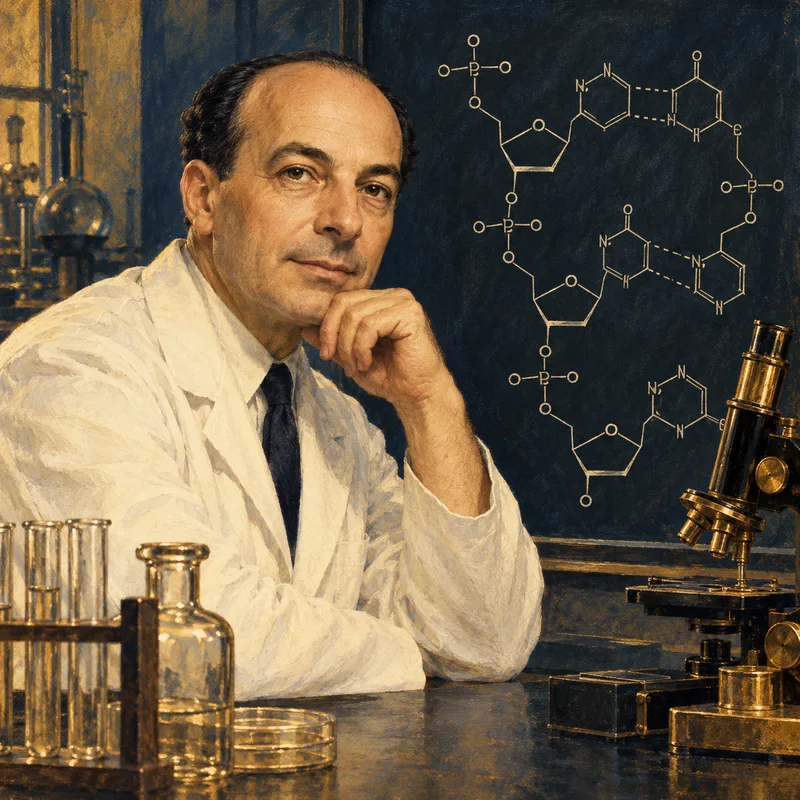
About the chemist
Arthur Kornberg
1918-2007 · United States · Nobel Physiology/Medicine 1959
Enzymatic synthesis of DNA; DNA polymerase