The discovery, explained · Chemist no. 318 of 350
Arthur Kornberg and DNA Polymerase: Building DNA in a Test Tube
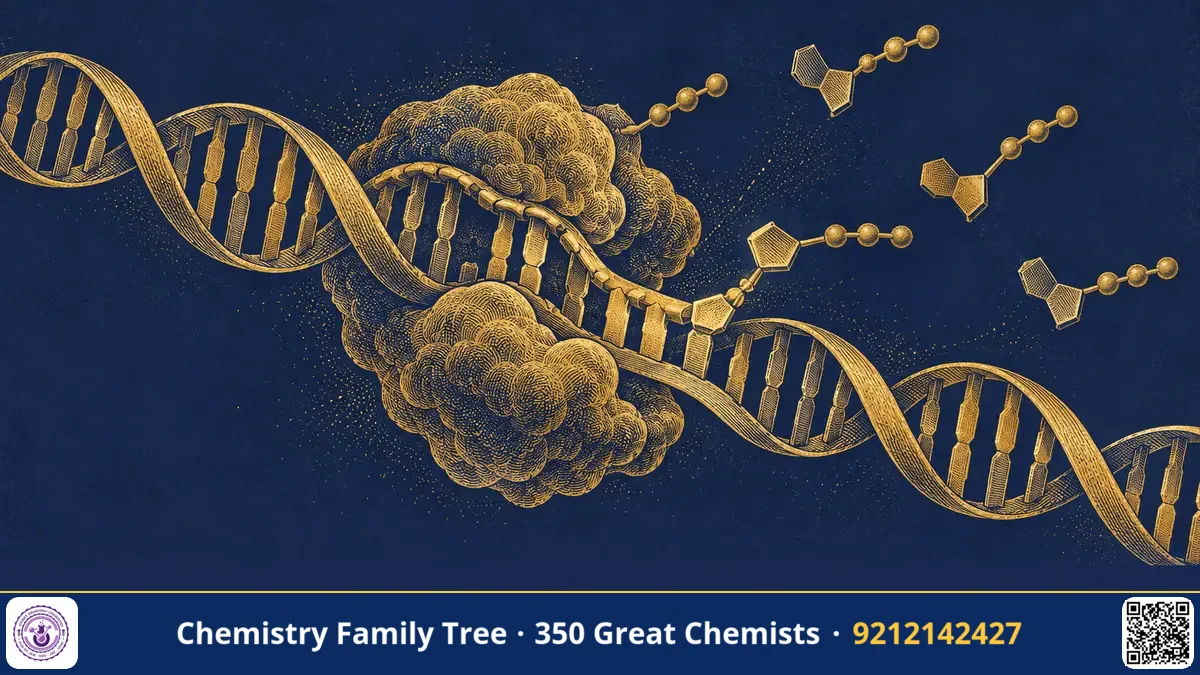
In 1956 the American biochemist Arthur Kornberg (1918-2007) and his team at Washington University in St Louis showed that an enzyme from the bacterium Escherichia coli could assemble new DNA from its building blocks. The enzyme, now called DNA polymerase I, copies a template strand and builds a new strand with the same sequence. Kornberg proved for the first time that DNA can be made by a purified enzyme, outside a living cell. For this he shared the 1959 Nobel Prize in Physiology or Medicine with Severo Ochoa. His discovery gave the first molecular picture of how genes are copied, and led directly to PCR, DNA sequencing and genetic engineering.
The Scientific Problem Before the Discovery
In 1953 Watson and Crick suggested that the double helix could be copied by separating the strands and using each as a template. This was a beautiful idea but only an idea. Nobody knew what enzyme made DNA, what building blocks it needed, or whether a template was necessary. Many scientists doubted that the long DNA molecule could be made in a test tube at all. They suspected that the process was too complex and linked to the living cell.
Kornberg had worked on how coenzymes such as NAD+ and FAD are made, and found that activated nucleotides were involved in making them. He applied the same logic: a chain-building enzyme should use activated nucleotides, with the pyrophosphate released as the driving force. He decided to search for the enzyme of DNA synthesis.
The Discovery / Experiment
Step 1: Design of a sensitive assay
Kornberg's method was simple but clever. He used building blocks labelled with radioactive carbon-14 or tritium, in the form of thymidine. Labelled thymidine was first converted into thymidine 5'-triphosphate. If an enzyme builds DNA, the labelled units would become part of a large molecule that is insoluble in acid and stays on the filter when small molecules are washed away. He measured radioactivity in the acid-insoluble material.
Step 2: Purification from E. coli
He ground E. coli cells and fractionated the extract through many purification steps, using precipitation and column chromatography. After years of work, he and his students, including Robert Lehman, Maurice Bessman and Ernest Simms, obtained a pure enzyme that produced a small amount of acid-insoluble labelled material. The early activity was just a tiny fraction of a percent of the starting material, but it was repeatable. Kornberg's rule, "Don't waste clean thinking on dirty enzymes", encouraged purification before interpretation.
Step 3: Requirements of the reaction
The reaction needs four things: all four deoxynucleoside triphosphates (dATP, dGTP, dCTP, dTTP), Mg2+ ions, a DNA template, and a primer with a free 3'-OH group. The overall reaction is:
(dNMP)n + dNTP  →  (dNMP)n+1 + PPi
DNA chain (n units)   incoming nucleotide   chain extended by one unit
The new nucleotide is added at the 3' end of the chain, so DNA grows in the 5' to 3' direction. The 3'-OH of the last nucleotide attacks the α-phosphate of the incoming dNTP, forming a phosphodiester bond and releasing pyrophosphate. The pyrophosphate is split by pyrophosphatase into two phosphate ions, making the process effectively irreversible in the cell.
Step 4: Does it copy faithfully?
Kornberg's team checked that the new DNA was an exact copy by examining the base composition and the nearest-neighbour frequencies. The composition of the product matched that of the template, not that of a random mix, even when the template was from different species (with the A/T ratio varying over a wide range). This proved that the template, and not the enzyme, determines the sequence, as predicted by Watson-Crick base pairing: A pairs with T through two hydrogen bonds, G pairs with C through three.
Step 5: Later understanding
In 1969 a mutant bacterium lacking polymerase I (isolated by De Lucia and Cairns) was still able to replicate its DNA, and so polymerase I could not be the main replicating enzyme. Kornberg's group then found polymerase II and III. DNA polymerase III is the main replicative enzyme in E. coli, while polymerase I is involved in repair and in removing RNA primers. Despite this, Kornberg's work had shown the way.
The Chemistry Behind It
- Template and primer: DNA polymerases cannot start a chain from nothing; they need a 3'-OH to extend.
- Three activities of Pol I: 5'→3' polymerase, 3'→5' exonuclease (proofreading), and 5'→3' exonuclease (removes primer or damaged DNA).
- Klenow fragment: Pol I treated with subtilisin gives a large fragment, which has the polymerase and proofreading activities but not the 5'→3' exonuclease, widely used in laboratories.
- Fidelity: base pairing and proofreading keep the error rate near one in 107 for Pol I and much lower overall with repair.
- Metal-ion catalysis: Two Mg2+ ions at the active site stabilise the negative charge in the transition state and help the 3'-OH attack.
- Energy: The cleavage of the high-energy triphosphate with release of PPi, followed by hydrolysis of PPi, drives the polymerisation.
Applications Today
- Sanger sequencing: The Klenow fragment and later enzymes were used in the dideoxy chain-termination method.
- PCR: Taq DNA polymerase, a heat-stable relative of Pol I from Thermus aquaticus, copies DNA in the polymerase chain reaction, used in India for COVID-19 testing, TB diagnosis and forensic tests.
- Molecular cloning: Filling in ends of restriction fragments, labelling DNA by nick translation and site-directed mutagenesis.
- Cancer therapy and antivirals: Drugs such as acyclovir and zidovudine (AZT) work as chain terminators of viral DNA polymerases and reverse transcriptase.
- Biotechnology industry: Indian biotech firms make recombinant polymerases for diagnostic kits.
Exam Corner
- DNA polymerase I adds nucleotides to the 3'-OH end (5'→3' synthesis) and needs template, primer, four dNTPs and Mg2+.
- Pol I has 5'→3' polymerase, 3'→5' proofreading exonuclease and 5'→3' exonuclease activity. Klenow fragment lacks the last.
- Main replicative enzyme in E. coli is DNA polymerase III; Pol I removes RNA primers and fills gaps.
- Kornberg shared the 1959 Nobel Prize in Physiology or Medicine with Ochoa.
- Pyrophosphate released is hydrolysed by inorganic pyrophosphatase, making the reaction irreversible.
Common Misconceptions
- "Pol I is the main replication enzyme." It is not; Pol III does most of the work in E. coli.
- "DNA polymerase can start a new chain." It cannot. It needs a primer, which in cells is made by primase as a short RNA.
- "Kornberg's Nobel Prize was in Chemistry." It was in Physiology or Medicine. His son Roger Kornberg won the Nobel Prize in Chemistry in 2006.
Quick Revision Box
- Year of DNA polymerase discovery: 1956 (E. coli), Washington University.
- Substrates: dATP, dGTP, dCTP, dTTP; product: DNA + PPi.
- Needs template, primer with free 3'-OH, and Mg2+.
- Direction: 5' to 3'.
- Klenow fragment = Pol I minus 5'→3' exonuclease.
- Nobel Prize 1959, Physiology or Medicine, with Severo Ochoa.
FAQ
What did Arthur Kornberg discover?
DNA polymerase I, the first enzyme shown to synthesise DNA from nucleotides in a test tube, using a template.
Why did the mutant without Pol I survive?
Because other enzymes, mainly Pol III, carry out the main replication, which showed that Pol I is mostly for repair and primer removal.
What is the Klenow fragment used for?
It is used for filling in DNA ends, labelling DNA and in older sequencing and cloning methods because it has polymerase and proofreading activities but no 5'→3' exonuclease.
How is this topic asked in IIT-JAM or CSIR-NET?
Questions typically cover polymerase requirements, direction of synthesis, proofreading, Okazaki fragments and the role of Pol I and Pol III in bacteria.
Published by ABC Chemistry — IIT-JAM | CSIR-NET | GATE Chemistry Coaching. Visit abcchemistry.com
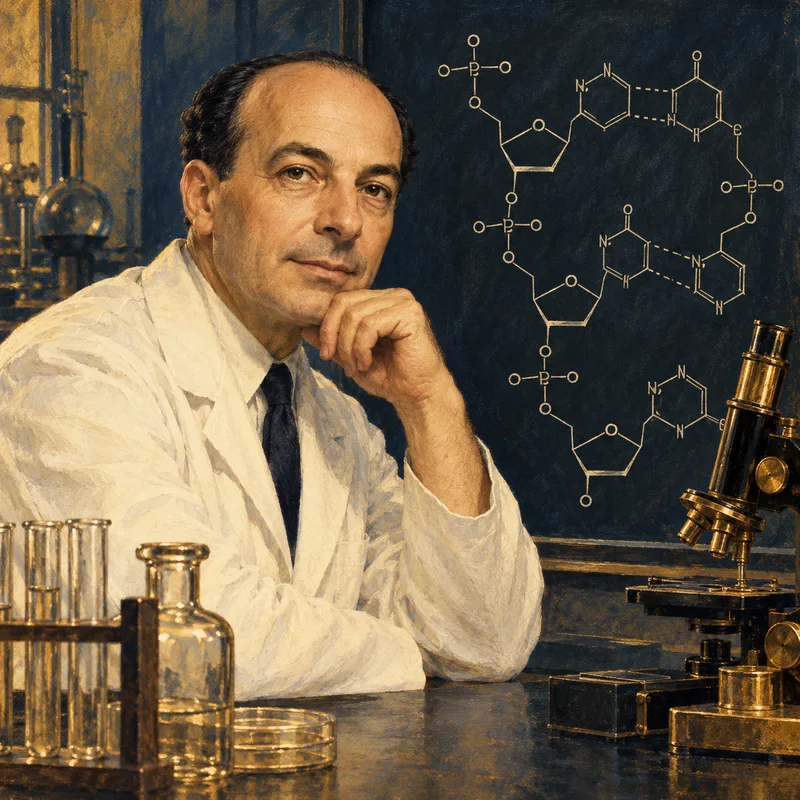
About the chemist
Arthur Kornberg
1918-2007 · United States · Nobel Physiology/Medicine 1959
Enzymatic synthesis of DNA; DNA polymerase