Biography · Chemist no. 289 of 350
Arthur Lapworth (1872–1941): The Quiet Founder of Mechanistic Organic Chemistry
Introduction
Arthur Lapworth was a British organic chemist whose measurements of reaction rates opened a new way of understanding how molecules react. At a time when most organic chemists were making new compounds, Lapworth asked a different question: what happens between the reactants and the products? His answers on cyanohydrin formation and on the halogenation of ketones were among the earliest true mechanistic studies, and his ideas about electronic displacement influenced Robert Robinson and Christopher Ingold. In one line: Lapworth was the thinker who taught organic chemistry to follow the electrons.
Early Life & Family
Arthur Lapworth was born in 1872 in Galashiels, in the Scottish Borders. His father, Charles Lapworth, was a schoolmaster and a gifted geologist who became famous for solving the geology of the Scottish Southern Uplands using graptolite fossils, and who later became professor of geology at Mason College in Birmingham. Growing up in a scientific household, Arthur saw the value of careful observation and patient reasoning from his earliest years. The family moved to Birmingham when Charles Lapworth took up his post there.
Education & Mentors
Arthur Lapworth studied chemistry at Mason College (the forerunner of the University of Birmingham) and then at the Central Technical College in London (the City and Guilds institution), where he worked under Henry Armstrong, an energetic teacher and critic who championed the idea that chemists should explain reactions and not only describe them. Armstrong's influence on Lapworth's habit of questioning was lasting. He then took up a position teaching at Goldsmiths' Institute in London, where he carried out his first important investigations alongside his teaching duties.
Career Timeline
| Year | Event |
|---|---|
| 1872 | Born in Galashiels, Scotland |
| 1890s | Studies at Mason College and the Central Technical College in London |
| c. 1900 | Teaches at Goldsmiths' Institute, London, and begins independent research |
| 1903 | Publishes the study of cyanohydrin formation |
| 1904 | Shows that bromination of acetone is independent of bromine concentration |
| 1909 | Moves to Manchester University |
| 1910 | Elected Fellow of the Royal Society |
| 1913 | Becomes professor of organic chemistry at Manchester |
| 1920s | Develops ideas on alternating polarity and electron displacement |
| 1935 | Retires from Manchester |
| 1941 | Dies on 5 April in Manchester |
Major Scientific Contributions
- Cyanohydrin mechanism: showing that cyanide ion, not HCN, is the nucleophile and that carbonyl addition proceeds in two steps.
- Enolisation as a slow step: showing that halogenation of acetone is zero order in halogen and first order in acid, evidence for the enol intermediate.
- Electronic theory: proposing that conjugated systems show alternating polarity when influenced by a reacting centre, and introducing the terms anionoid and cationoid.
- Key-atom ideas: the concept that the first atom to react in a molecule creates polarity in the rest of the chain, a precursor of modern ideas of inductive and mesomeric effects.
- Teaching mechanism in practice: training students who carried mechanistic thinking into industry and universities.
For the mechanisms, see our companion discovery post on Arthur Lapworth.
Awards, Honours & Nobel Prize
Lapworth did not win a Nobel Prize. He was elected a Fellow of the Royal Society in 1910 and later received the Society's Davy Medal and a Royal Medal, reflecting how highly British scientists valued his work. He held the chair of organic chemistry at Manchester, one of the most distinguished posts in British chemistry.
Personality, Struggles & Lesser-Known Facts
- Son of a famous geologist. His father Charles Lapworth is one of the great figures of geology, and the Ordovician period of the geological time scale was proposed by him.
- A modest, reserved scientist. Colleagues described him as quiet and thoughtful; his influence spread more through ideas and students than through public presence.
- Colleague of Robert Robinson. Robinson, who won the 1947 Nobel Prize in Chemistry, was a professor at Manchester during Lapworth's years there, and the two exchanged ideas on the electronic theory of reactions.
- Ideas ahead of the tools. Lapworth proposed polarity effects before the electron was fully integrated into chemical bonding theory, and before quantum mechanics.
- A Manchester tradition. A lively tradition of organic chemistry grew up around him in Manchester, and his students carried the mechanistic approach into universities and industry.
- Priority question. Recognition of his priority in the electronic theory was sometimes overshadowed by the more vocal Ingold and Robinson, and historians now give him more credit than he received at the time.
Legacy & Influence on Modern Chemistry
Lapworth's legacy is the habit of thinking that every student of organic chemistry uses: write the mechanism, identify the rate-determining step, and check it against kinetic data. His cyanohydrin and acetone studies are standard examples in textbooks. The idea of electron-rich and electron-poor sites, the movement of electrons toward electronegative atoms, and the use of rate laws to deduce mechanisms flow directly from his approach. The later work of Ingold on SN1/SN2 and E1/E2 mechanisms, and Robinson's curved-arrow notation, built on the foundation that Lapworth set. In Indian syllabi, mechanisms and kinetics, covered in the JAM, NET and GATE papers, are the direct descendants of this approach.
Lessons for Students
- Do not just memorise products. Ask how and why the reaction happens.
- Measure something: rate data can reveal the mechanism better than guesswork.
- Quiet, careful work can have enormous influence; fame is not required.
- Learn from mentors, but think independently, as Lapworth did with Armstrong's ideas.
- Be generous with ideas; they live on in the students who use them.
Quick Facts Box
- Born: 1872, Galashiels, Scotland
- Died: 5 April 1941, Manchester, England
- Nationality: British (Scottish-born)
- Field: Organic and physical organic chemistry
- Famous for: Mechanisms of cyanohydrin formation and ketone halogenation; electronic theory of organic reactions
- Nobel Prize: None
FAQ
Who was Arthur Lapworth's famous father?
Charles Lapworth, the geologist known for his work on graptolites and for proposing the Ordovician period.
Which university did Lapworth teach at?
He moved to the University of Manchester in 1909 and later held the chair of organic chemistry there.
Did Lapworth win the Nobel Prize?
No, although his Manchester colleague Robert Robinson did, in 1947.
What is Lapworth known for?
For the first detailed mechanisms of cyanohydrin formation and acid-catalysed halogenation of ketones, and for early electronic theories of organic reactivity.
Published by ABC Chemistry — IIT-JAM | CSIR-NET | GATE Chemistry Coaching. Visit abcchemistry.com
About the chemist
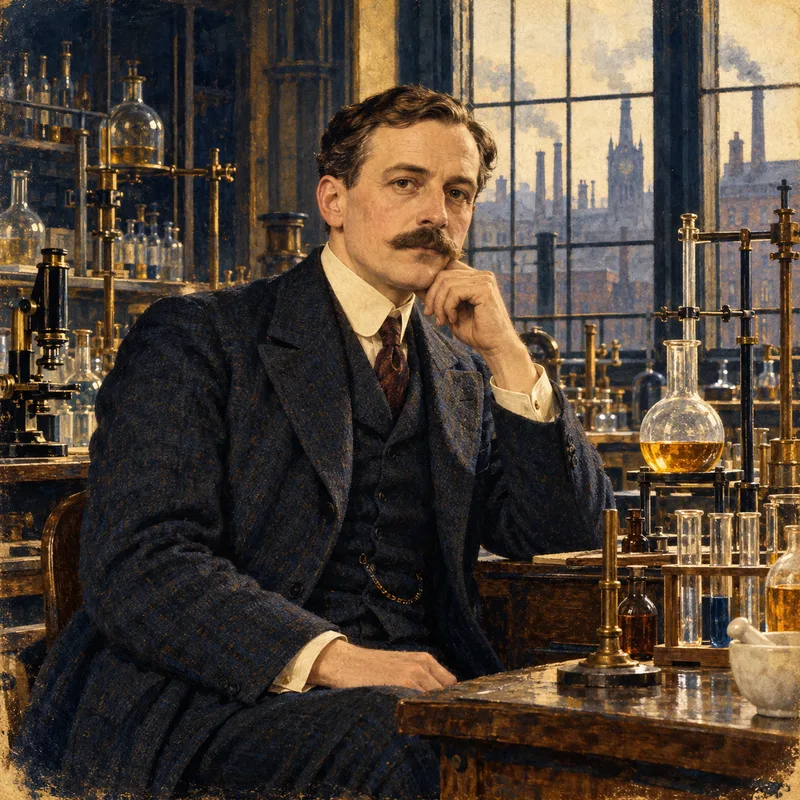
Arthur Lapworth
1872-1941 · United Kingdom
Electronic theory of organic reaction mechanisms