The discovery, explained · Chemist no. 289 of 350
Arthur Lapworth: The Man Who Taught Organic Chemists to Think in Mechanisms
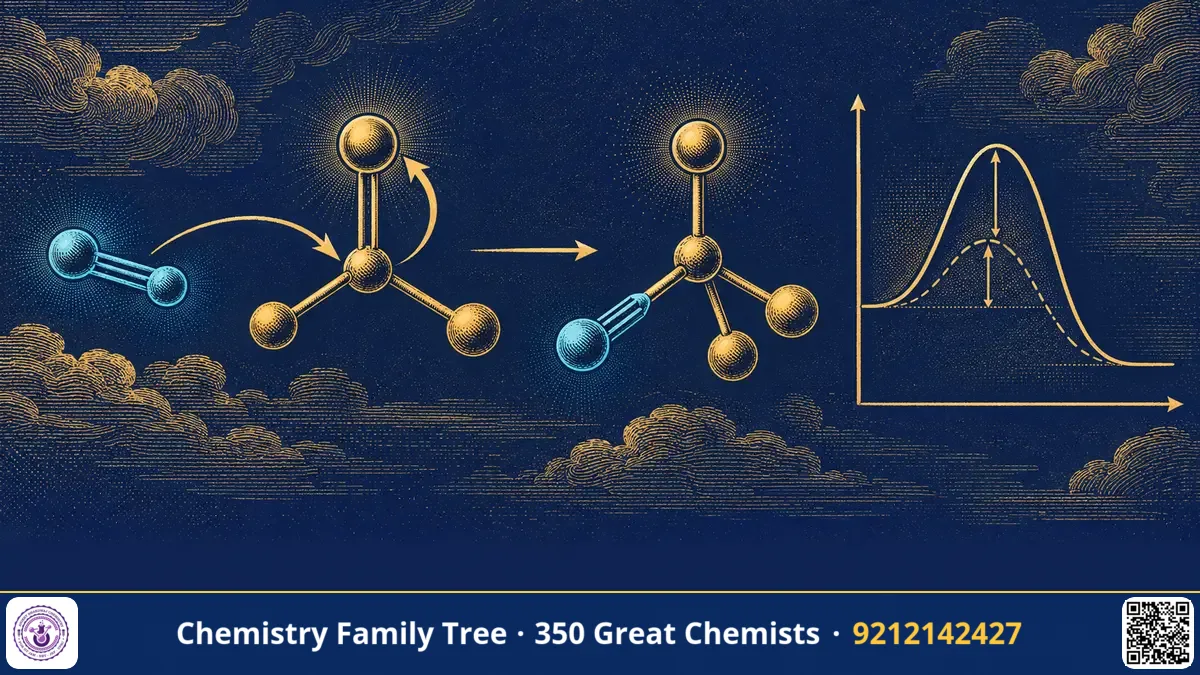
Today every chemistry student learns that a nucleophile attacks a carbonyl carbon and that the reaction proceeds in steps. In the early years of the twentieth century this was not obvious. Organic chemistry was mostly a science of recipes: mix these reagents, get that product. Arthur Lapworth, a British chemist, changed this by measuring how fast reactions go and asking what the rate tells us about the path. His work on cyanohydrin formation (1903) and on the halogenation of ketones (1904) gave some of the first real mechanisms, and his ideas about electron displacement in molecules shaped the electronic theory later developed by Robinson and Ingold. This post explains his key experiments and the ideas behind them.
The Scientific Problem Before the Discovery
By 1900, chemists could write the overall equation for hundreds of reactions, but they had very little idea how the atoms moved during a reaction. Structural theory told them what the starting materials and products looked like, but not the route between them. Questions included: Does the reaction happen in one step or several? What does the catalyst do? Why do some reactions need acid and others base? Why does a reagent attack one atom in a molecule and not another?
A special puzzle was the addition of hydrogen cyanide to aldehydes and ketones. It was known that HCN adds to a carbonyl group to give a cyanohydrin, but sometimes the reaction was extremely slow in pure HCN and fast if traces of alkali were present. No one had explained this satisfactorily.
The Discovery / Experiment
1. Cyanohydrin formation (1903). Lapworth studied the addition of HCN to carbonyl compounds such as benzaldehyde and acetone and measured the rate under different conditions. He found:
- In pure HCN the reaction was very slow.
- A trace of base (which generates cyanide ions) made it fast.
- Adding acid (which suppresses CN⁻ by pushing HCN ⇌ H⁺ + CN⁻ to the left) slowed it down.
He concluded that the active species is the cyanide ion, not molecular HCN, and proposed a two-step mechanism:
Step 1 (slow):  R₂C=O + CN⁻  →  R₂C(O⁻)–CN
Step 2 (fast):  R₂C(O⁻)–CN + HCN  →  R₂C(OH)–CN + CN⁻
2. Halogenation of acetone (1904). Lapworth studied the reaction of acetone with bromine or iodine in acidic solution. He found that the rate depended on the concentration of acetone and of acid, but not on the concentration of the halogen. This showed that the slow step does not involve the halogen at all. Instead, acetone slowly converts into its enol form, and the enol then reacts rapidly with the halogen:
CH₃COCH₃  ⇌(slow, H⁺)  CH₃C(OH)=CH₂   (enol)
CH₃C(OH)=CH₂ + Br₂  →(fast)  CH₃COCH₂Br + HBr
Rate = k [acetone] [H⁺]
3. Polarity and electronic ideas (1920s). Lapworth proposed that atoms in a conjugated chain have "alternating polarity" under the influence of a reacting centre, and introduced the terms anionoid and cationoid for reagents that seek positive or negative sites. These were later replaced by Ingold's names nucleophile and electrophile.
The Chemistry Behind It
Rate-determining step. The slowest step controls the overall rate, and the rate law reveals which species take part in this step. Lapworth's acetone experiment is a textbook example: the rate law is zero order in halogen. Similarly, in the cyanohydrin reaction, the rate is proportional to [carbonyl] and [CN⁻].
Why nucleophilic attack on C=O? The carbonyl carbon carries a partial positive charge (δ+) because oxygen is more electronegative. A nucleophile such as CN⁻ attacks this carbon, pushing the π electrons onto oxygen to form an alkoxide. The alkoxide then picks up a proton. This is the model for all nucleophilic addition to carbonyl groups, including Grignard additions, hydride reductions and hemiacetal formation.
Acid-catalysed enolisation. H⁺ protonates the carbonyl oxygen, making the α-hydrogen more acidic, and a base (water) removes it to give the enol. In base, the α-hydrogen is removed directly to give an enolate. Either path converts the carbonyl to a nucleophilic carbon, which is the root of aldol chemistry, halogenation and racemisation of α-chiral ketones.
Reactivity order. Aldehydes react faster than ketones in cyanohydrin formation, because ketones have two electron-donating alkyl groups and more steric hindrance. Aromatic ketones react more slowly due to conjugation.
Applications Today
- Cyanohydrins as intermediates: Hydrolysis of a cyanohydrin gives an α-hydroxy acid (lactic acid from acetaldehyde), and reduction gives amino alcohols. The Kiliani–Fischer synthesis extends sugar chains through cyanohydrin formation.
- Industrial acrylics: Acetone cyanohydrin is the starting point for methyl methacrylate, the monomer of acrylic glass (PMMA or Perspex).
- Asymmetric catalysis: Enzymes called hydroxynitrile lyases make chiral cyanohydrins, used in pharmaceutical and agrochemical synthesis.
- Mechanistic method: Rate studies of the Lapworth type remain the main tool for working out mechanisms in drug and catalyst development.
- Teaching: The iodination of acetone is a classic kinetics experiment in B.Sc. physical chemistry laboratories, where students show that the rate is independent of iodine concentration.
Exam Corner
- Cyanohydrin formation is catalysed by base because CN⁻ is the real nucleophile; acid slows it.
- Rate law of acid-catalysed iodination of acetone: Rate = k[acetone][H⁺], independent of [I₂].
- The slow step is enol formation; halogenation is fast.
- Reactivity towards nucleophilic addition: HCHO > RCHO > ArCHO > RCOR > ArCOR.
- Lapworth's terms anionoid and cationoid correspond to nucleophile and electrophile.
Common Misconceptions
- "Rate depends on every reagent in the equation." Only species involved up to and including the slow step appear in the rate law.
- "HCN itself attacks the carbonyl group." The nucleophile is the cyanide ion; adding HCN alone is slow.
- "Enols are dominant in acetone." The enol content of acetone is tiny; it is just very reactive once formed.
Quick Revision Box
- Lapworth 1903: CN⁻ is the nucleophile in cyanohydrin formation.
- Lapworth 1904: acetone halogenation rate independent of halogen, so enolisation is the slow step.
- Rate = k[acetone][H⁺] in acid.
- Anionoid = nucleophile; cationoid = electrophile.
- Aldehydes react faster than ketones in nucleophilic addition.
- Cyanohydrin hydrolysis gives α-hydroxy acids.
FAQ
Why does a trace of base speed up cyanohydrin formation?
Base converts some HCN to the cyanide ion, which is a much stronger nucleophile than HCN itself.
What does zero order in iodine tell us?
That iodine is not involved in the slow step, so the slow step must be a prior process, enolisation of the ketone.
Who introduced nucleophile and electrophile?
Christopher Ingold proposed these names in 1929, replacing Lapworth's anionoid and cationoid.
Why is Lapworth important for modern students?
Because he showed that measuring rates and thinking about electron movement can reveal how reactions work, the foundation of mechanism questions in every exam.
Published by ABC Chemistry — IIT-JAM | CSIR-NET | GATE Chemistry Coaching. Visit abcchemistry.com
About the chemist
Arthur Lapworth
1872-1941 · United Kingdom
Electronic theory of organic reaction mechanisms