The discovery, explained · Chemist no. 120 of 350
Artturi Virtanen: Preserving Green Fodder and Understanding Nitrogen Fixation
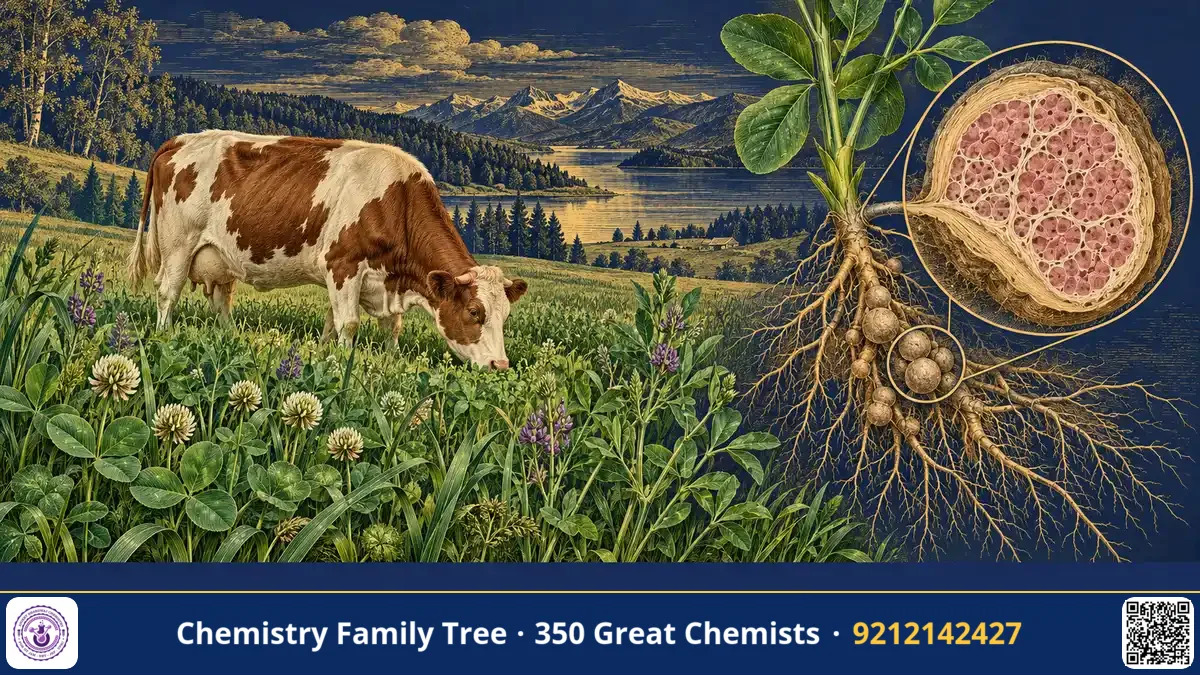
In northern countries like Finland, cows must live on stored feed for many months of the long winter. If green grass and clover are simply piled up, they rot, lose protein and vitamins, and spoil the milk. Artturi Ilmari Virtanen, a Finnish biochemist, found a chemical solution: treat the fresh fodder with dilute mineral acid so that the pH falls to about 3 and unwanted bacteria cannot grow. This became known as the AIV method, named after his initials. He also studied how legumes such as peas and clover fix atmospheric nitrogen with the help of bacteria in their root nodules. For "his research and inventions in agricultural and nutrition chemistry, especially for his fodder preservation method" he was awarded the Nobel Prize in Chemistry for 1945.
The Scientific Problem Before the Discovery
Farmers have long used silage, which is green fodder packed in a pit or silo and allowed to ferment. In ordinary silage, bacteria change the sugars of the plants into acids. Good fermentation produces lactic acid, which lowers the pH and prevents further spoilage. But the process was difficult to control.
- If the pH did not fall quickly, Clostridium bacteria produced butyric acid (CH₃CH₂CH₂COOH), which has a bad smell and damages the quality of the feed and the milk.
- Plant proteins were broken down into ammonia and amines, so valuable nitrogen was lost.
- Carotene (provitamin A) and other vitamins were destroyed, and the feed lost much of its nutritional value.
- Finland had a short growing season and large dairy needs, so the quality of winter feed was directly important to the national economy.
The second problem was in the soil. Legumes enrich soil in nitrogen, a fact known to farmers since ancient times, but the mechanism was still poorly understood in the 1920s and 1930s. How does a plant take nitrogen gas, which is extremely unreactive because of the very strong N≡N triple bond (bond energy about 945 kJ/mol), and make it a part of proteins?
The Discovery: Step by Step
The AIV method
- Observation. At the Valio dairy laboratory and later at the Biochemical Research Institute in Helsinki, Virtanen studied the microbes and chemistry in silage. He realised that the key to quality is to fix the pH quickly in the range where harmful bacteria cannot grow but plant enzymes and valuable nutrients survive.
- Acid treatment. Dilute hydrochloric acid and sulfuric acid (a mixture) is sprinkled on the fresh crop as it is chopped and packed into the silo, in an amount that brings the pH to about 3.0 to 3.5.
- Result. At this pH the butyric acid bacteria are inhibited, protein breakdown is much reduced, and carotene is kept. The fodder stays fresh and green for a long time.
- Feeding trials. Cows fed AIV fodder gave milk of normal taste with no taint, and the fodder kept its carotene content. This was tested in practical trials in Finland.
Butyric fermentation:  C₆H₁₂O₆ → CH₃CH₂CH₂COOH + 2CO₂ + 2H₂
AIV principle: pH ≈ 3.0–3.5 stops Clostridium growth
Biological nitrogen fixation
Virtanen studied the symbiosis between legumes and Rhizobium bacteria in root nodules. Overall, the reaction catalysed by the enzyme nitrogenase is:
N₂ + 8H⁺ + 8e⁻ + 16 ATP → 2NH₃ + H₂ + 16 ADP + 16 Pᵢ
In 1939, with his co-worker Laine, he showed that the red pigment in the nodules, leghemoglobin, is linked with nitrogen fixation. Nodules that contain it are red or pink and active, while green nodules are inactive. Leghemoglobin binds oxygen very tightly, which keeps free oxygen low inside the nodule, because nitrogenase is poisoned by O₂, while still providing enough oxygen to supply energy for the bacteria.
Other natural product studies
Virtanen also studied the chemistry of plants of the onion and cabbage families. He worked on the sulfur compounds which release the tear-producing substance when an onion is cut. The precursor is an amino acid sulfoxide, and an enzyme (alliinase) acts on it when the cells are broken. His group's work helped to explain how onion flavour and the lachrymatory factor are formed.
The Chemistry Behind It
Acids and microbes. Most bacteria need a pH close to neutral. At pH 3 the concentration of H⁺ is 10⁻³ mol/L, and the cell membranes and enzymes of Clostridium are inhibited. Lactic acid bacteria are more tolerant to acid, but in AIV silage the acid is added directly, which avoids the risky early phase of fermentation.
Protein preservation. Proteolytic enzymes and bacteria hydrolyse the peptide bond (–CO–NH–) to amino acids and then deaminate them to ammonia. At low pH the activity of these processes falls, so the true protein is saved.
Nitrogenase. It has two proteins, an Fe protein and a MoFe protein, with iron-sulfur clusters and a molybdenum-iron cofactor. Electrons are passed from ferredoxin through the Fe protein to the MoFe protein where N₂ is reduced to ammonia. Ammonia is then taken into glutamine (glutamate + NH₃ + ATP → glutamine) and other amino acids. The process needs 16 ATP per N₂ and is therefore energy intensive, which is why legumes invest a lot of sugar in their nodules.
Comparison with Haber-Bosch. Industrial synthesis needs 150-300 atm and about 400-500 °C with an iron catalyst. Nitrogenase does the same job at ordinary temperature and pressure.
Applications Today
- Dairy farming. Fodder preservation using acids, or acid-based additives such as formic acid in silage, follows Virtanen's principle. Formic acid and propionic acid are commonly used preservatives.
- Sustainable agriculture. Crop rotation with legumes such as gram, pea, lentil, soybean and groundnut reduces the need for nitrogen fertiliser. This is highly relevant to India, where pulses are both food crops and soil improvers.
- Biofertilisers. Rhizobium culture packets are used in India for pulse seed treatment, and blue-green algae and Azolla in rice fields.
- Research. Studies of nitrogenase inspire attempts to build catalysts that reduce N₂ under mild conditions.
Exam Corner
- AIV method: dilute HCl/H₂SO₄ added to green fodder to reach pH 3-3.5; prevents butyric fermentation and preserves protein and carotene.
- Symbiotic nitrogen fixation: Rhizobium in legume root nodules; enzyme nitrogenase (Fe and Mo-Fe proteins).
- Leghemoglobin: oxygen-binding protein in nodules; protects nitrogenase from oxygen.
- N₂ + 8H⁺ + 8e⁻ + 16 ATP → 2NH₃ + H₂ + 16 ADP + 16 Pᵢ.
- Virtanen: Nobel Prize in Chemistry, 1945.
Common Misconceptions
- "Acid in fodder makes milk sour." The acid stays in the feed and is largely neutralised in the animal. Virtanen's tests showed normal milk.
- "Plants fix nitrogen themselves." It is the bacteria in the nodules that fix nitrogen. The plant supplies sugars and a protected environment.
- "AIV stands for a chemical." It stands for Artturi Ilmari Virtanen, the inventor.
Quick Revision Box
- AIV = Artturi Ilmari Virtanen; method developed in the late 1920s.
- Target pH of treated fodder is about 3.0 to 3.5.
- Harmful butyric acid bacteria are Clostridium species.
- Nitrogenase needs anaerobic conditions; leghemoglobin buffers oxygen.
- 16 ATP are used per N₂ reduced.
- Nobel Prize in Chemistry, 1945.
FAQ
Why does acid preserve fodder?
At low pH, spoilage bacteria cannot grow and enzymes that break down protein work slowly, so the nutrients last longer.
What is leghemoglobin?
It is a haem protein in legume root nodules that binds oxygen and keeps its level low for nitrogenase, giving the nodules a pink colour.
Was Virtanen's prize in Medicine?
No. It was the Nobel Prize in Chemistry for 1945, awarded for agricultural and nutrition chemistry.
Is AIV fodder used in India?
The exact AIV method is not common, but acid and microbial silage additives in dairy farming follow the same principle.
Published by ABC Chemistry — IIT-JAM | CSIR-NET | GATE Chemistry Coaching. Visit abcchemistry.com
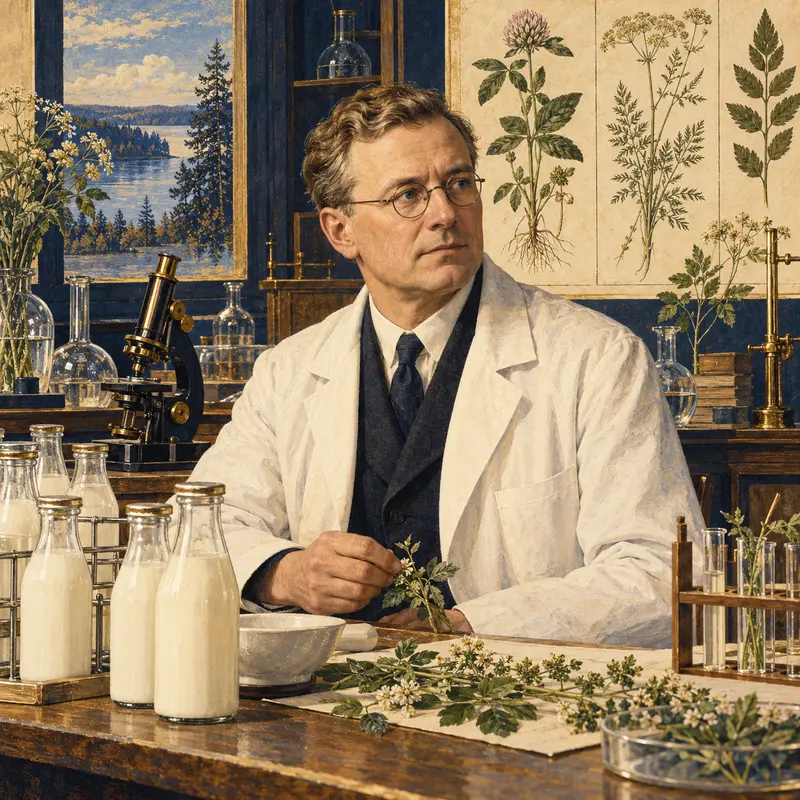
About the chemist
Artturi Virtanen
1895-1973 · Finland · Nobel Chemistry 1945
AIV fodder preservation, nitrogen fixation