Biography · Chemist no. 120 of 350
Artturi Virtanen: The Finnish Chemist Who Taught Cows and Clover to Work Together
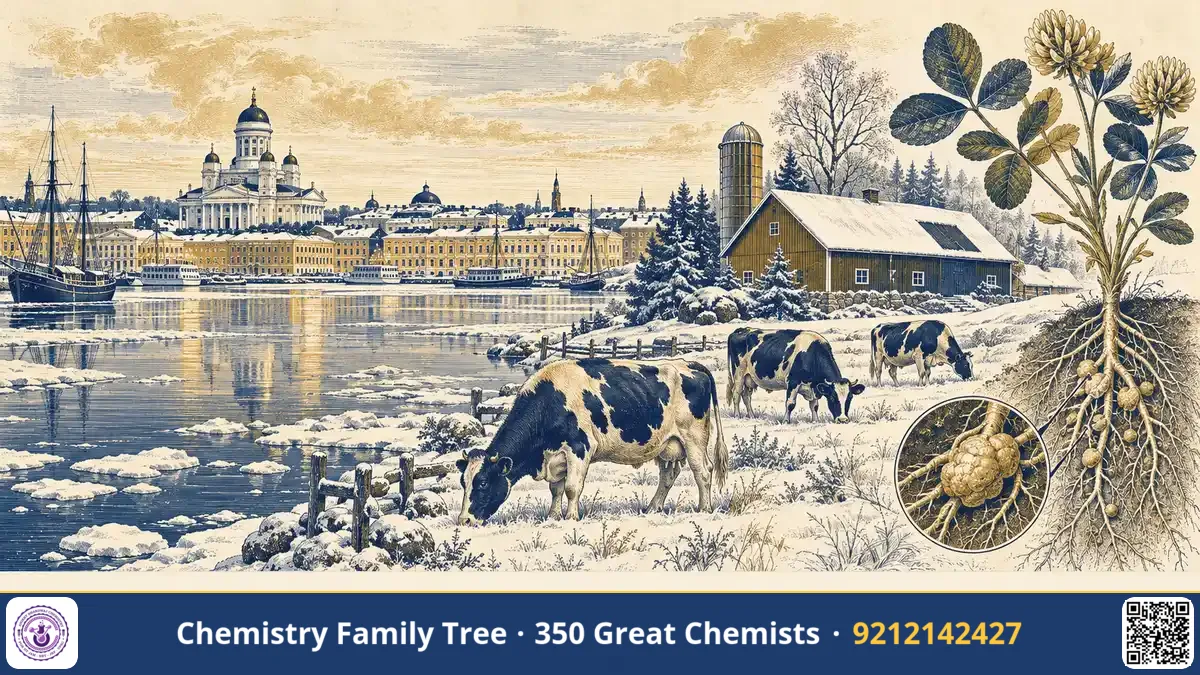
Artturi Ilmari Virtanen (1895-1973) was a Finnish biochemist who applied chemistry to the problems of farms and dairies. He is famous for the AIV fodder preservation method, for studies on nitrogen fixation in legume root nodules, and for his leadership in Finnish science. He received the Nobel Prize in Chemistry for 1945. His legacy is the idea that careful chemistry can improve food and farming, even in a country with a cold climate and a short growing season.
Early Life & Family
Virtanen was born on 15 January 1895 in Helsinki, which was then part of the Grand Duchy of Finland within the Russian Empire. He grew up as Finland was moving toward independence, which came in 1917, and the national feeling of those years shaped many scientists of his generation. His language was Finnish, and he studied in Finnish, which was important for the young nation.
He married Lilja Moisio in 1920 . Throughout his working life he combined research with a strong interest in the practical well-being of his country.
Education & Mentors
He studied chemistry, together with biology and physics, at the University of Helsinki. He completed his doctorate in 1919 with a thesis on chemical subjects related to bacteriology and physical chemistry. After a period of work as a young researcher, he went abroad for further study. In Zürich he studied physical chemistry and in Stockholm he worked with the biochemist Hans von Euler-Chelpin, a Nobel laureate (1929) for work on fermentation and enzymes. In Sweden, he also became familiar with the study of enzymes and bacteria.
These years in Switzerland and Sweden, together with his early training in bacteriology and microbial chemistry, prepared him for a field where chemistry, biology and agriculture meet. He saw that a laboratory in a country that depends on dairy farming should work on problems of milk, fodder and soil.
Career Timeline
| Year | Event |
|---|---|
| 1895 | Born in Helsinki, Grand Duchy of Finland |
| 1919 | Doctorate at the University of Helsinki |
| 1920-1921 | Studies in Zürich and in Stockholm with Hans von Euler |
| 1921 | Becomes head of the laboratory of the dairy cooperative Valio in Helsinki |
| 1920s | Studies the microbiology and chemistry of silage; develops the idea of the AIV method |
| 1931 | Director of the Biochemical Research Institute in Helsinki and professor of biochemistry at the Helsinki University of Technology |
| 1939 | Shows, with Laine, that leghemoglobin is connected with nitrogen fixation in nodules |
| 1945 | Awarded the Nobel Prize in Chemistry |
| 1973 | Dies in Helsinki |
Major Scientific Contributions
The main contributions of Virtanen can be grouped as follows. You can find the chemistry in more detail in our discovery post on AIV fodder and nitrogen fixation.
- AIV fodder. Preservation of green crops by acidifying to pH 3.0 to 3.5, which prevented harmful butyric fermentation and kept protein and carotene.
- Nitrogen fixation. Studies of Rhizobium in legume nodules, and the role of leghemoglobin in protecting nitrogenase from oxygen.
- Protein from simple nitrogen. Work showing how ruminants such as cows can use simple nitrogen sources in their feed, because microbes in the rumen turn them into protein.
- Plant sulfur compounds. Work on onion and cabbage-family chemistry, including the lachrymatory factor formation.
- Organisation of science. He built the Biochemical Research Institute into a centre for applied research and trained many young scientists.
Awards, Honours & Nobel Prize
Virtanen won the Nobel Prize in Chemistry for 1945 "for his research and inventions in agricultural and nutrition chemistry, especially for his fodder preservation method". The prize was presented in 1946 after the war, and he gave his Nobel lecture on the practical results of his methods. He was among the very few scientists who received this honour for agricultural chemistry. He also received honorary degrees and membership of many foreign academies, and was celebrated in Finland as a national figure, with commemorations in Finnish science.
Personality, Struggles & Lesser-Known Facts
- A Finnish success story. He worked in a young nation during hard times, including the Second World War, which strongly affected Finland. His practical focus on food and farming matched the needs of his country.
- Science for the farmer. His AIV method was developed through large field trials with dairies and farms, and not only in a laboratory. The cooperative dairy Valio supported much of this work.
- Initials as a brand. The fodder method carries his initials A.I.V., one of the few chemical methods named after the initials of its inventor.
- Debate and criticism. Some of his ideas on the details of nitrogen fixation were later questioned, and the mechanism of the nitrogen fixation was clarified by later work. This is a normal part of science, and the main practical results of his work stayed valid.
- Public figure. After the Nobel Prize he took part in scientific life and in public discussion on nutrition and agriculture in Finland.
Legacy & Influence on Modern Chemistry
The principle of acid preservation is still used in livestock farming, where formic acid and other organic acid additives are added to silage. His work on nitrogen fixation belongs to the foundation of modern studies of nitrogenase and symbiosis, and these continue to be among the most important topics in biochemistry and sustainable agriculture. The fixation of nitrogen reduces dependence on factory-made fertiliser, which uses energy from fossil fuels through the Haber-Bosch process. For India, where pulses and legumes are central to diet and farming, his lessons are particularly relevant: legume rotation and biofertilisers such as Rhizobium cultures are promoted by agricultural universities and government programmes.
Lessons for Students
- Apply chemistry to local problems. Winter feed for cows was a real Finnish problem, and chemistry solved it.
- Do large trials. A good idea in a flask must be proved on the farm.
- Be ready to revise. Science improves by testing and correcting earlier explanations.
- Learn from different fields. Virtanen combined chemistry, microbiology and agriculture.
Quick Facts Box
- Born: 15 January 1895, Helsinki, Finland
- Died: 11 November 1973, Helsinki, Finland
- Nationality: Finnish
- Field: Biochemistry, agricultural chemistry
- Famous for: AIV fodder preservation; nitrogen fixation research
- Nobel: Chemistry, 1945
FAQ
What does AIV stand for?
It stands for Artturi Ilmari Virtanen, the full name of the inventor.
With which famous scientist did Virtanen study in Stockholm?
Hans von Euler-Chelpin, who won the Nobel Prize in Chemistry in 1929.
What was the Nobel Prize awarded for?
For research and inventions in agricultural and nutrition chemistry, especially the fodder preservation method.
Why is his work relevant to India?
Because legume crops and biofertilisers reduce nitrogen fertiliser use, and dairy farming needs good-quality preserved fodder.
Published by ABC Chemistry — IIT-JAM | CSIR-NET | GATE Chemistry Coaching. Visit abcchemistry.com
About the chemist
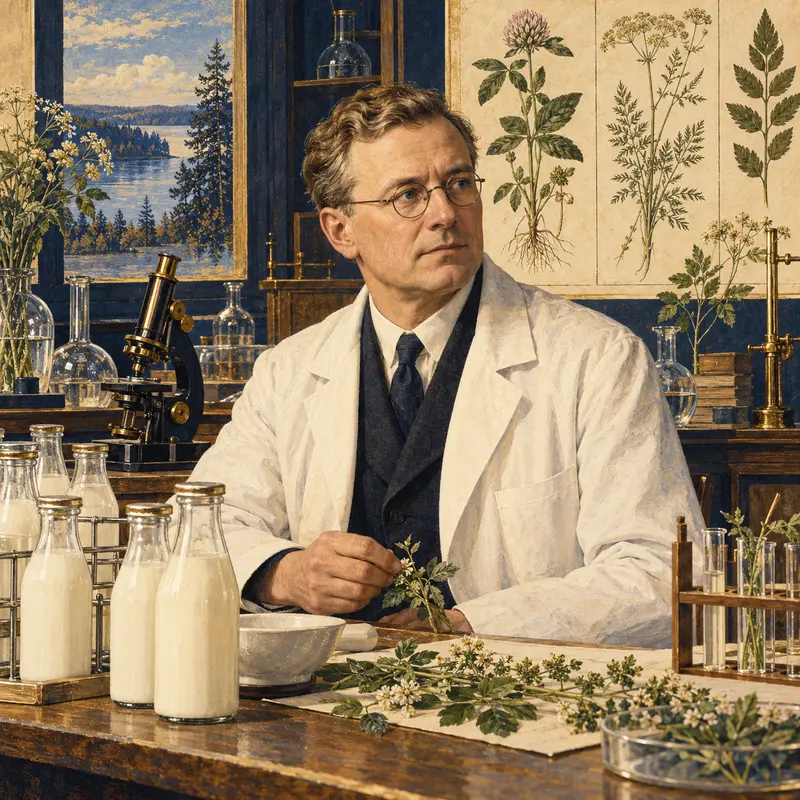
Artturi Virtanen
1895-1973 · Finland · Nobel Chemistry 1945
AIV fodder preservation, nitrogen fixation