Biography · Chemist no. 326 of 350
Asima Chatterjee: Complete Life and Legacy of India's Pioneering Woman Chemist
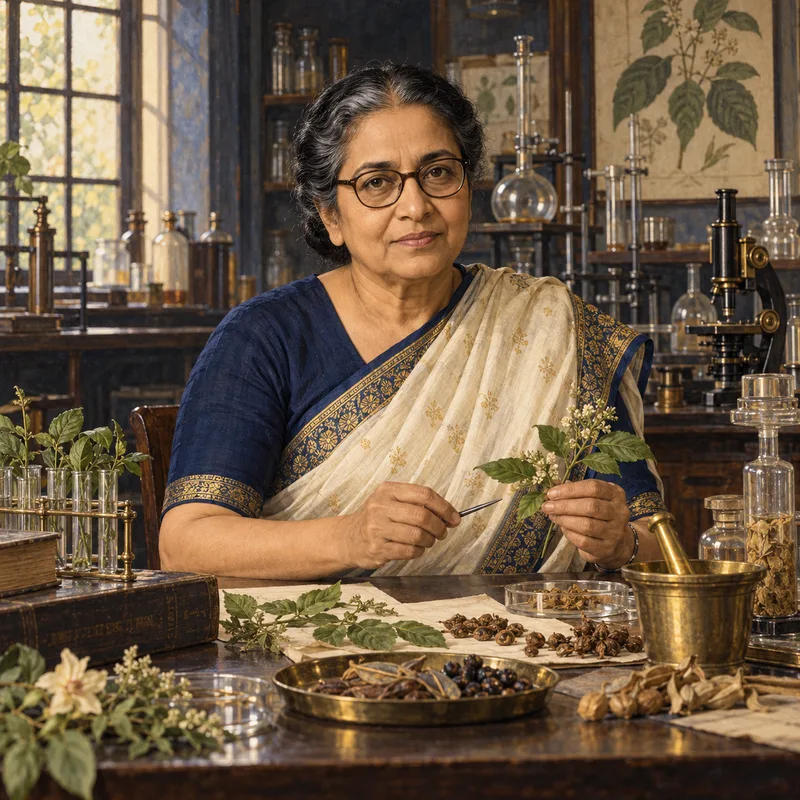
Asima Chatterjee (1917-2006) was an Indian organic chemist who devoted her life to the chemistry of Indian medicinal plants. She was the first Indian woman to receive a Doctor of Science (D.Sc.) degree from an Indian university, the University of Calcutta, in 1944. Her research on vinca alkaloids and on anti-epileptic and antimalarial drugs from plants, her long career as teacher and research guide, and her service in the Rajya Sabha make her one of the most important women in the history of Indian science. She received the Padma Bhushan in 1975. For girls and boys studying chemistry in India today, her life proves that science can be built from India's own soil, plants and traditions.
Early Life and Family
Asima Mukherjee (she became Chatterjee after marriage) was born on 23 September 1917 in Calcutta (now Kolkata), in a Bengali family. Her father, Dr Indra Narayan Mukherjee, was a physician with a deep love of plants and gardening. As a child she grew up among his collection of medicinal plants and flowers, and this early contact with plants became the seed of her later research. Her family valued education, which was a rare and precious thing for a girl in India in the 1920s and 1930s, when very few women went to college, and far fewer chose science. Her family's encouragement was her first great support. After her marriage she became Asima Chatterjee; her husband, Baradananda Chatterjee, was a fellow academic and supported her career, and they had a daughter, Juli.
Education and Mentors
Asima studied chemistry at the Scottish Church College in Calcutta, graduating with honours in 1936. She then took her M.Sc. in organic chemistry at the University of Calcutta in 1938, a university where she would spend most of her working life. Her doctoral research was guided by Prafulla Kumar Bose, a leading organic chemist of Calcutta, and she studied the chemistry of plant products. She also worked with the Calcutta chemists of the school founded by Sir Prafulla Chandra Ray and Sir Asutosh Mookerjee, whose vision created the University College of Science, where Indians could do world-class research. In 1944 she was awarded the D.Sc. degree of the University of Calcutta, a historic first for an Indian woman. Later she gained international experience, working with Professor Paul Karrer in Zurich and with Professor Zechmeister at the California Institute of Technology, on natural product methods, before returning to India.
Career Timeline
| Year | Event |
|---|---|
| 1917 | Born in Calcutta |
| 1936 | B.Sc. (Honours) in Chemistry, Scottish Church College |
| 1938 | M.Sc. in Organic Chemistry, University of Calcutta |
| 1940 | Founded and headed the Department of Chemistry at Lady Brabourne College, Calcutta |
| 1944 | D.Sc., University of Calcutta; first Indian woman to receive a D.Sc. from an Indian university |
| 1947 onwards | Research visits abroad (Zurich and Caltech) |
| 1954 | Joined the University College of Science, University of Calcutta, as Reader |
| 1960 | Elected Fellow of the Indian National Science Academy, the first woman to receive this honour |
| 1962 | Appointed Khaira Professor of Chemistry, University of Calcutta |
| 1975 | Padma Bhushan; General President of the Indian Science Congress, the first woman in that role |
| 1982-1990 | Nominated Member of the Rajya Sabha |
| 2006 | Died in Kolkata on 22 November |
Major Scientific Contributions
- Vinca alkaloids: Chemistry of the alkaloids of Catharanthus roseus, the source of the anticancer drugs vinblastine and vincristine.
- Anti-epileptic drugs: Development of anti-epileptic medicine from Indian plants including Marsilea minuta, and of the Ayush-56 formulation from Alstonia scholaris.
- Antimalarial drugs: Studies on Indian plants such as Alstonia scholaris, Swertia chirata and Picrorhiza kurroa.
- Natural product chemistry: Isolation and structural study of coumarins, terpenoids and alkaloids from a wide range of Indian plants.
- A research school: She guided a large number of research students and built a strong natural products group at Calcutta.
The chemistry and methods are explained in our discovery blog on Asima Chatterjee's work on vinca alkaloids and medicinal plants. She published several hundred research papers over her career.
Awards, Honours and Nobel Prize
Asima Chatterjee did not receive a Nobel Prize, but she won many honours in India. In 1960 she became the first woman Fellow of the Indian National Science Academy. She was awarded the Padma Bhushan in 1975, among the highest civilian awards in India. In the same year she became the first woman General President of the Indian Science Congress Association. She held the Khaira Chair of Chemistry at the University of Calcutta, one of its most prestigious professorships. She was also nominated to the Rajya Sabha, the upper house of the Indian Parliament, by the President of India, from 1982 to 1990, in recognition of her service to science and education. The University of Calcutta awarded her honorary degrees and recognition, and she is remembered by institutions and lectures named in her honour.
Personality, Struggles and Lesser-Known Facts
- A pioneer in a male world: In her student days, women scientists were rare, and she had to work harder than others to be taken seriously. She succeeded through persistent, quiet work.
- Founder of a department: At a young age she started the chemistry department at Lady Brabourne College, which strengthened science education for women in Calcutta.
- Science from Indian plants: She was convinced that India's plants could provide medicines for Indian diseases, and she spent decades proving this with laboratory evidence, not just tradition.
- A devoted teacher: Her students remembered her as a strict but caring guide, who insisted on careful experiments and pure compounds.
- Active after retirement: She continued to work in her laboratory and contribute to research and national committees long after she retired from the University in 1982.
- Balancing work and family: She raised her daughter while working long hours in the laboratory, and she is often cited as a model for women who want both a career and a family.
Legacy and Influence on Modern Chemistry
Asima Chatterjee's influence is seen in three areas. First, her chemistry of Indian medicinal plants produced real drugs and gave scientific support to traditional medicine, which is the same approach followed today by CSIR laboratories and Ayush research councils. Second, she built a school of natural product chemistry at Calcutta, and her students taught at universities across India. Third, she opened the door for women in Indian science, showing that a woman could reach the top level of research, administration and national leadership. In a country where many girls still face barriers to science education, her story gives courage. Students of M.Sc. organic chemistry and CSIR-NET who learn about alkaloids, terpenoids and structure determination study the same class of compounds she worked on.
Lessons for Students
- Look at your own surroundings. A garden and a father's love of plants became a lifetime of research.
- Persist even when you are the first. Being the first woman D.Sc. in India meant that nobody had shown the way before her.
- Join tradition and modern science. Respect traditional knowledge, but test it with careful chemistry.
- Teach and lead. A scientist's work is multiplied by the students she trains.
Quick Facts Box
- Born: 23 September 1917, Calcutta (Kolkata), British India
- Died: 22 November 2006, Kolkata, India
- Nationality: Indian
- Field: Organic chemistry, natural product chemistry, phytochemistry
- Famous for: Vinca alkaloid chemistry, anti-epileptic and antimalarial drugs from Indian plants, first Indian woman D.Sc.
- Nobel: None; Padma Bhushan (1975)
FAQ
Why is Asima Chatterjee famous?
She was the first Indian woman to receive a D.Sc. from an Indian university and a pioneer in the chemistry of medicinal plants, including anticancer vinca alkaloids and anti-epileptic and antimalarial drugs.
Where did she study and teach?
She studied at the Scottish Church College and the University of Calcutta, and she taught at Lady Brabourne College and the University of Calcutta, where she held the Khaira Chair.
Did Asima Chatterjee win a Nobel Prize?
No. Her main national honours were the Padma Bhushan (1975) and Fellowship of the Indian National Science Academy, along with the leadership of the Indian Science Congress in 1975.
How is she relevant to chemistry students today?
Her work on alkaloids, coumarins and terpenoids is part of the organic chemistry and natural products syllabus for B.Sc., M.Sc., CSIR-NET and GATE.
Published by ABC Chemistry — IIT-JAM | CSIR-NET | GATE Chemistry Coaching. Visit abcchemistry.com
About the chemist
Asima Chatterjee
1917-2006 · India
Vinca alkaloids; anticonvulsant and antimalarial drugs