The discovery, explained · Chemist no. 326 of 350
Asima Chatterjee: Medicines from Indian Plants and the Vinca Alkaloids
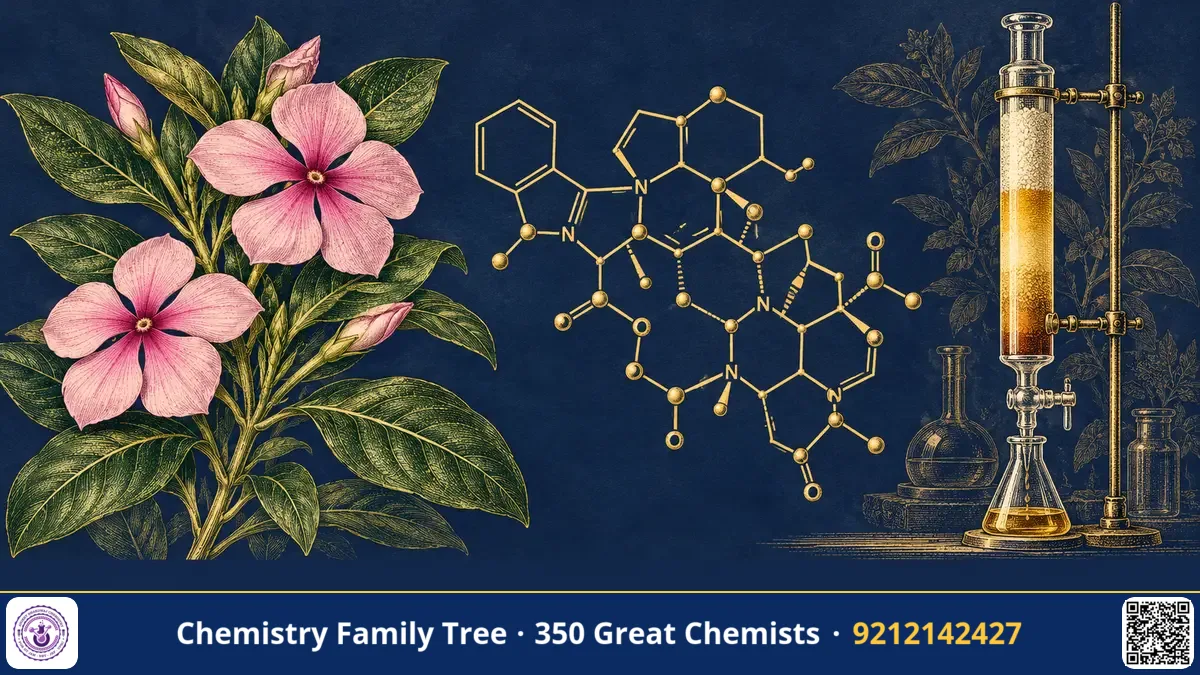
India has used plants as medicines for thousands of years, in Ayurveda, Siddha and folk traditions. But how can we be sure which chemical in a plant does the healing? The Indian organic chemist Asima Chatterjee (1917-2006) spent more than five decades answering this question. Working at the University of Calcutta, she isolated, purified and studied the structure of many alkaloids, coumarins and terpenoids from Indian plants. She is best known for her work on vinca alkaloids from the Madagascar periwinkle (Catharanthus roseus, formerly Vinca rosea), which are the source of the anticancer drugs vinblastine and vincristine, and for developing anti-epileptic and antimalarial drugs from plants. She also contributed to the formulation of the Ayurvedic drug Ayush-56, used against epilepsy. Her work shows how organic chemistry can turn traditional knowledge into evidence-based medicine.
The Scientific Problem Before the Discovery
In the 1950s and 1960s, Western pharmaceutical firms discovered that plants contain complex chemicals of high potency. In 1958 researchers in Canada and the United States, led by Robert Noble and Charles Beer at the University of Western Ontario and by Gordon Svoboda at Eli Lilly, found that the leaves of the periwinkle contain alkaloids that reduce white blood cell counts, and which are active against leukaemia and Hodgkin's lymphoma. The plant was used in folk medicine for diabetes. This raised a major question for India: the country has very rich plant biodiversity and a long tradition of using plants, but the active compounds in most of them were unknown. Without isolation and structural proof, the traditional medicines could not be standardised or tested for safety.
The challenge in this work is that plant extracts are very complex mixtures. A single leaf may contain hundreds of compounds, and the useful alkaloid may be present at a fraction of a percent. Their structures are large and complicated, and in the 1950s-60s chemists had no modern NMR or mass spectrometers. They had to work with classical tools.
The Discovery / Experiment
Step 1: Collecting and extracting plant material
Plant material (leaves, bark, roots, seeds) is dried and powdered, then extracted with solvents of different polarity, such as petroleum ether, chloroform, ethanol and water. Alkaloids, which are basic nitrogen-containing compounds, are separated using an acid-base procedure:
Plant extract in organic solvent + dilute HCl → alkaloid hydrochloride (water-soluble)
Aqueous layer + NH3 (basify) → free alkaloid base (precipitates or extracts into chloroform)
R3N + HCl → R3NH+Cl-   (and reverse with base)
Step 2: Purification
The crude alkaloid mixture was separated by column chromatography on alumina or silica gel, and by crystallisation. Chatterjee's group became known for carefully isolating pure compounds from difficult mixtures. For the periwinkle, they studied the indole alkaloids of the plant, including the dimeric alkaloids whose structures are explained below.
Step 3: Structure determination
She used a combination of classical degradation methods and modern spectroscopy as it became available, including ultraviolet, infrared and NMR spectroscopy, mass spectrometry and X-ray analysis. The classical approach included:
- Elemental analysis and molecular formula.
- Functional group tests, such as methoxyl determination (Zeisel), N-methyl determination and active hydrogen tests.
- Degradation reactions (Hofmann elimination, zinc dust distillation, selenium dehydrogenation) which break large alkaloids into known simple fragments, such as indole or carbazole derivatives.
- Comparison with known compounds and finally synthesis for confirmation.
Step 4: The vinca alkaloids
The anticancer vinca alkaloids, vinblastine and vincristine, are dimers made of two units, catharanthine (an indole alkaloid of the iboga type) and vindoline (an indoline), which are joined by a carbon-carbon bond:
catharanthine + vindoline  →  anhydrovinblastine → vinblastine (R = CH3 on N)
vincristine differs from vinblastine by having N-CHO (formyl) instead of N-CH3 in the vindoline half
Vinblastine and vincristine bind to tubulin and prevent the formation of the microtubules of the mitotic spindle, so dividing cells are stopped in metaphase. Chatterjee's group worked on the chemistry of vinca alkaloids and other Indian plant alkaloids, including those with structure types useful for new drugs. She also studied the alkaloids of Rauwolfia (the source of reserpine), Alstonia scholaris (saptaparni), and Picrorhiza kurroa (kutki), among other plants.
Step 5: From plants to drugs
Chatterjee developed several drugs from Indian plants. These include:
- An anti-epileptic preparation from the Indian plant Marsilea minuta (a small aquatic fern known as sushni or sunisunia), and Ayush-56, an anti-epileptic formulation based on Alstonia scholaris (saptaparni), developed by her group and used in Ayurvedic practice.
- Antimalarial compounds from Alstonia scholaris, Swertia chirata (chirata) and Picrorhiza kurroa.
- Studies on coumarins and terpenoids from other Indian plants, with tests for biological activity.
The Chemistry Behind It
- Alkaloids: basic, nitrogen-containing secondary metabolites of plants, usually with a heterocyclic ring, often physiologically active, e.g. morphine, quinine, reserpine, vinblastine.
- Indole alkaloids: derived biosynthetically from tryptophan and the terpenoid secologanin (via strictosidine). Most monoterpenoid indole alkaloids, like those in Catharanthus, are formed this way.
- Coumarins: benzopyran-2-one compounds, made by the shikimate pathway, with anticoagulant, antibacterial and anti-inflammatory action.
- Terpenoids: built from isoprene (C5H8) units, e.g. monoterpenes (C10), diterpenes (C20).
- Techniques: acid-base extraction, chromatography, crystallisation, UV (λmax of indole chromophore near 220, 280 nm), IR, NMR and MS.
Applications Today
- Cancer chemotherapy: Vinblastine is used for Hodgkin's lymphoma and testicular cancer, and vincristine for childhood leukaemia; they are on the WHO list of essential medicines.
- Standardised herbal medicine: Isolating marker compounds allows quality control of Ayurvedic and herbal products in India, for example by HPLC fingerprinting.
- Drug discovery: Natural products and their derivatives remain the starting point for many drugs, including paclitaxel and artemisinin.
- Conservation and rural economy: Periwinkle is cultivated in India for alkaloid production, and the study of useful plants supports their protection.
- Education: Natural product chemistry is a core part of M.Sc. organic chemistry and CSIR-NET syllabuses.
Exam Corner
- Vinblastine and vincristine are dimeric indole (vinca) alkaloids from Catharanthus roseus; they bind tubulin and block mitosis.
- Vincristine has an N-formyl group where vinblastine has N-methyl.
- Monoterpenoid indole alkaloids arise from tryptophan and secologanin via strictosidine.
- Alkaloids are extracted by acid-base treatment: free base in organic solvent, salt in water.
- Reserpine (Rauwolfia serpentina) is an antihypertensive indole alkaloid; Indian chemists such as Siddiqui and Chatterjee worked on Indian plant alkaloids.
Common Misconceptions
- "Natural means safe." Many plant alkaloids are highly toxic; dose and purity matter, which is why isolation and testing are essential.
- "Vincristine and vinblastine are the same drug." They differ by one group and have different cancers and side effects (vincristine is mainly neurotoxic; vinblastine causes bone marrow suppression).
- "Vinca alkaloids were first discovered in India." The anticancer activity was found by Canadian and American groups; Indian chemists, including Chatterjee, contributed to the chemistry of the plant's alkaloids and to other plant-derived drugs.
Quick Revision Box
- Vinca alkaloids come from Catharanthus roseus (periwinkle).
- Vinblastine = catharanthine + vindoline dimer; vincristine has N-CHO.
- Mode of action: tubulin binding, metaphase arrest.
- Chatterjee: natural product chemist, University of Calcutta, drugs from Indian plants.
- Ayush-56 (antiepileptic) and antimalarial plant drugs are linked to her work.
- Alkaloid extraction relies on acid-base chemistry.
FAQ
What is Asima Chatterjee best known for?
For her work on the chemistry of plant natural products, especially vinca alkaloids, and for developing anti-epileptic and antimalarial drugs from Indian medicinal plants.
Why are vinca alkaloids important?
They are anticancer drugs that stop cell division by binding to tubulin; vinblastine and vincristine are used in many chemotherapy regimens.
How are alkaloids isolated from plants?
By solvent extraction followed by acid-base partitioning, chromatography and crystallisation, then characterised by spectroscopy.
Is natural product chemistry important for CSIR-NET and GATE?
Yes. Alkaloid, terpenoid and coumarin chemistry, along with extraction and structure determination methods, are important topics in organic chemistry papers.
Published by ABC Chemistry — IIT-JAM | CSIR-NET | GATE Chemistry Coaching. Visit abcchemistry.com
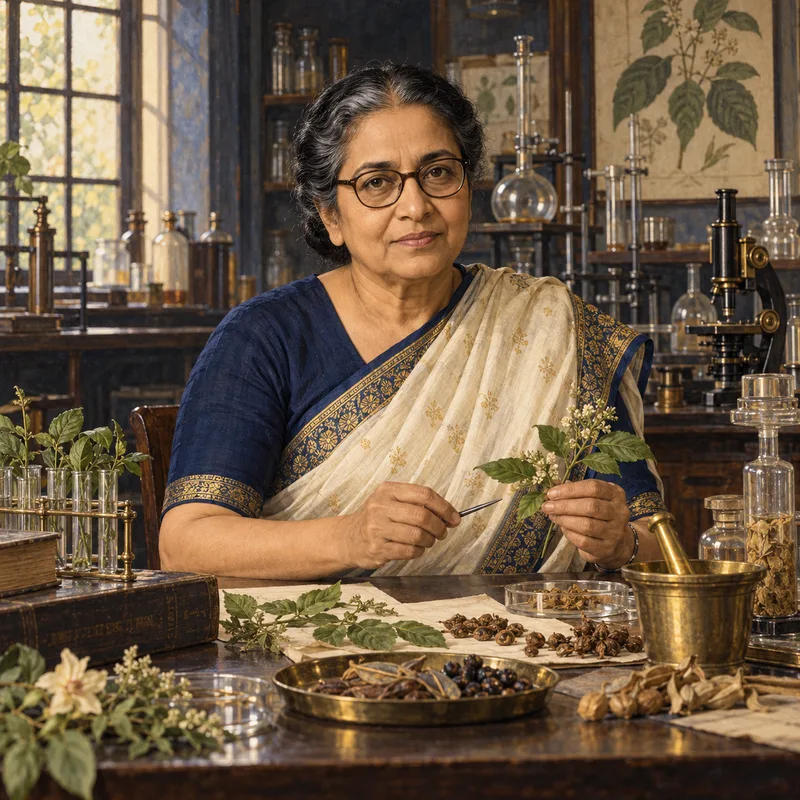
About the chemist
Asima Chatterjee
1917-2006 · India
Vinca alkaloids; anticonvulsant and antimalarial drugs