The discovery, explained · Chemist no. 269 of 350
Auer von Welsbach: How Rare-Earth Chemistry Lit Up the Streets
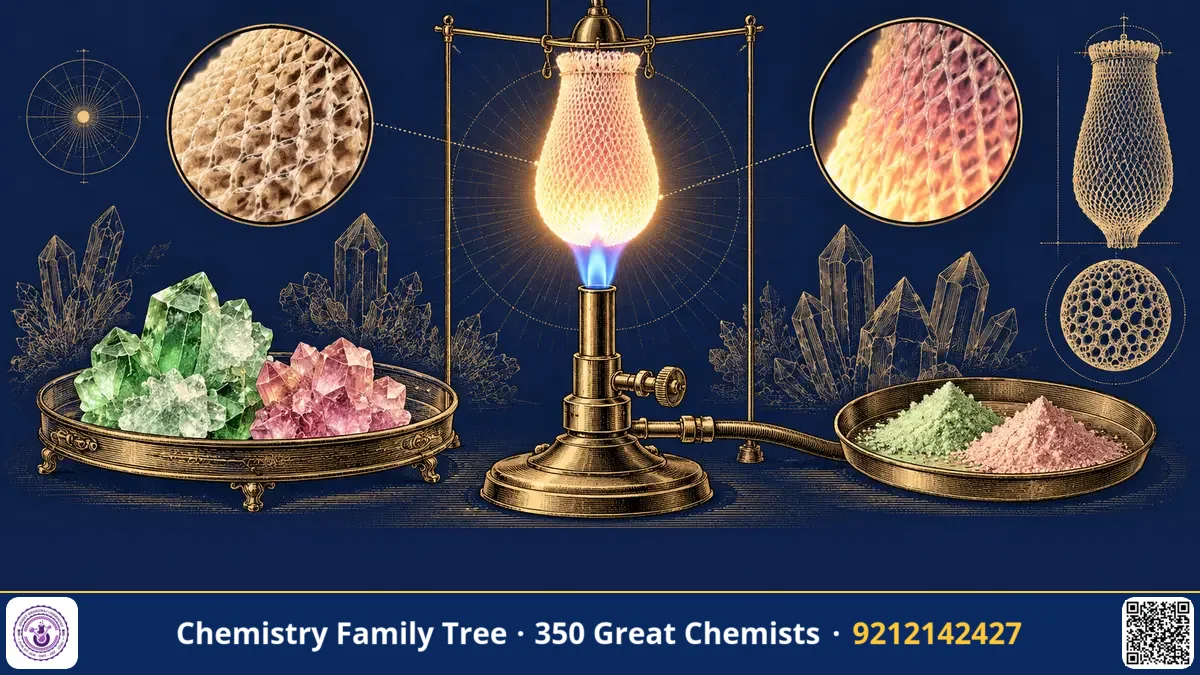
Before electric bulbs were common, cities were lit by gas lamps whose flames were weak and yellow. In the 1880s, an Austrian chemist, Carl Auer von Welsbach, changed this with a small cap of woven fabric soaked in rare-earth salts, the gas mantle. At the same time, in the laboratory, he did something that had defeated many chemists: he showed that the supposed element "didymium" was really two elements, praseodymium and neodymium. His work connects pure analysis with real-world technology, and it is a good example of rare-earth chemistry for exams.
The Scientific Problem Before the Discovery
The rare earths (lanthanides plus scandium and yttrium) are chemically very similar. They all form stable +3 ions, with similar sizes that decrease slowly across the series (lanthanide contraction). This made them extremely hard to separate. Carl Mosander in Sweden had found in 1839–43 that "ceria" contained lanthanum and a mixture he called didymium (from Greek didymos, twin, because it was a "twin" of lanthanum). Didymium salts were pink-violet and gave a complicated absorption spectrum. For forty years, didymium was listed as an element.
Other chemists, including Lecoq de Boisbaudran, suspected it was a mixture, since its spectrum was complicated. But nobody had been able to separate it. The only available method was fractional crystallisation repeated hundreds or thousands of times.
The Discovery: Step by Step
Auer von Welsbach studied in Vienna and then worked in Heidelberg under Robert Bunsen, where he learned spectroscopy and rare-earth chemistry. In 1885, back in Vienna, he took didymium compounds and applied a very patient procedure:
- Prepare the double salt: He used didymium ammonium nitrate, Di(NO₃)₃·2NH₄NO₃·4H₂O, a double salt that crystallises well.
- Fractional crystallisation: He dissolved the salt in nitric acid and allowed part of it to crystallise. The crystals and the remaining solution were slightly different in composition. He repeated the process more than a hundred times, working with the most and least soluble parts.
- Observe colour changes: One end of the series produced green salts, and the other end gave rose-pink salts.
- Check by spectroscopy: The green fraction had its own absorption bands, and the pink fraction had different ones. The two were distinct elements.
He named them praseodymium ("green twin", from Greek prasios, leek-green) and neodymium ("new twin"). The two elements are adjacent in the lanthanide series: Pr (Z = 59) and Nd (Z = 60).
The Chemistry Behind It
The reason for the separation is that the solubility of salts changes very slightly with ionic radius. Ln³⁺ radius decreases from La³⁺ to Lu³⁺, which changes lattice energy and hydration energy a little. Repeating the crystallisation many times makes these tiny differences add up. Today, chemists use ion-exchange chromatography and solvent extraction, which do the same job in a more efficient way.
| Property | Praseodymium | Neodymium |
|---|---|---|
| Atomic number | 59 | 60 |
| Electron configuration | [Xe] 4f³ 6s² | [Xe] 4f⁴ 6s² |
| Common ion colour | Pr³⁺ pale green | Nd³⁺ pink-violet |
| Main oxidation state | +3 (also +4) | +3 |
The gas mantle (1885–1891). Auer discovered that a fabric mantle impregnated with thorium dioxide and a little cerium dioxide glows brilliantly white when heated in a Bunsen flame. The best composition is about 99% ThO₂ and 1% CeO₂. The oxides do not melt, and they emit strong visible light when heated, a process called incandescence, with the cerium helping the oxide to radiate in the visible region.
Th(NO₃)₄ → ThO₂ + 4NO₂ + O₂   (on first heating, fabric burns away)
ThO₂ (99%) + CeO₂ (1%) skeleton → intense white light in a gas flame
He also developed other inventions: the osmium filament lamp (1898), an early metal-filament bulb, which led to the trade name "Osram" (from osmium and Wolfram); and ferrocerium or "Auer metal" (1903), an alloy of about 70% cerium-rich mischmetal and 30% iron, which gives sparks when scratched. This is the "flint" in cigarette lighters and fire-starters.
Applications Today
- Neodymium magnets: Nd₂Fe₁₄B magnets are the strongest permanent magnets, used in motors of electric vehicles, wind turbines, headphones, hard disks and MRI machines.
- Lasers: Nd:YAG lasers (Nd³⁺ in yttrium aluminium garnet) are used in surgery, cutting and range finding.
- Glass and ceramics: Praseodymium gives yellow-green colours in glass and ceramic glazes; didymium glass filters are used by glassblowers to remove yellow sodium light.
- Alloys: Mischmetal and ferrocerium are used in lighters and in steelmaking.
- Gas mantles: Still used in camping lanterns and pressure-lamp lighting in places with unreliable power. Thorium-free versions are now made because of radioactivity concerns.
India has major rare-earth reserves in monazite beach sands, and companies such as IREL process them.
Exam Corner
- Didymium was shown to be a mixture of Pr and Nd by Auer von Welsbach in 1885, using fractional crystallisation of double ammonium nitrates.
- Gas mantle = ThO₂ (about 99%) + CeO₂ (about 1%).
- Lanthanide contraction: steady decrease of Ln³⁺ radius with increasing atomic number, due to poor shielding by 4f electrons.
- Ferrocerium (Auer metal): Ce-rich mischmetal with iron, used in lighter flints.
- Nd₂Fe₁₄B is the strongest commercial permanent magnet; Nd:YAG is a common solid-state laser.
Common Misconceptions
- "The mantle burns like a candle." No. The gas flame only heats the oxide skeleton, which then glows by incandescence.
- "Rare earths are rare in the crust." Cerium is more abundant than copper in the crust. They are "rare" because they are hard to separate and are spread out in low concentrations.
- "Didymium was a discovery by Auer." Mosander named didymium (1841). Auer proved it was two elements.
Quick Revision Box
- Praseodymium (Pr, 59) and neodymium (Nd, 60) isolated from didymium in 1885.
- Method: repeated fractional crystallisation of didymium ammonium nitrate.
- Gas mantle: 99% ThO₂ + 1% CeO₂ on a fabric network.
- Osmium filament lamp (1898); ferrocerium flint (1903).
- Pr³⁺ is green, Nd³⁺ is pink-violet.
- Nd₂Fe₁₄B magnets and Nd:YAG lasers are major uses.
FAQ
What does "didymium" mean?
It means "twin" in Greek, because the supposed element was found with lanthanum, like a twin.
Why does cerium oxide matter in a gas mantle?
A small amount of CeO₂ with ThO₂ makes the mantle emit much brighter visible light than ThO₂ alone.
Why was it so difficult to separate rare earths?
Their +3 ions have almost identical size and chemistry, so only tiny differences in solubility can be used.
What modern method separates lanthanides?
Ion-exchange chromatography and solvent extraction are used today.
Published by ABC Chemistry — IIT-JAM | CSIR-NET | GATE Chemistry Coaching. Visit abcchemistry.com
About the chemist
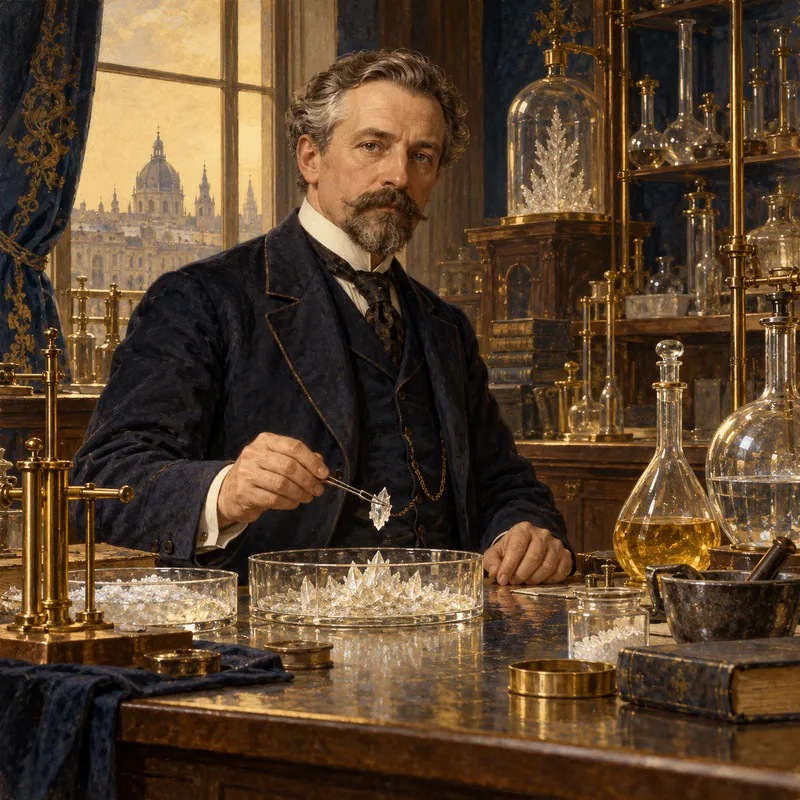
Carl Auer von Welsbach
1858-1929 · Austria
Gas mantle; ferrocerium flints; discovered Pr, Nd