Biography · Chemist no. 269 of 350
Carl Auer von Welsbach (1858–1929): The Chemist Who Lit Up Cities
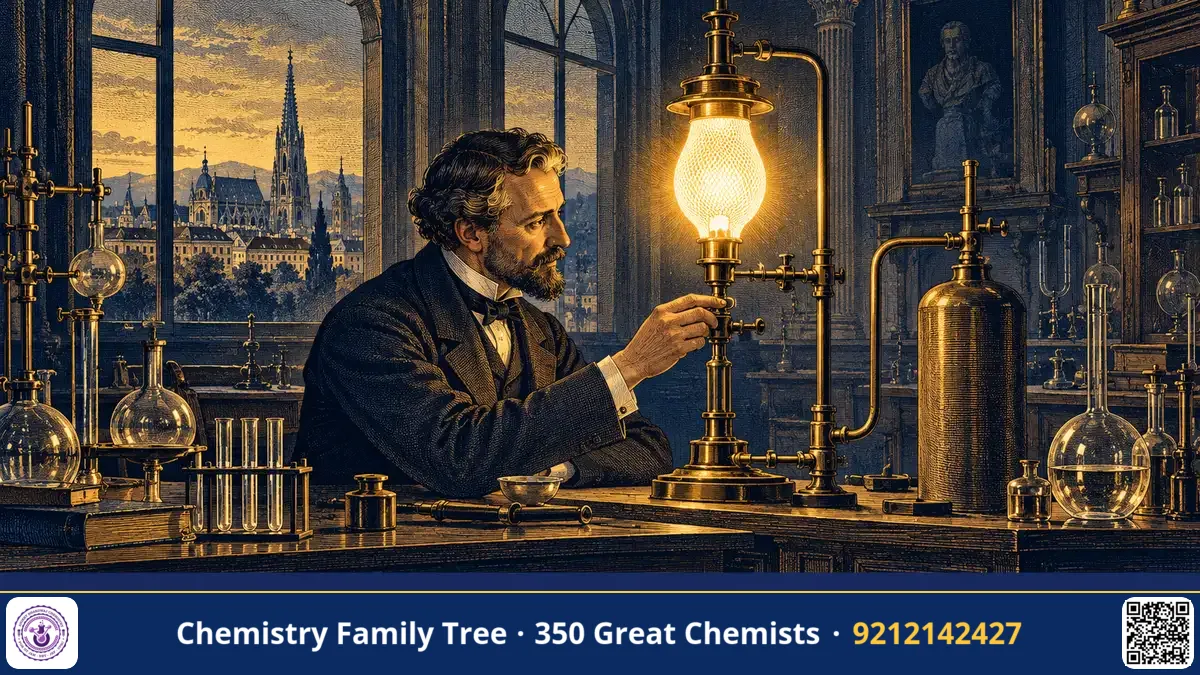
Carl Auer von Welsbach was an Austrian chemist and inventor who combined deep laboratory skill with business sense. He discovered the elements praseodymium and neodymium, independently found lutetium, and invented the gas mantle, an early metal-filament electric lamp and the ferrocerium "flint" used in lighters. Few chemists have had such a large effect on daily life.
Early Life and Family
He was born on 1 September 1858 in Vienna, Austria. His father, Alois Auer, was a notable figure in the printing world, the director of the Imperial and Royal Court and State Printing Office (k.k. Hof- und Staatsdruckerei). Alois Auer was an innovator in printing techniques, and the boy grew up in a household that valued invention and science. The family name "von Welsbach" came from his father's ennoblement, and Carl himself was made a baron (Freiherr) in 1901.
Education and Mentors
He studied chemistry and physics at the University of Vienna and the Technical University of Vienna. In 1880 he moved to Heidelberg to work with Robert Bunsen, one of the founders of spectroscopy. Bunsen introduced him to rare earths, and Auer used Bunsen's methods all his life. He also learned careful spectroscopic analysis there. He returned to Vienna in 1882 and continued his research on rare earths, including the puzzle of didymium.
Career Timeline
| Year | Event |
|---|---|
| 1858 | Born in Vienna (1 September). |
| 1880 | Goes to Heidelberg to work in Bunsen's laboratory. |
| 1885 | Splits didymium into praseodymium and neodymium; patents the first gas mantle. |
| 1891 | After improving the mantle (thorium oxide with cerium oxide), launches commercial production. |
| 1898 | Develops the osmium filament lamp. |
| 1903 | Invents ferrocerium (Auer metal) lighter flint. |
| 1901 | Receives the title of Freiherr (baron). |
| 1905–1907 | Separates ytterbium into two components, the second later called lutetium (his name: cassiopeium). |
| 1929 | Dies at Schloss Welsbach, near Mölbling, Carinthia (4 August). |
Major Scientific Contributions
1. Praseodymium and neodymium. By more than a hundred crystallisations of didymium ammonium nitrate, he showed that "didymium" contained two elements. See our discovery article for the chemistry.
2. The gas mantle. His first mantles in the mid-1880s used mixtures of magnesium, lanthanum and yttrium oxides, and gave a greenish light. The improved version of 1890–91, with about 99% thorium dioxide and 1% cerium dioxide, gave a bright white light and was a worldwide commercial success, extending the life of gas lighting for decades.
3. The osmium lamp. Osmium has a very high melting point, so it was a good filament material. The lamps were later replaced by tungsten, but the trade name Osram, from OSmium and WolfRAM (German for tungsten), survives as a brand.
4. Ferrocerium. A pyrophoric alloy of cerium-rich mischmetal and iron. When scraped, tiny hot particles of metal ignite in air:
4Ce + 3O₂ → 2Ce₂O₃ (hot particles produce sparks)
5. Lutetium. Working around 1905, he separated what was thought to be ytterbium into two elements. He called them aldebaranium (now ytterbium) and cassiopeium (now lutetium). The French chemist Georges Urbain published similar results at about the same time and was granted priority for lutetium, though some German scientists continued to use the name cassiopeium for some time.
Awards, Honours and Nobel Prize
He was made a baron in 1901 and received many honours from scientific societies and from Austria. A memorial and a museum, the Auer-von-Welsbach Museum, are located in Althofen, Carinthia, where he built a factory for his industrial interests. He did not win a Nobel Prize.
Personality, Struggles and Lesser-Known Facts
- Self-funded research. Income from the gas mantle business let him follow pure research, including expensive rare-earth separations, in his own laboratory.
- Patience as a method. The splitting of didymium needed well over a hundred crystallisation steps, with spectroscopy used to monitor each result.
- Thorium problem. Mantles using thorium contain a radioactive element. At the time its risks were not understood; modern mantles are being made with yttrium or other substitutes.
- Quiet life. He spent his later years at an estate in Carinthia.
- Priority fight. The lutetium dispute shows how hard it was to prove who first found a rare earth when different groups worked at the same time.
Legacy and Influence on Modern Chemistry
Rare earths now play a key role in green technologies: neodymium for magnets in wind turbines and electric motors, and praseodymium for alloys and glass. His fractional crystallisation approach was replaced by ion exchange (developed in the 1940s) but the principle, using tiny differences repeated many times, is the same. The Auer company also became a pioneer of the lighting industry, and Osram remains a leading lighting company. Auer's career is cited as an example of how basic science can feed directly into industry.
Lessons for Students
- Persistent repetition can reveal tiny differences. A hundred crystallisations were needed to show two elements.
- Connect pure and applied science. The same element families (rare earths) that were a puzzle were also useful in lamps and lighters.
- Check safety. Early adoption of thorium shows why we must study long-term hazards.
- Credit and priority matter, so record your results clearly and publish them.
Quick Facts
- Born: 1 September 1858, Vienna, Austria.
- Died: 4 August 1929, Mölbling, Carinthia, Austria.
- Nationality: Austrian.
- Field: Inorganic chemistry, rare earths, industrial invention.
- Famous for: Praseodymium, neodymium, gas mantle, ferrocerium flint, osmium lamp.
- Nobel Prize: None.
FAQ
What did Auer von Welsbach study under Bunsen?
He learned spectroscopy and rare-earth analysis, which he used to separate didymium.
What is Osram named after?
The name combines osmium and Wolfram (tungsten), the metals used in early filament lamps.
Is lutetium credited to him?
The discovery is credited mainly to Georges Urbain, though Auer von Welsbach independently reached a similar result.
Did he receive a Nobel Prize?
No, but he was a baron and received many honours.
Published by ABC Chemistry — IIT-JAM | CSIR-NET | GATE Chemistry Coaching. Visit abcchemistry.com
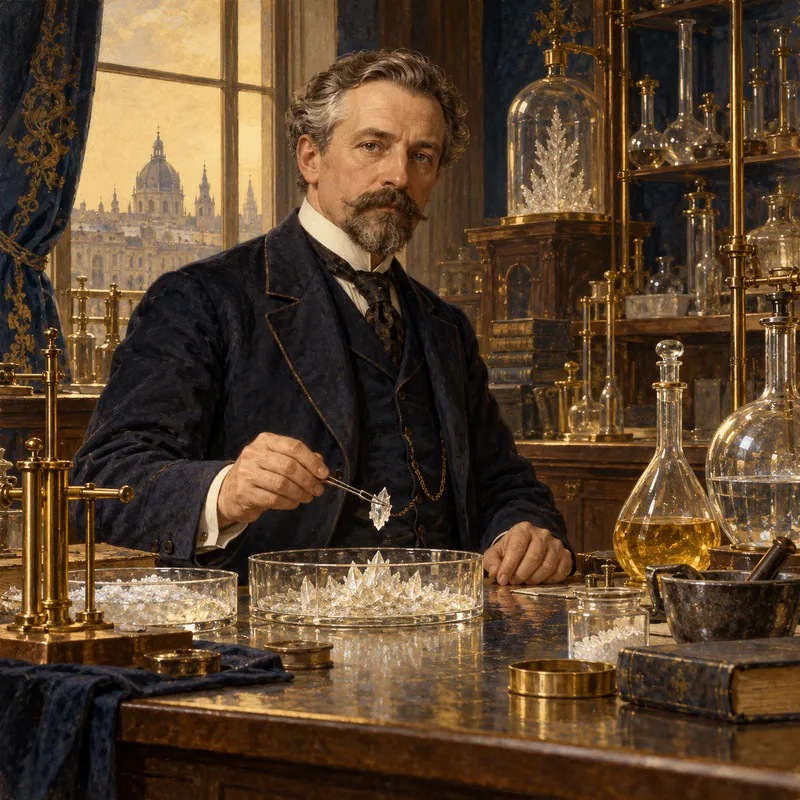
About the chemist
Carl Auer von Welsbach
1858-1929 · Austria
Gas mantle; ferrocerium flints; discovered Pr, Nd