The discovery, explained · Chemist no. 14 of 350
Kekulé and the Benzene Ring: The Structure That Built Organic Chemistry
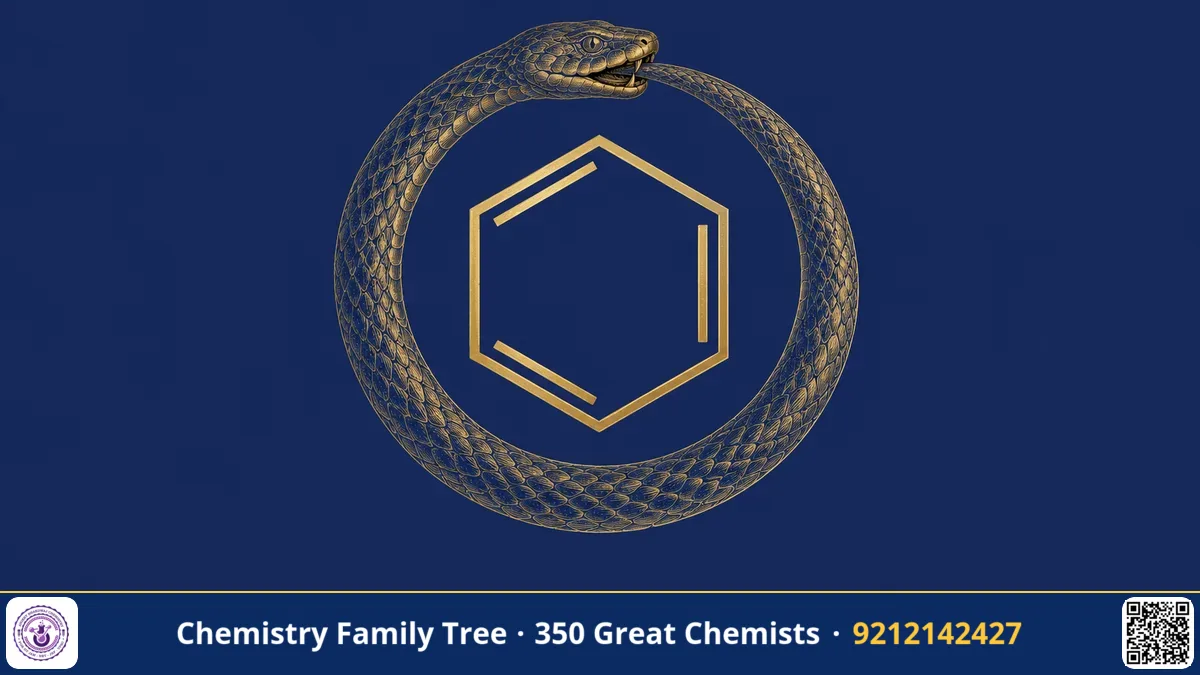
Few drawings in science are as famous as a simple hexagon with alternating double bonds. In 1865 the German chemist August Kekulé proposed that benzene, C₆H₆, is a closed ring of six carbon atoms, each bonded to one hydrogen. This idea solved a puzzle that had troubled chemists for forty years, and it opened the door to the chemistry of dyes, drugs, plastics and fragrances. Every Indian student who learns aromatic substitution, from Class 12 boards to GATE, is using a way of thinking that began with Kekulé's ring.
In this post we look at the problem Kekulé faced, how his proposal worked, what modern chemistry says about it, and how the topic appears in exams.
The Scientific Problem Before the Discovery
Michael Faraday first isolated benzene in 1825 from the oily liquid that collected in gas lighting cylinders. In 1834 Eilhard Mitscherlich heated benzoic acid with lime and obtained the same hydrocarbon, and from vapour density and analysis its molecular formula was fixed as C₆H₆. The formula was the trouble. A saturated hydrocarbon with six carbons should be C₆H₁₄ (hexane). Benzene has eight hydrogens fewer, so it appeared to be extremely unsaturated.
Yet benzene did not behave like an unsaturated compound. Alkenes quickly decolourise bromine water and react with cold dilute potassium permanganate. Benzene does neither. Instead it prefers substitution reactions, such as nitration and halogenation, in which a hydrogen is replaced and the ring survives. Chemists had a formula but no structure that explained this strange stability.
The wider background also mattered. Before 1858 there was no clear idea of how atoms were joined. Kekulé himself, along with Archibald Couper, contributed the key ideas that carbon is tetravalent (it forms four bonds) and that carbon atoms can link with each other to form chains. Without these two rules, no structure for benzene could even be attempted.
The Discovery: How the Ring Idea Emerged
Kekulé published his ring proposal in 1865 in French, and a fuller German version followed in 1866. He worked in Ghent, Belgium, at that time. His reasoning was a logical chain, not just a flash of imagination:
- Each carbon must have four bonds, and each carbon in benzene carries one hydrogen.
- Six carbons joined in an open chain could not use up their valencies with only six hydrogens, so the chain must close into a ring.
- To give every carbon four bonds, the ring needs alternating single and double bonds.
The structure can be written as:
      H
      |
  H–C   C–H        Kekulé structure I:
    ‖     |        C1=C2, C3=C4, C5=C6
  H–C   C–H
      C
      |
      H
Later, in 1890, at a celebration called the Benzolfest held in his honour, Kekulé told a story about how the idea came to him. He described dozing by the fire and seeing atoms form chains that twisted like snakes, one of which seized its own tail. He said he woke and spent the night working out the consequences. Historians still debate how literally to take this tale, but it is an excellent reminder that scientific insight needs both imagination and careful reasoning.
There was a problem with a fixed structure. If benzene really had three fixed double bonds, then 1,2-disubstituted benzene should exist in two forms: one where the substituents sit across a double bond and one where they sit across a single bond. Only one ortho isomer was ever found. In 1872 Kekulé answered this by suggesting that the double and single bonds oscillate rapidly between two positions. This idea is the ancestor of the modern concept of resonance.
The Chemistry Behind It
Today we know that benzene is a planar molecule and all six C–C bonds are the same length, about 139 pm. This lies between a C–C single bond (154 pm) and a C=C double bond (134 pm). Each carbon is sp² hybridised. The six unhybridised p orbitals overlap sideways to form a delocalised cloud of six π electrons above and below the plane of the ring.
Kekulé's two structures are resonance contributors; the real molecule is a resonance hybrid, often drawn as a hexagon with a circle inside. The extra stability can be seen in thermochemical data:
| Compound | Heat of hydrogenation (approx.) |
|---|---|
| Cyclohexene (1 double bond) | −120 kJ/mol |
| Hypothetical cyclohexatriene (3 × cyclohexene) | −360 kJ/mol |
| Benzene (actual) | −208 kJ/mol |
The difference, about 150 kJ/mol, is the resonance (delocalisation) energy. This is why benzene resists addition, which would destroy the aromatic sextet, and prefers electrophilic substitution, which keeps it. A typical example is nitration:
C₆H₆ + HNO₃ → C₆H₅NO₂ + H₂O (conc. H₂SO₄, about 50 °C)
Later, Erich Hückel gave the rule for aromaticity: a planar, cyclic, fully conjugated molecule with (4n + 2) π electrons is aromatic. Benzene has six π electrons (n = 1).
Applications Today
Benzene itself is now handled carefully because it is a known carcinogen, but its derivatives are everywhere. Phenol leads to resins and medicines, aniline to azo dyes, and styrene to polystyrene. Paracetamol, aspirin and many antibiotics contain benzene rings. Toluene and xylenes are important industrial solvents, and para-xylene is the raw material for polyester fibre. Petrochemical complexes in India produce aromatic hydrocarbons from refinery streams, supporting a large textile and packaging industry. In the laboratory, the whole subject of aromatic substitution, from Friedel–Crafts reactions to diazonium chemistry, depends on the structural picture that Kekulé started.
Exam Corner
- Benzene has a molecular formula C₆H₆, with all C–C bonds equal (139 pm) and all bond angles 120°.
- Resonance energy of benzene is about 150 kJ/mol (36 kcal/mol); it explains the lower heat of hydrogenation than expected.
- Benzene gives electrophilic substitution, not addition, under normal conditions.
- Hückel's rule: (4n + 2) π electrons; cyclobutadiene (4 π) is antiaromatic, and the cyclopentadienyl anion (6 π) is aromatic.
- Kekulé's oscillation hypothesis explained why only one 1,2-disubstituted benzene exists; modern resonance theory replaces it.
Common Misconceptions
- "Benzene flips between two structures." It does not. Kekulé's structures are not real, separate forms in equilibrium. There is one structure, the hybrid.
- "Benzene has alternating long and short bonds." Experiments show all six bonds are equal.
- "Kekulé discovered benzene." Faraday isolated it in 1825; Kekulé proposed its structure.
Quick Revision Box
- Benzene isolated by Faraday (1825); structure proposed by Kekulé (1865).
- Planar, sp² carbons, six delocalised π electrons.
- C–C bond length 139 pm; resonance energy about 150 kJ/mol.
- Aromatic if planar, cyclic, conjugated with (4n + 2) π electrons.
- Typical reaction: electrophilic aromatic substitution.
- Kekulé also stated carbon is tetravalent and forms chains.
FAQ
When did Kekulé propose the benzene ring?
He published the ring structure in 1865 and gave a longer German paper in 1866.
Why does benzene not decolourise bromine water?
Its π electrons are delocalised, giving a large resonance stabilisation. Addition would destroy this, so benzene needs a catalyst such as FeBr₃ and reacts by substitution.
Is the snake dream a proven fact?
The story comes from Kekulé's own speech in 1890, decades after the event. Many historians treat it as a colourful memory, not a documented record.
How is the modern structure of benzene drawn?
Either as one Kekulé structure with the understanding that it is a resonance contributor, or as a hexagon with a circle that represents the delocalised electrons.
Published by ABC Chemistry — IIT-JAM | CSIR-NET | GATE Chemistry Coaching. Visit abcchemistry.com
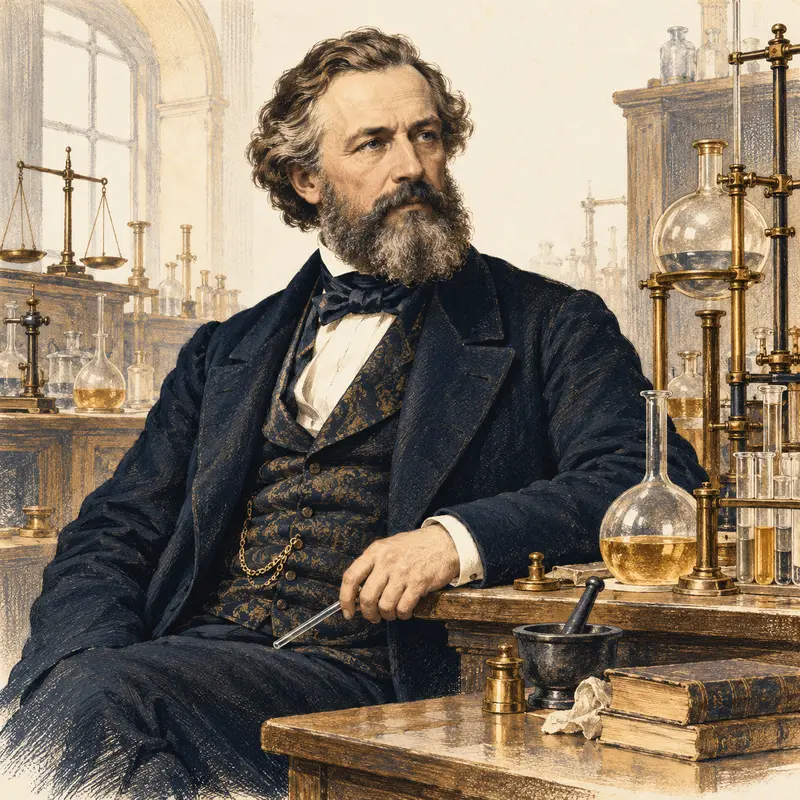
About the chemist
August Kekulé
1829-1896 · Germany
Structure of benzene; valence theory