Biography · Chemist no. 14 of 350
August Kekulé: The Architect Who Drew the Structure of Organic Chemistry
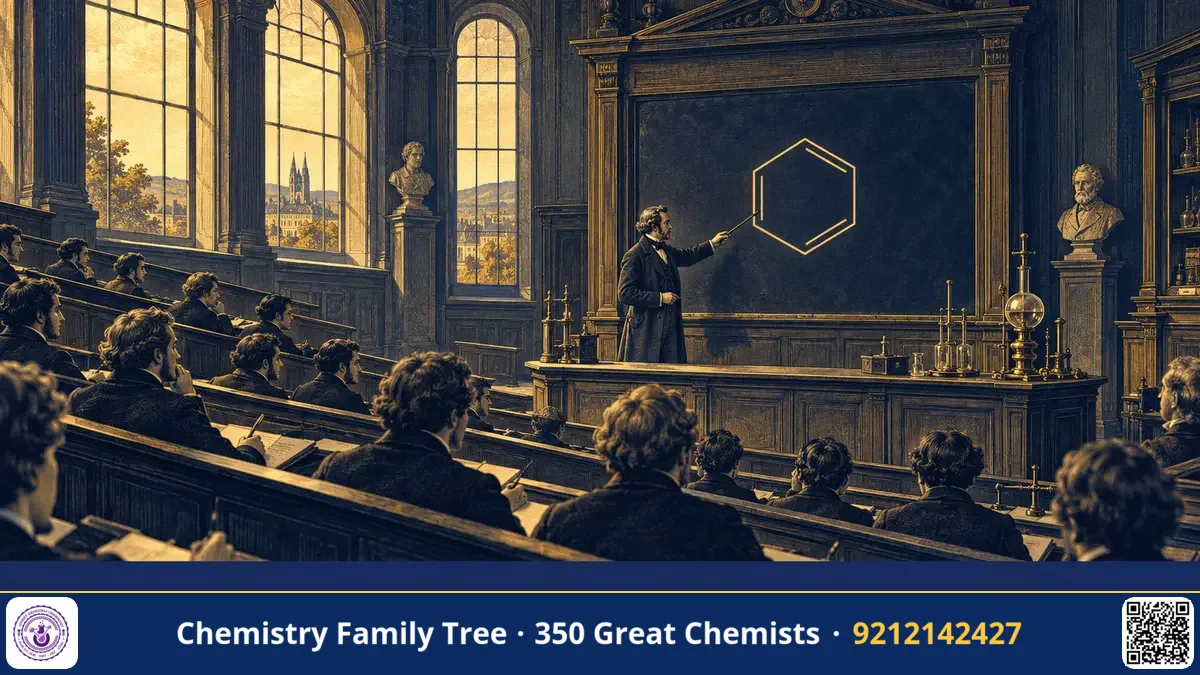
August Kekulé (1829–1896) was a German organic chemist who changed the way chemists think about molecules. He was among the first to state clearly that carbon is tetravalent and that carbon atoms can join to form chains, and in 1865 he proposed the ring structure of benzene. Because of these two ideas, organic chemistry became a science of structures instead of a collection of recipes. His legacy: the hexagon that every chemistry student learns to draw.
Early Life and Family
Friedrich August Kekulé was born on 7 September 1829 in Darmstadt, in the Grand Duchy of Hesse, Germany. His father, Ludwig Carl Kekulé, held a senior administrative post in the state service. The family was comfortable and well educated, and young August showed talent in drawing, languages and mathematics. Later in life, in 1895, the Emperor granted him the right to add "von Stradonitz" to his name, recalling the family's origins in Bohemia; he is therefore sometimes listed as Kekulé von Stradonitz.
His personal life carried sorrow. He married Stéphanie Drory in Ghent, but she died not long after the birth of their son, Stephan. Kekulé later remarried and had further children. His son Stephan became a well-known genealogist.
Education and Mentors
In 1847 Kekulé entered the University of Giessen to study architecture, which suited his talent for drawing and spatial thinking. He attended lectures by the great chemist Justus von Liebig and was so inspired that he switched to chemistry, despite his family's hopes. He received his doctorate at Giessen in 1852.
After this he travelled and learned from several centres of chemistry:
- Switzerland, as assistant to Adolf von Planta.
- Paris, where he met the ideas of Charles Gerhardt and others of the French school and became acquainted with Charles-Adolphe Wurtz.
- London, where he worked with Alexander Williamson at University College and, with John Stenhouse, at St Bartholomew's Hospital.
Williamson's work on ether formation and Gerhardt's "type theory" strongly influenced Kekulé's ideas about how atoms are combined.
Career Timeline
| Year | Event |
|---|---|
| 1829 | Born in Darmstadt on 7 September |
| 1847 | Enters Giessen to study architecture; switches to chemistry under Liebig |
| 1852 | Doctorate at Giessen |
| 1853–1855 | Studies and works in Paris and London |
| 1856 | Becomes Privatdozent at Heidelberg |
| 1858 | Publishes his paper on carbon's tetravalency and chain formation; appointed professor at Ghent |
| 1860 | Helps organise the first international chemistry congress at Karlsruhe |
| 1865–1866 | Proposes the cyclic structure of benzene |
| 1867 | Moves to the University of Bonn as professor |
| 1872 | Puts forward the oscillation hypothesis for benzene |
| 1895 | Ennobled; adds "von Stradonitz" |
| 1896 | Dies in Bonn on 13 July |
Major Scientific Contributions
Kekulé's work can be grouped into three major contributions:
- Tetravalency of carbon. In 1857–1858 he argued that carbon forms four bonds. Archibald Couper reached similar conclusions independently in Britain, and the two are rightly credited together.
- Carbon chains. He proposed that carbon atoms can link to each other, which explains the enormous number of organic compounds. Methane, ethane and propane are the simplest examples: CH₄, C₂H₆, C₃H₈.
- The benzene ring. His 1865 proposal accounted for benzene's formula, its single isomer of monosubstituted products, and the existence of three disubstituted isomers (ortho, meta, para).
He also wrote an influential textbook, the Lehrbuch der organischen Chemie, which defined organic chemistry as "the chemistry of the carbon compounds". For a detailed look at the benzene problem, see our discovery post on Kekulé and the benzene ring.
Awards, Honours and Nobel Prize
Kekulé died in 1896, five years before the first Nobel Prizes were awarded in 1901, so he never received one. He was widely honoured during his lifetime. He served several times as president of the German Chemical Society (Deutsche Chemische Gesellschaft), was a member of leading scientific academies, and received the title of nobility mentioned above. In 1890 the German Chemical Society organised the Benzolfest in Berlin to celebrate twenty-five years of the benzene theory, a rare honour for a living scientist.
Personality, Struggles and Lesser-Known Facts
- From architecture to chemistry. His training in drawing may explain why he thought of molecules as structures built in space and on paper.
- The Karlsruhe Congress, 1860. Kekulé was one of the organisers of the first international meeting of chemists, held to settle the confusion over atomic weights and formulae. Stanislao Cannizzaro's ideas presented there helped bring order to the subject.
- The dream stories. Kekulé described two famous visions: atoms forming chains while he rode on a London omnibus, and, later, the snake biting its tail. He told these stories in his 1890 speech. They show how he valued imagination, and he even encouraged his audience to "learn to dream", but to check dreams with the sober test of experiment.
- A gifted teacher. Many later leaders of chemistry passed through his laboratories, including Adolf von Baeyer, who worked with him as assistant, and Jacobus van 't Hoff, who studied in Bonn for a time.
- Debates over priority. Josef Loschmidt, Archibald Couper and others drew related ideas, and historians still discuss how much credit each should receive. Such debates are normal in science, and it is fair to say Kekulé was the one who made the benzene ring idea widely accepted.
Legacy and Influence on Modern Chemistry
The language of organic chemistry, with its lines for bonds and its rings and chains, is built on Kekulé's approach. Structural formulae enabled the synthetic dye industry in Germany, the pharmaceutical industry, and the spread of petrochemicals. The concept of resonance, developed fully in the 1920s and 1930s by Linus Pauling and others, is a direct descendant of his oscillation idea. Modern concepts such as aromaticity, Hückel's rule and the stability of heterocycles like pyridine and furan all rest on his picture. The Kekulé structure is still used every day in textbooks, in exams and in research papers.
Lessons for Students
- Combine imagination with logic: Kekulé's dream was only useful because he tested it against isomer data.
- Learn from many places and teachers, as he did in Giessen, Paris and London.
- Be ready to revise a model. He changed his structure to answer the isomer problem.
- Draw clearly. Good diagrams are a powerful scientific tool, and in exams they earn marks.
Quick Facts Box
- Born: 7 September 1829, Darmstadt, Hesse (Germany)
- Died: 13 July 1896, Bonn, Germany
- Nationality: German
- Field: Organic chemistry, chemical structure
- Famous for: Tetravalency of carbon, carbon chains, ring structure of benzene
- Nobel Prize: None (he died before the prizes began)
FAQ
Did August Kekulé win a Nobel Prize?
No. He died in 1896, and the first Nobel Prizes were awarded in 1901.
Where did Kekulé work when he proposed the benzene ring?
He was a professor at the University of Ghent in Belgium. He moved to Bonn in 1867.
Why did Kekulé first study architecture?
He had a talent for drawing and design. After hearing Liebig's lectures at Giessen he decided that chemistry was his real interest.
Who were Kekulé's famous students?
Adolf von Baeyer assisted him early in his career, and Jacobus van 't Hoff studied in Bonn with him. Both later won Nobel Prizes in Chemistry.
Published by ABC Chemistry — IIT-JAM | CSIR-NET | GATE Chemistry Coaching. Visit abcchemistry.com
About the chemist
August Kekulé
1829-1896 · Germany
Structure of benzene; valence theory