Biography · Chemist no. 184 of 350
Avram Hershko: The Survivor Who Explained How Cells Destroy Proteins
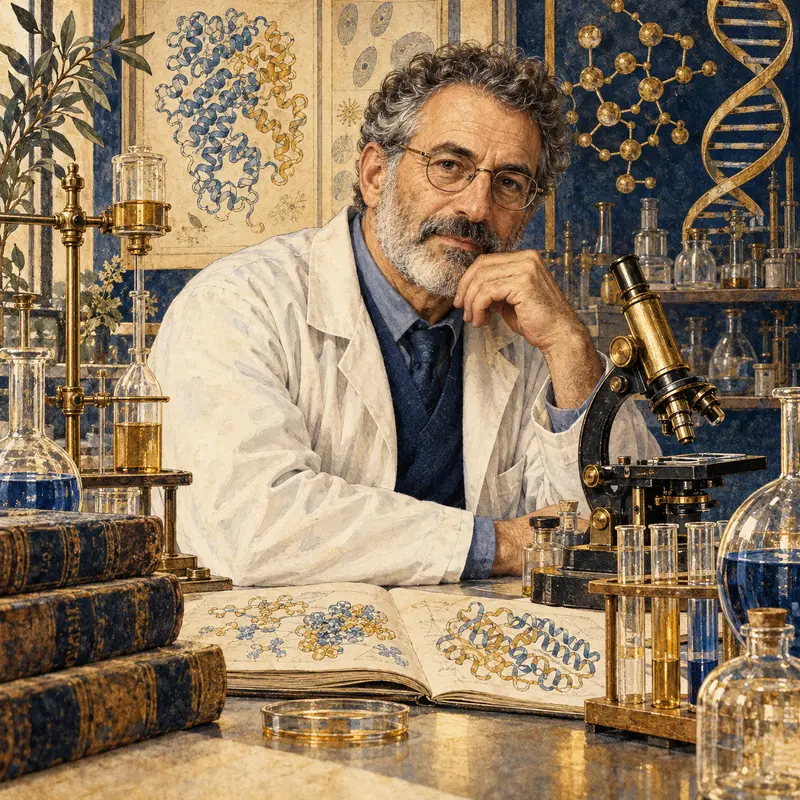
Avram Hershko (born 31 December 1937) is a Hungarian-born Israeli biochemist and physician who spent his career at the Technion – Israel Institute of Technology. With his student Aaron Ciechanover and with Irwin Rose, he uncovered the ubiquitin system of regulated protein degradation. They shared the 2004 Nobel Prize in Chemistry. His life story, from a childhood in wartime Hungary to Stockholm, is as remarkable as his science.
Early Life and Family
Hershko was born in Karcag, Hungary, and was originally named Herskó Ferenc. He was a child during World War II and, as a Jewish boy, experienced the persecution of Hungarian Jews in the war years. He survived the Holocaust, and in 1950 his family emigrated to Israel, where he grew up. Arriving as a boy in a young country, he adjusted to a new language and culture and found that school and reading opened doors. He has spoken in interviews about the importance of his teachers and about the fact that he loved reading and learning science.
Education and Mentors
He studied medicine at the Hebrew University–Hadassah Medical School in Jerusalem, receiving his MD in 1965, and served as a military physician in the Israel Defense Forces. He then returned to the Hebrew University for a PhD (1969) in biochemistry. He did a postdoctoral stay at the University of California, San Francisco, with Gordon Tomkins, who studied how hormones regulate enzyme levels (the work of tyrosine aminotransferase). This was important: it made Hershko ask how enzymes are degraded as well as made. He returned to Israel and joined the Technion's new Faculty of Medicine in Haifa in 1972. In the following decade he spent sabbaticals in the laboratory of Irwin Rose at the Fox Chase Cancer Center in Philadelphia, where he was taught rigorous enzyme chemistry.
Career Timeline
| Year | Event |
|---|---|
| 1937 | Born in Karcag, Hungary |
| 1950 | Family emigrates to Israel |
| 1965 | MD, Hebrew University–Hadassah Medical School |
| 1969 | PhD, Hebrew University |
| Early 1970s | Postdoctoral work at UCSF with Gordon Tomkins; joins the Technion |
| Late 1970s | With Ciechanover and Rose, discovers ATP-dependent ubiquitin conjugation of proteins |
| 1990s | Shows that cyclins are ubiquitinated and destroyed in the cell cycle |
| 2004 | Nobel Prize in Chemistry (shared) |
Major Scientific Contributions
Hershko's work answers a question that looked paradoxical: why does the hydrolysis of proteins need ATP? The answer is that ATP is spent on marking a substrate with ubiquitin, not on cutting the peptide bonds. In the cascade, E1 adenylates and then forms a thioester with ubiquitin, E2 carries it, and E3 ligases pick the substrate. Chains of four or more Lys48-linked ubiquitins send the protein to the 26S proteasome. The equation, ubiquitin–COO⁻ + ATP → ubiquitin–CO–AMP + PPi, followed by thioester and isopeptide formation, appears in our discovery article.
His group also found that cyclin B is destroyed by ubiquitination, via the anaphase-promoting complex, which is how mitosis ends in a one-way step. This tied a biochemical pathway to one of the central events in cell biology.
Awards, Honours and Nobel Prize
- Nobel Prize in Chemistry 2004: shared by Aaron Ciechanover, Avram Hershko and Irwin Rose "for the discovery of ubiquitin-mediated protein degradation". The prize was in Chemistry, not Medicine.
- Albert Lasker Basic Medical Research Award (2000), shared with Ciechanover and Alexander Varshavsky.
- Israel Prize (2003) in life sciences with Ciechanover.
- Foreign membership of major academies, including the US National Academy of Sciences, and many honorary degrees.
Personality, Struggles and Lesser-Known Facts
- A survivor's perspective: Having survived the Holocaust as a child, he has described science as a haven where curiosity could be pursued freely.
- Serendipity and rigour: He emphasises that while a lucky observation may start a discovery, the hard biochemistry that follows must be done with care, which is how his lab separated fractions and identified each one.
- Small lab, big result: The Technion medical faculty was new and had limited facilities, and the work succeeded with simple equipment and clever thinking.
- Crediting colleagues: He has regularly credited Ciechanover, Rose and others for their roles in the shared discovery.
- Medicine to biochemistry: Although trained as a doctor, he left clinical work to spend his life on basic research, an uncommon choice.
Legacy and Influence on Modern Chemistry
The ubiquitin system has become a large field, with hundreds of E3 ligases known in humans. It forms the basis for cancer drugs such as bortezomib and for the new class of targeted protein degraders. It explains the regulation of the cell cycle, DNA repair, immune signalling and even plant growth. Indian laboratories at institutions such as the National Centre for Biological Sciences (NCBS, Bengaluru) and several IISERs study the ubiquitin system, and its chemistry (adenylation, thioester exchange and isopeptide formation) appears in advanced biochemistry courses.
Lessons for Students
- Ask questions about what looks paradoxical; a puzzle is a doorway.
- Learn enzymology: fractionation and assay design never go out of fashion.
- Your circumstances do not limit your future; Hershko rebuilt his life after war.
- Share credit with students and collaborators.
- Combine medicine, chemistry and biology rather than choosing one box.
Quick Facts Box
- Born: 31 December 1937, Karcag, Hungary
- Died: Living
- Nationality: Israeli (born in Hungary)
- Field: Biochemistry
- Famous for: Ubiquitin-mediated protein degradation; cyclin destruction
- Nobel: Chemistry 2004 (shared with Ciechanover and Rose)
FAQ
Where did Hershko work?
At the Technion – Israel Institute of Technology in Haifa, with sabbaticals in the United States.
Who was his famous student?
Aaron Ciechanover, who carried out much of the early experimental work and shared the Nobel Prize.
Was the prize in Medicine?
No. It was the Nobel Prize in Chemistry for 2004.
What is the main idea of his work?
Cells use ATP to tag unwanted or regulatory proteins with ubiquitin, so that the proteasome destroys them at the right time.
Published by ABC Chemistry — IIT-JAM | CSIR-NET | GATE Chemistry Coaching. Visit abcchemistry.com
About the chemist
Avram Hershko
1937- · Israel · Nobel Chemistry 2004
Ubiquitin-mediated protein degradation