The discovery, explained · Chemist no. 184 of 350
Avram Hershko and ATP-Dependent Proteolysis: The Logic of Controlled Destruction
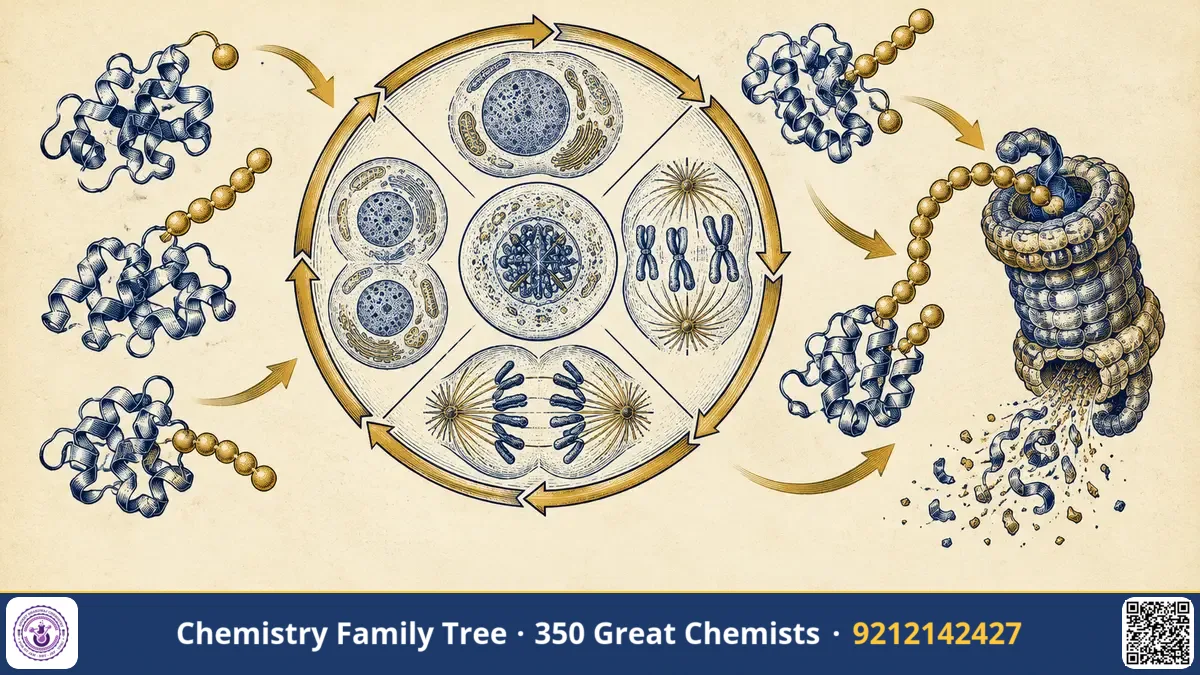
Why would a cell spend chemical energy to destroy a protein? Breaking a peptide bond by water releases energy rather than costing it. Yet in the 1970s Avram Hershko, a biochemist at the Technion in Haifa, noticed that protein breakdown in cells needs ATP. This paradox led to the discovery of the ubiquitin-proteasome system. In 2004 Hershko, his former student Aaron Ciechanover and Irwin Rose shared the Nobel Prize in Chemistry for it.
While the previous post on Ciechanover focused on the first conjugation experiments, this one follows Hershko's intellectual path: the question of energy and selectivity, the polyubiquitin chain as a signal, and the discovery that cells use the system to control the cell cycle.
The Scientific Problem Before the Discovery
Hershko began as a physician and became interested in how cells regulate enzyme levels. Textbooks of the time concentrated on enzyme synthesis (the central dogma of DNA to RNA to protein). But the steady-state level of any protein is a balance between synthesis and degradation:
d[P]/dt = k_synthesis − k_degradation · [P]
If degradation is slow and unregulated, then regulation by synthesis alone would be sluggish. Yet cells respond to hormones within minutes, so degradation of some proteins must be rapid and regulated. Experiments by Alfred Goldberg and others had shown that in reticulocytes, and in bacteria, protein breakdown needed ATP. A thermodynamically downhill reaction needing ATP strongly suggested a hidden mechanism that couples ATP hydrolysis to selection of the target. Hershko wanted to find it with traditional enzymology: take cells apart, separate fractions, and identify each component.
The Discovery: Step by Step
- Fractionation of reticulocyte lysate (1977–78): Hershko and Ciechanover separated the extract on a DEAE-cellulose column into a flow-through fraction (called fraction I) and a bound fraction (fraction II). Both fractions plus ATP were needed to degrade proteins.
- APF-1: The active factor in fraction I was small, heat-stable and became attached to proteins, as shown with radioactive labelling.
- Sabbatical at Fox Chase (1977–78 and later): Working with Irwin Rose, whose strength was classical enzyme mechanisms, Hershko tested ideas about how ATP is used. The group demonstrated that APF-1 conjugation to proteins was the energy-dependent step and that it formed multiple linkages.
- Polyubiquitin chain model (1980s): The group proposed that proteins are tagged with chains of ubiquitin, in which each ubiquitin is linked to a lysine of the previous one. Later work showed that a chain of at least four ubiquitins linked through lysine-48 forms the proteasome-targeting signal.
- Cell-cycle regulation (1990s): Using extracts of clam eggs (for cyclins) and other systems, Hershko's group showed that cyclin B, the partner of Cdk1, is ubiquitinated by an E3 ligase complex now called the anaphase-promoting complex/cyclosome (APC/C). Destruction of cyclin lets the cell exit mitosis.
The Chemistry Behind It
The need for ATP is explained by the activation chemistry. A carboxylate is not reactive enough to form an amide with an amine, so it must be turned into an activated acyl derivative first:
Ub–COO⁻ + ATP → Ub–CO–AMP + PPi
Ub–CO–AMP + E1–SH → Ub–CO–S–E1 + AMP
Ub–CO–S–E2 + H₂N–Lys–Protein → Ub–CO–NH–Lys–Protein + HS–E2
The sum of these steps is the formation of an isopeptide bond at the cost of ATP → AMP + PPi (two high-energy phosphate bonds). So the energy of ATP is spent on marking the protein, and the later proteolysis in the proteasome is energetically downhill. The ATP also drives the AAA+ ATPase ring of the 19S regulatory particle, which unfolds the substrate and pushes it into the 20S catalytic core, where threonine residues cut the peptide chain.
The cell-cycle example shows why chemistry matters for biology. The activity of Cdk1 depends on cyclin B. Cyclin level rises during interphase, and Cdk1 triggers mitosis. At metaphase–anaphase transition APC/C, activated by its partner Cdc20, attaches ubiquitin chains to cyclin B and to securin. Destruction of securin releases separase, which cleaves the cohesin that holds sister chromatids together. A chemical modification therefore creates an irreversible biological decision: once cyclin is destroyed, the cell cannot go backward.
Applications Today
- Cancer biology: Many oncogenes and tumour suppressors are controlled by ubiquitination (p53 by the E3 ligase Mdm2, for instance). Proteasome inhibitors such as bortezomib treat multiple myeloma.
- Cell-cycle drugs: Understanding APC/C helps in designing mitosis-targeting anticancer drugs.
- Targeted protein degradation: Molecules such as PROTACs and molecular glues redirect E3 ligases to destroy chosen proteins.
- Agriculture: Plant hormones such as auxin act by triggering ubiquitin-dependent degradation of repressor proteins.
- Research tools: Degron tags allow scientists to remove a protein quickly in a living cell.
Exam Corner
- Hershko shared the 2004 Nobel Prize in Chemistry with Ciechanover and Rose.
- ATP is used to adenylate ubiquitin and then form an E1–ubiquitin thioester; the final isopeptide bond forms between Gly-76 and Lys ε-NH₂.
- Lys48-linked chains with at least four ubiquitins target substrates to the 26S proteasome.
- APC/C is an E3 ligase that ubiquitinates cyclin B and securin in mitosis.
- The 26S proteasome = 20S core (catalytic) + 19S regulatory cap (ATPases).
Common Misconceptions
- "Hershko discovered ubiquitin." Ubiquitin was isolated in 1975 by Gideon Goldstein and colleagues; Hershko's group discovered its function in proteolysis.
- "All ubiquitination leads to degradation." Only some chain types do; others signal repair or trafficking.
- "Proteolysis is just waste disposal." It is a precise regulatory switch, as in the cell cycle.
Quick Revision Box
- Hershko: Technion, Haifa; Chemistry Nobel 2004 (one-third share).
- Paradox solved: ATP is used to tag, not to cut.
- Activation: Ub + ATP → Ub–AMP → E1~Ub thioester.
- Signal: Lys48 polyubiquitin chain (four or more).
- APC/C ubiquitinates cyclin B, ending mitosis.
- 26S proteasome: 20S core plus 19S ATPase cap.
FAQ
How is Hershko's contribution different from Ciechanover's?
Ciechanover did the key labelling and fractionation experiments as a student; Hershko led the project, developed the concepts, including chains and regulation, and extended it to cell-cycle control.
What is an E3 ligase?
An enzyme or complex that recognises a particular substrate and transfers ubiquitin to it, giving the system specificity.
Why does the cell cycle need proteolysis?
Because destroying cyclin and securin at the right moment is irreversible, ensuring that mitosis proceeds in one direction.
Is ubiquitination reversible?
Yes. Deubiquitinating enzymes remove ubiquitin, and the free ubiquitin is recycled.
Published by ABC Chemistry — IIT-JAM | CSIR-NET | GATE Chemistry Coaching. Visit abcchemistry.com
About the chemist
Avram Hershko
1937- · Israel · Nobel Chemistry 2004
Ubiquitin-mediated protein degradation