The discovery, explained · Chemist no. 205 of 350
Aziz Sancar and the Chemistry of DNA Repair: How Cells Fix Sunlight Damage
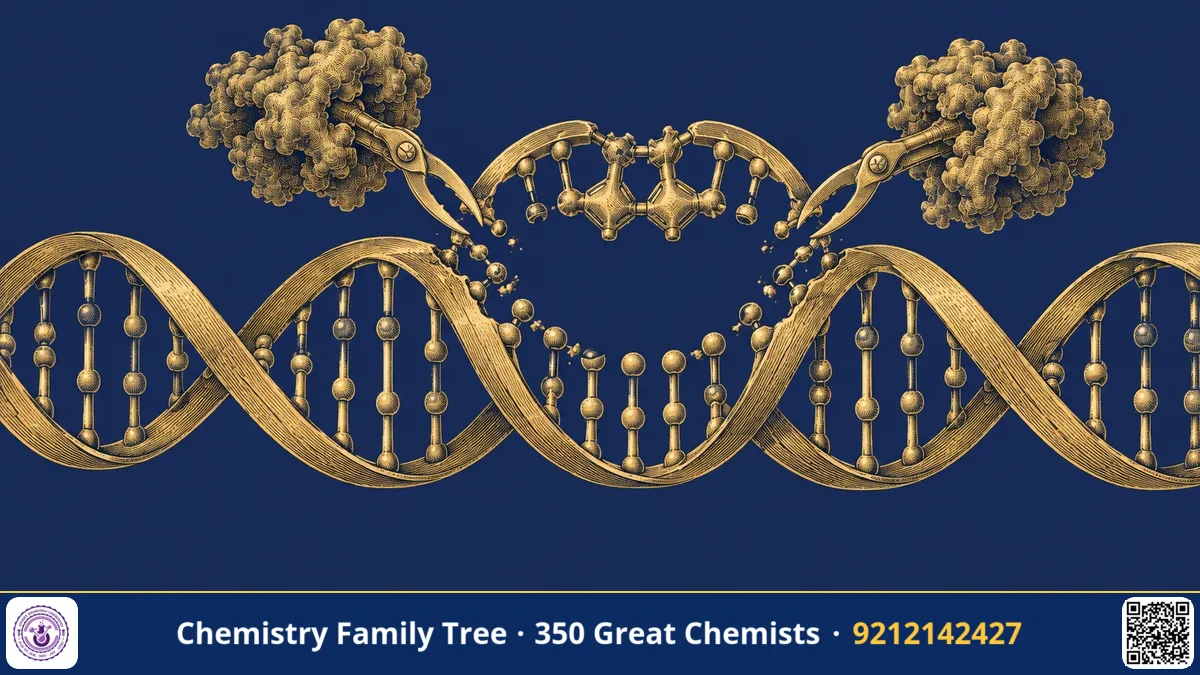
Every day, the DNA in each of your cells is hit by thousands of damaging events. Ultraviolet light from the sun, chemicals in smoke, and even normal metabolism chemically alter the bases of DNA. If these errors were not corrected, life as we know it could not survive. Aziz Sancar, a Turkish-American biochemist, spent decades working out exactly how cells detect and remove such damage. His work on photolyase and on nucleotide excision repair earned him a share of the 2015 Nobel Prize in Chemistry, together with Tomas Lindahl and Paul Modrich, "for mechanistic studies of DNA repair".
For students, this story is a perfect mix of organic chemistry (photochemistry of pyrimidines), biochemistry (enzymes and cofactors) and molecular biology. Let us walk through it step by step.
The Scientific Problem Before the Discovery
By the 1950s and 1960s, scientists knew that ultraviolet (UV) light kills bacteria and causes skin cancer in mammals. They also knew that DNA is the genetic material, and that UV light is strongly absorbed by DNA bases near 260 nm. What they did not know was how a cell survives such an assault.
The key chemical lesion was identified: when two pyrimidine bases (thymine or cytosine) sit next to each other on the same strand, UV light can make them react. The most common product is the cyclobutane pyrimidine dimer (CPD), formed by a [2+2] photocycloaddition between the C5=C6 double bonds of neighbouring thymines. A second lesion, the 6-4 photoproduct, is also formed. Both distort the double helix and block DNA polymerase.
Two puzzles remained. First, bacteria exposed to UV light survived much better if they were afterwards exposed to visible blue light, a phenomenon called photoreactivation. Second, bacteria kept in the dark could also recover, which suggested a light-independent repair route. Humans with the rare inherited disease xeroderma pigmentosum (XP) develop skin cancers at very young ages after sun exposure, hinting that a repair system was missing in them.
The Discovery: Step by Step
Step 1: Cloning the photolyase gene
As a young researcher at the University of Texas at Dallas, Sancar worked on photoreactivation. Using recombinant DNA techniques that were new in the late 1970s, he cloned the gene for DNA photolyase from E. coli and produced the enzyme in large quantity. This was a landmark because it let him purify and study the protein in detail. Photolyase contains a flavin cofactor (FADH⁻) and a second light-harvesting cofactor. It binds to a CPD in DNA, absorbs blue light, and transfers an electron to the dimer, which splits the cyclobutane ring and restores two normal thymines:
T<>T (cyclobutane dimer) + hv (blue light, photolyase) → T + T
Step 2: Finding the dark repair system
Sancar then turned to repair in the dark. Earlier genetics had identified E. coli genes called uvrA, uvrB and uvrC that were needed to survive UV damage. Sancar cloned these genes, purified the three proteins UvrA, UvrB and UvrC, and showed in a test tube that together they act as an "excision nuclease", an enzyme system that cuts out a damaged piece of DNA.
Step 3: The mechanism
The repair process in E. coli that Sancar and colleagues established can be summarised as follows:
- Damage recognition: A UvrA dimer with UvrB (UvrA₂B) scans DNA and locates a distortion.
- Verification: UvrA leaves; UvrB remains bound at the lesion and opens the DNA locally.
- Dual incision: UvrC joins UvrB and makes two cuts on the damaged strand, one on each side of the lesion. In E. coli this releases a fragment of about 12 to 13 nucleotides carrying the damage.
- Removal: The helicase UvrD removes the short damaged oligonucleotide.
- Gap filling and sealing: DNA polymerase I fills the gap using the undamaged strand as template, and DNA ligase seals the nick.
Sancar later showed that human cells use the same logic with different proteins. Using human cell extracts, his group reconstituted human excision repair, found that the damaged strand is cut on both sides of the lesion and that a fragment of roughly 24 to 32 nucleotides is released. Defects in these human proteins explain xeroderma pigmentosum.
The Chemistry Behind It
Three chemical ideas run through this work.
- Photochemistry: Absorption of a UV photon excites a pyrimidine to an excited state where its C5=C6 double bond reacts with a neighbouring base, a [2+2] cycloaddition that is thermally forbidden but photochemically allowed (Woodward-Hoffmann rules).
- Electron transfer catalysis: In photolyase, excited FADH⁻ donates an electron to the dimer, forming a radical anion that splits its ring bonds, and the electron then returns to the flavin. The enzyme is truly catalytic and regenerates itself.
- Molecular recognition: Excision repair does not recognise a specific chemical structure. It senses distortion of the helix, which is why one system can fix many different lesions such as UV dimers, bulky chemical adducts and cisplatin-DNA adducts.
Sancar also found that photolyase has relatives called cryptochromes, which are blue-light receptors and part of the circadian clock in animals and plants. His laboratory later showed their role in the molecular clock, linking DNA repair chemistry to our body rhythms.
Applications Today
- Cancer medicine: Cisplatin and related platinum drugs create DNA crosslinks. Tumours with strong nucleotide excision repair resist these drugs, so measuring repair capacity helps in choosing therapy.
- Skin cancer understanding: XP and related disorders are explained by faults in NER genes. Sun protection advice in India and elsewhere rests on this chemistry.
- Cosmetics and sunscreens: Products that include photolyase-like enzymes aim to help reverse CPD damage.
- Chronobiology: Cryptochrome research informs sleep and jet-lag studies.
- Basic biotechnology: UV-damage assays and excision assays are standard tools in toxicology labs.
Exam Corner
- Which lesion is the main UV product in DNA? Cyclobutane pyrimidine dimer (and the 6-4 photoproduct).
- Photolyase uses which cofactor and which light? FAD (reduced form) and blue/near-UV light.
- Name the E. coli NER proteins in order of action: UvrA, UvrB, UvrC, UvrD, DNA polymerase I, DNA ligase.
- Which disease results from defective human NER? Xeroderma pigmentosum (also Cockayne syndrome).
- The 2015 Chemistry Nobel for DNA repair went to Lindahl (base excision repair), Modrich (mismatch repair) and Sancar (nucleotide excision repair).
Common Misconceptions
- "DNA repair is a single pathway." No. Cells have base excision repair, nucleotide excision repair, mismatch repair, direct reversal and double-strand break repair, each for different damage.
- "Photolyase exists in humans." Placental mammals including humans lack functional photolyase for CPD repair; we rely on excision repair. We do have cryptochromes, which resemble it.
- "UV light only harms the skin surface." UV photons chemically change DNA bases in living cells, and unrepaired lesions become mutations.
Quick Revision Box
- Sancar shared the 2015 Nobel Prize in Chemistry with Lindahl and Modrich.
- CPD forms by [2+2] photocycloaddition of adjacent thymines.
- Photolyase reverses CPD using FADH⁻ and blue light.
- UvrABC excision nuclease cuts about 12 to 13 nucleotides in E. coli.
- Human NER removes about 24 to 32 nucleotides.
- Cryptochromes are photolyase-like clock proteins.
FAQ
Why did Sancar win a Chemistry Nobel and not Medicine?
The committee honoured the molecular mechanisms of repair, which are chemical processes carried out by enzymes. The 2015 prize in Chemistry was awarded for "mechanistic studies of DNA repair".
What is the difference between photoreactivation and excision repair?
Photoreactivation uses photolyase and light to reverse the damage directly. Excision repair cuts out the damaged piece and rebuilds it using the other strand as template, and works in the dark.
Why is a fragment, not just one base, removed?
The enzyme recognises helix distortion, so it removes a short stretch around the lesion, which makes the system flexible for many kinds of damage.
Is this topic useful for CSIR-NET?
Yes. DNA repair pathways, photochemistry of nucleic acids and cofactors such as FAD appear in Life Sciences and Chemical Sciences papers.
Published by ABC Chemistry — IIT-JAM | CSIR-NET | GATE Chemistry Coaching. Visit abcchemistry.com
About the chemist
Aziz Sancar
1946- · United States · Nobel Chemistry 2015
Nucleotide excision repair of DNA