Biography · Chemist no. 208 of 350
Ben Feringa: The Dutch Farm Boy Who Built a Molecular Motor
Bernard Lucas "Ben" Feringa (born 18 May 1951) is a Dutch synthetic organic chemist and professor at the University of Groningen. He shared the 2016 Nobel Prize in Chemistry with Jean-Pierre Sauvage and Fraser Stoddart. His legacy in one line: he created the first molecular motor that rotates continuously in one direction and showed how light can control molecules, from machines to medicines.
Early Life and Family
Feringa was born in Barger-Compascuum, in the province of Drenthe in the north-east Netherlands. He grew up in a farming family; he is the eldest of several children, and he has spoken about growing up on a small farm, where he helped with daily work. His parents had limited formal education but supported curiosity and hard work. He has often said that growing up on a farm taught him about nature and about the value of practical thinking. As a boy he was interested in science and also in how things work.
Education and Mentors
He studied chemistry at the University of Groningen and obtained his PhD there in 1978 under Hans Wynberg, an organic chemist known for his work on asymmetric synthesis and thiophene chemistry. Wynberg's interest in chirality had a lasting influence. After his doctorate, Feringa worked in industry at Shell in Amsterdam and then The Hague, working on applied organic chemistry and catalysis for several years before returning to Groningen as a lecturer in 1984. He became a full professor in 1988.
Career Timeline
| Year | Event |
|---|---|
| 1951 | Born in Barger-Compascuum, the Netherlands |
| 1978 | PhD, University of Groningen, under Hans Wynberg |
| Late 1970s-1984 | Research at Shell |
| 1984 | Returns to Groningen as lecturer |
| 1988 | Appointed professor of organic chemistry |
| 1999 | Reports the first unidirectional light-driven molecular motor |
| 2011 | Group reports a four-wheel-drive molecular nanocar |
| 2016 | Shares the Nobel Prize in Chemistry |
Major Scientific Contributions
- Molecular motors: light-driven rotary motors based on overcrowded alkenes with a four-step rotation cycle.
- Molecular switches: chiral photoswitches, controlling properties such as colour, liquid-crystal order and chirality.
- Nanocar: a molecule with four motor units as wheels that moved on a surface.
- Asymmetric catalysis: development of copper-catalysed enantioselective conjugate additions of organometallic reagents, and of phosphoramidite ligands such as MonoPhos for asymmetric hydrogenation.
- Photopharmacology: drugs that can be switched on and off with light.
More detail on the motor chemistry is in our companion post on the molecular motor discovery.
Awards, Honours and Nobel Prize
The Nobel Prize in Chemistry 2016 was shared among Sauvage, Stoddart and Feringa "for the design and synthesis of molecular machines". Feringa is a member of the Royal Netherlands Academy of Arts and Sciences and has received numerous other honours, including the Spinoza Prize in the Netherlands, and he was made a Knight of the Order of the Netherlands Lion.
Personality, Struggles and Lesser-Known Facts
- Farm roots: He often connects his scientific approach to his childhood on a farm, saying that curiosity and patience matter.
- Industry experience: Working at Shell gave him a practical view of chemistry before he returned to academia.
- Speaking to the public: He is known as a lively communicator who explains molecular machines with analogies such as cars and elevators.
- Asymmetric catalysis was his earlier fame: Many chemists knew him first for catalysis, and the motors came as a very different, risky direction.
- Playing with ideas: He has said the freedom to follow curiosity, without a fixed application in mind, was essential to his discoveries.
Legacy and Influence on Modern Chemistry
Feringa's motors turned the idea of nanotechnology from a vision into a molecular reality. They introduced the principle of using light energy plus a chemical ratchet for directional motion. The same group's photopharmacology offers a path to drugs with precise spatial and time control, and may help address antibiotic resistance, since a drug that switches off by itself will not persist in the environment. His school of thought encourages chemists to design function through control of structure and dynamics.
Another side of Feringa's career deserves mention for students: his belief in teaching and in the wider purpose of science. At Groningen he trained a large number of doctoral students and postdoctoral researchers, and he often says that the best ideas come from the interaction between young minds and experienced ones. He has also been active in explaining science to the public and to schools, using demonstrations and everyday comparisons to describe how a molecule can behave like a motor. His earlier work on asymmetric catalysis is still taught in advanced organic chemistry, where the copper-catalysed conjugate addition of Grignard and organozinc reagents appears as an example of enantioselective carbon-carbon bond formation. In this way, his career links two major themes of modern organic chemistry: the control of three-dimensional shape in synthesis, and the control of motion in function. Both rely on the same foundation, namely a deep understanding of stereochemistry.
Lessons for Students
- Keep curiosity alive. A farm child became a molecular engineer.
- Explore beyond your speciality. He moved from catalysis to machines.
- Learn stereochemistry well. Chirality sits at the heart of his motor design.
- Communicate clearly. Simple analogies help science reach everyone.
- Take scientific risks. Great discoveries come from unexpected ideas.
Quick Facts Box
- Born: 18 May 1951, Barger-Compascuum, Netherlands
- Died: Living (as of this writing)
- Nationality: Dutch
- Field: Organic chemistry, molecular nanotechnology
- Famous for: Light-driven molecular motors, nanocar, photopharmacology
- Nobel: Chemistry 2016, shared with Sauvage and Stoddart
FAQ
Where does Feringa work?
At the University of Groningen, in the Netherlands.
Who was his doctoral supervisor?
Hans Wynberg.
What is photopharmacology?
A field in which drugs contain photoswitchable units so their activity can be turned on or off by light at a chosen place and time.
Which exam topics link to his work?
Stereochemistry, photochemistry of alkenes, asymmetric catalysis and organometallic reagents.
Published by ABC Chemistry — IIT-JAM | CSIR-NET | GATE Chemistry Coaching. Visit abcchemistry.com
About the chemist
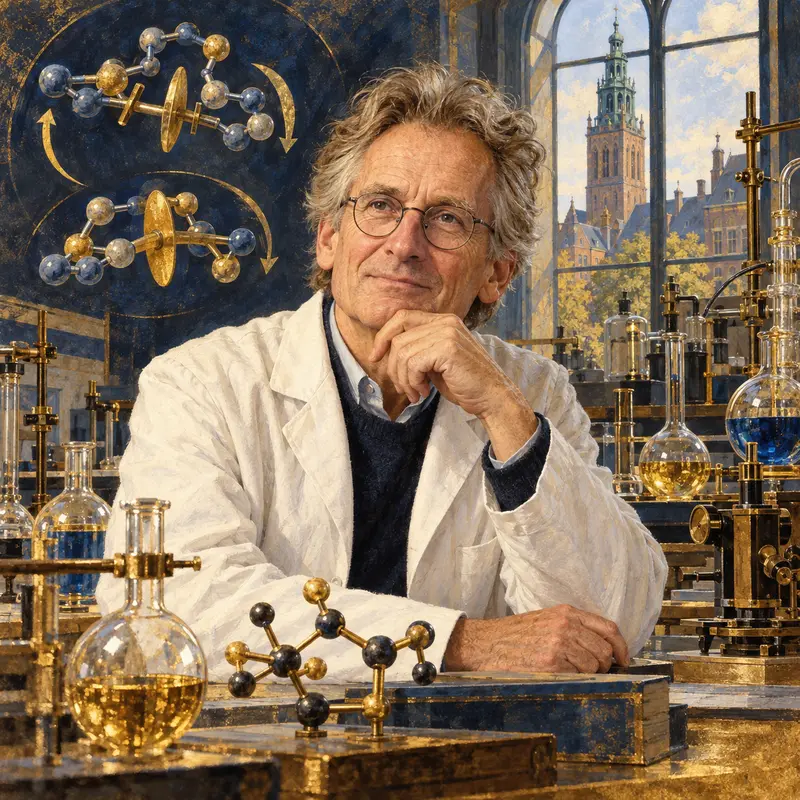
Ben Feringa
1951- · Netherlands · Nobel Chemistry 2016
Light-driven molecular motors