The discovery, explained · Chemist no. 208 of 350
Ben Feringa and the First Light-Driven Molecular Motor
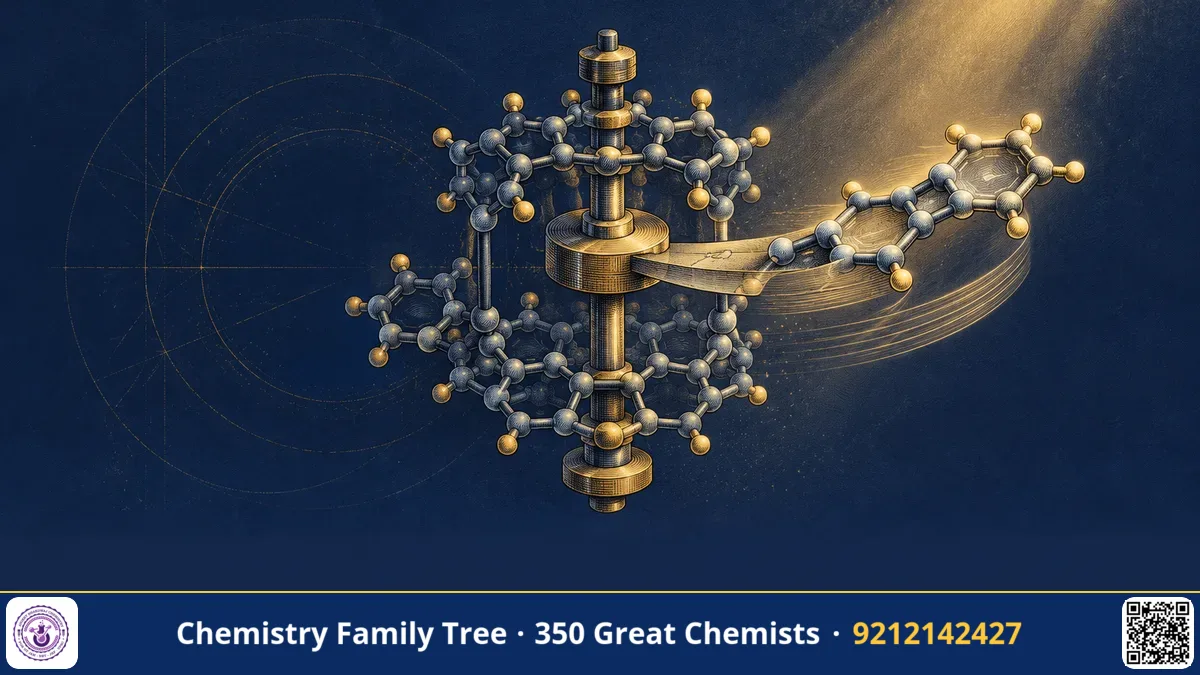
Motors are everywhere: in fans, cars and trains. But can a motor be built from a single molecule? In 1999, Bernard (Ben) Feringa and his team at the University of Groningen in the Netherlands reported exactly that: a molecule whose one half rotates continuously in one direction relative to the other half when it is lit. This was the first unidirectional rotary molecular motor. For this and related work, Feringa shared the 2016 Nobel Prize in Chemistry with Jean-Pierre Sauvage and Fraser Stoddart.
The Scientific Problem Before the Discovery
Nature has molecular motors. ATP synthase rotates as protons flow through it, and myosin walks along actin filaments. Chemists dreamed of making artificial counterparts. Earlier work by Sauvage and Stoddart had produced switches and shuttles, in which a ring moves back and forth between two positions. But a shuttle moves randomly in both directions by Brownian motion; it is not a motor. A true motor needs directionality: it must repeatedly turn in one direction, using an input of energy.
Another difficulty is physical. At the molecular scale, thermal motion is violent, so any machine must use a built-in mechanism to prevent backward motion, in the way a ratchet works. Chemists needed a design in which energy input and structural features together impose one-way rotation.
The Discovery: Step by Step
Step 1: Start with a switch
Feringa had earlier made chiral molecular switches based on photoisomerisation, in which light changes the shape and optical properties of a molecule. This experience led him to think about a molecule with a central C=C double bond, which can isomerise under light, linking an upper half (the rotor) to a lower half (the stator).
Step 2: Use an overcrowded alkene
The motor is built from an overcrowded alkene, in which large groups on the two halves clash and force the molecule to twist into a helical shape. Each half carries a stereogenic centre with a methyl group; the methyl group chooses a particular orientation (pseudo-axial) to relieve strain. This gives the molecule helicity, which can be left-handed (M) or right-handed (P).
Step 3: The four-step cycle
- Photochemical E/Z isomerisation: A pulse of UV light excites the molecule and rotates the central double bond by 180 degrees. The helicity inverts (for example P to M) and the methyl groups are forced into a strained pseudo-equatorial orientation.
- Thermal helix inversion: The strained molecule relaxes by itself (heat is enough) as the helix flips back, moving the methyl groups to the stable pseudo-axial orientation. This step is irreversible, because the molecule goes downhill in energy. It acts as the ratchet.
- Second photochemical step: Another light pulse rotates the double bond by another 180 degrees.
- Second thermal helix inversion: Again the molecule relaxes, completing a full 360 degree turn.
Because the thermal steps cannot run backwards, the rotation keeps one direction. Feringa's group proved the cycle using circular dichroism and NMR spectroscopy, and with different substituents they could tune the speed. Later versions rotate at very high speeds (megahertz range, and beyond in advanced designs) and can be driven by visible light.
The Chemistry Behind It
- Photoisomerisation: Absorption of a photon promotes a π electron into a π* orbital, weakening the C=C bond order and allowing rotation. The molecule then returns to the ground state in the opposite configuration.
- Stereochemistry and helicity: The molecule is chiral. Its handedness determines the direction of rotation, so the motor's direction is set by its configuration.
- Energy ratchet: Two photochemical "uphill" steps are followed by two thermal "downhill" steps. The combination breaks microscopic reversibility in the driven system and gives net directional motion.
- Steric strain: Overcrowding drives the helical twist and sets the barrier of the thermal step, which controls the rotational speed.
Feringa's group also demonstrated that a motor molecule can do work. When motors were added to a liquid-crystal film, light-driven rotation could reorient the film's texture so strongly that a microscopic glass rod, much larger than the molecules, was turned. In 2011, his group built a "nanocar" with four motor units acting as wheels, which moved on a copper surface when driven by electrons from a scanning tunnelling microscope tip.
Applications Today
- Responsive materials: Surfaces and gels that change shape or wettability when exposed to light.
- Photopharmacology: Feringa's group developed drugs with built-in photoswitches, so they can be turned on at the target site by light and then deactivate, which could reduce side effects and slow the spread of antibiotic resistance.
- Nanotechnology research: Motors on surfaces, in membranes and in polymers.
- Drug delivery experiments: Light-driven opening of carrier particles.
As with other molecular machines, many applications remain at the proof-of-concept stage.
Exam Corner
- Why is a molecular shuttle not a motor? A motor rotates repeatedly in one direction; a shuttle moves randomly back and forth.
- Which type of alkene is used in Feringa's motor? Sterically overcrowded alkene.
- Which steps of the cycle are photochemical and which are thermal? Two E/Z isomerisations (light) and two helix inversions (heat).
- What gives directionality? The irreversible thermal helix inversion that acts as a ratchet.
- Year of Nobel Prize and the field: 2016, Chemistry.
Common Misconceptions
- "The motor runs on electricity." The first motors run on light; some nanocar versions used electrons from a probe tip.
- "The motor spins forever without energy." It stops when light is switched off.
- "Photoisomerisation is just heating." It is an excited-state process, quite different from thermal reaction.
Quick Revision Box
- First unidirectional rotary molecular motor reported by Feringa in 1999.
- Built on a chiral, overcrowded alkene with a central C=C axis.
- Four-step cycle: light, heat, light, heat; 360 degrees of rotation.
- Thermal helix inversion is the ratchet step.
- Photopharmacology uses photoswitchable drugs.
- Nobel Prize in Chemistry 2016, shared.
FAQ
What does overcrowded mean here?
The groups attached to the double bond are so large that they clash, forcing the molecule out of planarity into a twisted helix.
How fast can these motors rotate?
Speeds range widely depending on design, from slow rotations to very fast ones at the megahertz range or above.
Is Feringa an organic chemist?
Yes, he is a synthetic organic chemist who also made major contributions to asymmetric catalysis, for example with copper-catalysed conjugate additions.
Why does this appear in competitive exams?
It combines stereochemistry, photochemistry and the idea of ratchets, and the Nobel years are common general-knowledge questions.
Published by ABC Chemistry — IIT-JAM | CSIR-NET | GATE Chemistry Coaching. Visit abcchemistry.com
About the chemist
Ben Feringa
1951- · Netherlands · Nobel Chemistry 2016
Light-driven molecular motors