Biography · Chemist no. 218 of 350
Benjamin List: The Chemist Who Showed That Small Organic Molecules Can Be Great Catalysts
Benjamin List, born in 1968 in Frankfurt, Germany, is a director at the Max-Planck-Institut fur Kohlenforschung (Max Planck Institute for Coal Research) in Mulheim an der Ruhr. In 2021 he received the Nobel Prize in Chemistry, together with David MacMillan, for developing asymmetric organocatalysis. His legacy in one line: he proved that a simple amino acid like proline can steer reactions toward a single mirror-image product, opening a third pillar of catalysis next to metals and enzymes.
Early Life and Family
List was born on 11 January 1968 in Frankfurt am Main, in what was then West Germany. He has spoken in interviews about growing up in a family environment where curiosity was welcome, and about being drawn to chemistry as a school student. Details of his family life are not widely documented, so this post does not go beyond what he has said publicly: his interest in how molecules are built and how reactions can be controlled developed early and stayed with him.
Education and Mentors
List studied chemistry at the Freie Universitat Berlin, and then carried out doctoral research under Johann Mulzer, a well-known synthetic chemist, completing his doctorate at Goethe University Frankfurt in 1997. His thesis work concerned total synthesis and methodology, which gave him a strong grounding in stereochemistry.
After the doctorate he moved to the United States as a postdoctoral fellow at the Scripps Research Institute in La Jolla, California, working with Richard Lerner and Carlos Barbas III. Lerner's lab was famous for catalytic antibodies: antibodies engineered to act as enzymes. This environment shaped List's thinking. He asked how enzymes such as type I aldolases work using an amine group, and whether a simple amine could mimic this.
Career Timeline
| Year | Event |
|---|---|
| 1968 | Born in Frankfurt, Germany |
| 1997 | Doctorate from Goethe University Frankfurt (under Johann Mulzer) |
| 1997-1998 | Postdoctoral researcher at Scripps Research Institute, USA |
| 1999-2003 | Assistant professor at Scripps |
| 2000 | Publishes proline-catalysed intermolecular aldol reaction |
| 2003 | Returns to Germany as group leader at the Max-Planck-Institut fur Kohlenforschung |
| 2005 | Becomes director of the Homogeneous Catalysis department |
| 2016 | Receives the Gottfried Wilhelm Leibniz Prize |
| 2021 | Nobel Prize in Chemistry (shared with David MacMillan) |
Major Scientific Contributions
Proline-catalysed aldol reaction (2000). His best-known work showed that L-proline catalyses the intermolecular aldol reaction between acetone and aldehydes with notable enantioselectivity, through an enamine mechanism. Read our companion post on this discovery for the equations.
Generalising enamine catalysis. His group and others extended amine catalysis to Mannich, Michael, alpha-amination and many other reactions, and to the use of primary amine catalysts for ketones.
Asymmetric counteranion-directed catalysis (ACDC). List's idea was that a chiral anion, for example a chiral phosphate derived from BINOL, can control the stereochemistry of reactions involving cationic intermediates. This was a new design principle.
Confined acids. His group created imidodiphosphates (IDPs) and related strong Bronsted acids with a tight chiral pocket, comparable to an enzyme active site. These catalysts can differentiate between substrates that are nearly identical, for example in reactions of small aliphatic molecules.
Awards, Honours and Nobel Prize
The Nobel Prize in Chemistry 2021 was awarded jointly to Benjamin List and David W. C. MacMillan "for the development of asymmetric organocatalysis". The Royal Swedish Academy of Sciences noted that organocatalysis is greener and cheaper than previous approaches and has had a major impact on pharmaceutical research. List also won the Leibniz Prize (2016), the highest research prize in Germany. He is an honorary professor at the University of Cologne and holds other academic distinctions that are not listed here because we cannot verify every detail.
Personality, Struggles and Lesser-Known Facts
- Surprised by the call. On the morning of the Nobel announcement, List was reportedly on vacation in Amsterdam with his family when the Nobel committee reached him. He has said in interviews that he was astonished.
- A serendipitous idea. List has said that the proline experiment began almost as a side project: he tested a hypothesis inspired by catalytic antibodies, and was not sure it would work. Many students find this encouraging.
- Years of scepticism. Early organocatalysis was met with doubt. Some chemists thought the amounts of catalyst (up to 30 mol%) were too high to be practical. Later work, including his own, reduced loadings and broadened scope.
- Parallel discovery. MacMillan, working at Berkeley and Caltech, independently reported organocatalytic Diels-Alder reactions almost at the same time. The two are friends as well as colleagues, and the Nobel committee recognised both.
- Leaving the US for Germany. He moved from Scripps back to the Max Planck Institute, where he could build a long-term, fundamental research programme.
Legacy and Influence on Modern Chemistry
Before List and MacMillan, textbooks listed metals and enzymes as the two main catalyst types. Today organocatalysis is the third pillar. Thousands of papers describe new organocatalysts, and the field has influenced photochemistry, electrochemistry and biocatalysis. Industrial chemists value its operational simplicity: reactions often do not need dry solvents, gloveboxes or expensive ligands. In pharmaceutical process chemistry, avoiding metal contamination reduces testing and cost.
List has also trained a large group of researchers who now lead laboratories around the world, including students and postdocs from India. His group has worked on making organocatalysts more active, so that ppm-level loadings may become possible, which would help address the main criticism of the field.
Lessons for Students
- Ask simple questions. "Could a small amino acid do what an enzyme does?" led to a Nobel Prize.
- Read the old literature. The proline aldol work of the 1970s was already published; List saw its potential.
- Test your hypothesis quickly. A short experiment can open a new field.
- Do not fear low initial performance. The first proline results were modest in some cases, and then improved.
- Learn mechanism. Understanding enamine and iminium chemistry is the key to designing new reactions, and it is core exam material.
Quick Facts Box
- Born: 11 January 1968, Frankfurt am Main, Germany
- Died: Living
- Nationality: German
- Field: Organic chemistry, asymmetric catalysis
- Famous for: Proline-catalysed asymmetric aldol reaction, organocatalysis, ACDC
- Nobel: Chemistry 2021, shared with David MacMillan
FAQ
Where does Benjamin List work?
He is a director at the Max-Planck-Institut fur Kohlenforschung in Mulheim an der Ruhr, Germany, where he leads the Homogeneous Catalysis department.
What did he win the Nobel Prize for?
For the development of asymmetric organocatalysis, shared with David MacMillan in 2021.
Who was his postdoctoral mentor?
He worked at Scripps Research Institute in the group of Richard Lerner and Carlos Barbas III, who studied catalytic antibodies.
Why should Indian chemistry students study his work?
Enamine catalysis, aldol reactions and enantioselectivity appear in JAM, NET and GATE syllabi, and organocatalysis is also an area of active research at Indian institutes.
Published by ABC Chemistry — IIT-JAM | CSIR-NET | GATE Chemistry Coaching. Visit abcchemistry.com
About the chemist
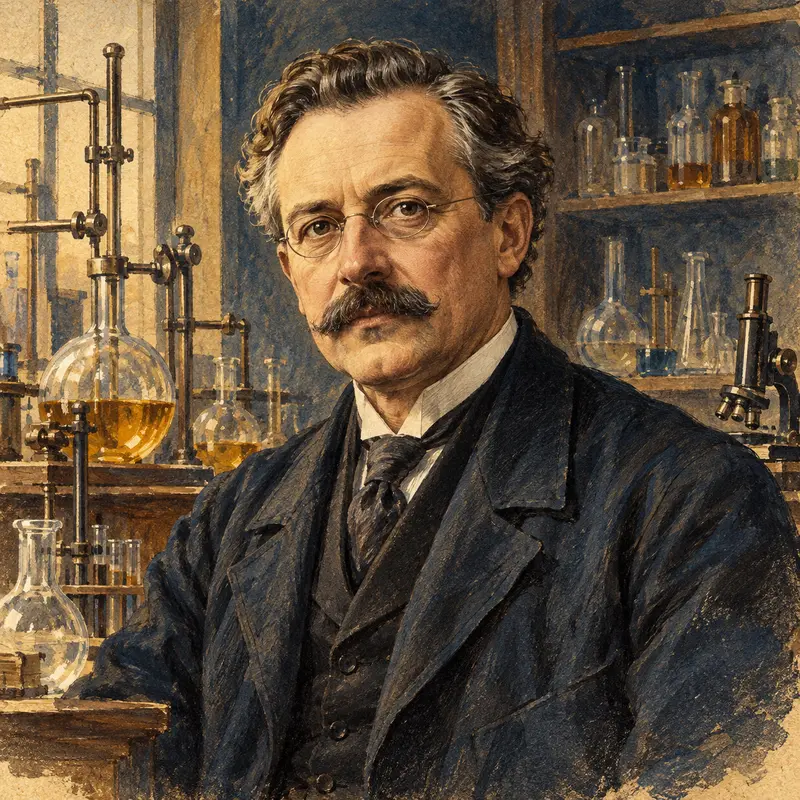
Benjamin List
1968- · Germany · Nobel Chemistry 2021
Asymmetric organocatalysis