The discovery, explained · Chemist no. 52 of 350
Friedrich Bergius: Making Liquid Fuel from Coal with Hydrogen
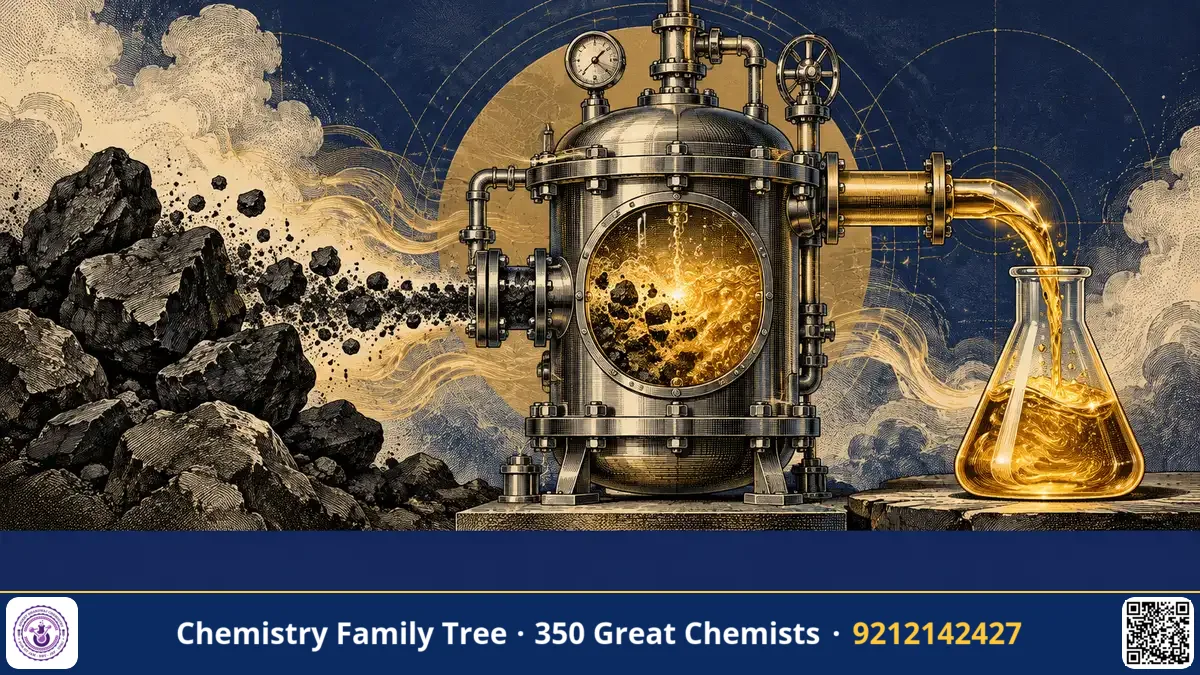
Coal is a black solid, and petrol is a clear liquid. Is it possible to turn one into the other? In the early 20th century, the German chemist Friedrich Bergius showed that it is. By heating coal with hydrogen under very high pressure, he broke down its large molecules and added hydrogen to them, forming liquid hydrocarbons that could be refined into fuels. This Bergius process (coal hydrogenation or direct coal liquefaction) gave countries without oil, such as Germany, a route to petrol and diesel from coal. Bergius shared the 1931 Nobel Prize in Chemistry with Carl Bosch for the invention and development of chemical high-pressure methods. This article explains the chemistry for B.Sc., IIT-JAM, CSIR-NET and GATE students.
The Scientific Problem Before the Discovery
At the start of the 1900s, the motor car, the ship and later the aeroplane were turning petroleum into a strategic resource. But oil was found in only a few places. Germany, with large coal reserves and almost no oil, was entirely dependent on imports.
- Coal has a low hydrogen content. The H : C atomic ratio of bituminous coal is about 0.8, compared with about 1.8-2.0 for petrol. Making liquid fuel from coal requires both breaking large molecules and adding hydrogen.
- Coal is a complex, cross-linked network of aromatic rings joined by bridges, with oxygen, nitrogen and sulphur, not a simple compound.
- Hydrogen at high pressure is difficult to handle, and few laboratories could work at hundreds of atmospheres in the early 1900s. Bergius had gained experience from working with Nernst, Haber and Bodenstein, three leaders in high-pressure and equilibrium research.
The Discovery: Step by Step
Step 1: Laboratory studies on coal formation (about 1910-1913)
Bergius first studied how natural coal formed. By heating cellulose (wood material) with water in sealed vessels under pressure, he obtained a coal-like substance, imitating the natural process of coalification. This work, published in 1913, brought him recognition. It also showed him the importance of pressure and of the hydrogen content of coal.
Step 2: Hydrogenation of coal
Bergius then heated a mixture of pulverised coal, heavy oil (to make a paste) and a catalyst in a steel autoclave in the presence of hydrogen at high pressure. He found that coal converts largely to liquid hydrocarbons. He patented the process in 1913.
Typical conditions: about 400-480 °C and hydrogen pressure of the order of 200 atm (higher in some versions). A simplified overall scheme is:
Coal (CₙHₘ, H/C ≈ 0.8)  +  H₂  →  liquid hydrocarbons (H/C ≈ 1.5-2)
nC + (n + 1)H₂  →  CₙH₂ₙ₊₂        (idealised overall change)
Step 3: What happens in the reactor
- Thermal cracking: at 400 °C and above, weak bridging bonds in coal break and form reactive free radical fragments.
- Radical capping: hydrogen (made reactive by the catalyst or by hydrogen-donor solvents) donates H atoms to the radicals, preventing them from recombining into tar and coke.
- Hydrogenation: aromatic rings are partly saturated and heteroatoms are removed as H₂O, NH₃ and H₂S.
- Separation: the product is distilled into light oil (gasoline range), middle oil (diesel) and heavy oil, which is recycled to make the paste.
R–OH + H₂ → R–H + H₂O           (deoxygenation)
R–SH + H₂ → R–H + H₂S           (desulphurisation)
R–NH₂ + H₂ → R–H + NH₃          (denitrogenation)
C₆H₆ + 3H₂ → C₆H₁₂              (saturation of aromatic rings)
Step 4: Industrial development
Bergius's early pilot work struggled with technical problems and funding, and was hit by the economic effects of the First World War and its aftermath. In the 1920s BASF (and later IG Farben), working with Carl Bosch's high-pressure experience, improved the process, which became the basis of the large hydrogenation plants, including the one at Leuna. By World War II, Germany obtained a large share of its aviation petrol from coal hydrogenation.
The Chemistry Behind It
Catalysts
Early catalysts were cheap iron compounds such as iron oxide, which become iron sulphides in the reactor. Later versions used more active molybdenum or tungsten sulphide catalysts, which tolerate the sulphur in coal. The catalyst must be sulphur-tolerant, as coal contains sulphur compounds that poison metals such as nickel and platinum.
Why high pressure?
Hydrogen solubility in the liquid, and the concentration of dissolved H₂ on the catalyst surface, increase with pressure. Hydrogenation reduces the number of gas moles, so by Le Chatelier's principle high pressure favours it. High temperature is needed to break bonds fast, but too high a temperature favours cracking to gas and coke.
Comparison of coal-to-liquid routes
| Feature | Bergius (direct) | Fischer-Tropsch (indirect) |
|---|---|---|
| Year | 1913 | 1925 (Fischer and Tropsch) |
| First step | Coal + H₂ directly | Coal gasified to CO + H₂ (syngas) |
| Main reaction | Hydrocracking and hydrogenation | nCO + (2n+1)H₂ → CₙH₂ₙ₊₂ + nH₂O |
| Typical catalyst | Iron or Mo/W sulphides | Fe or Co |
| Product | Aromatic-rich gasoline and diesel | Straight-chain alkanes, waxes |
| Modern use | China (Shenhua plants) | South Africa (Sasol), Qatar (gas-to-liquids) |
The second Bergius process: wood saccharification
Bergius also developed a method to break down cellulose of wood into sugars using concentrated hydrochloric acid (hydrolysis). The glycosidic bonds of cellulose are cleaved by acid and water:
(C₆H₁₀O₅)ₙ + nH₂O → nC₆H₁₂O₆ (cellulose → glucose, H⁺ or conc. HCl)
The sugars could be fermented to ethanol or used as food. This "Bergius-Rheinau process" was important in Germany during war years.
Applications Today
- Coal-to-liquid plants: China operates direct coal liquefaction plants based on modern versions of the same idea. The technology is of interest in India, which has large coal reserves but imports most of its crude oil.
- Refinery hydrocracking and hydrotreating: petroleum refineries (including Indian refineries at Jamnagar, Mathura and Panipat) use hydrogen at high pressure with catalysts to crack heavy oil and remove sulphur, direct descendants of Bergius's chemistry.
- Biomass conversion: acid and enzyme hydrolysis of cellulose to sugars is the basis of second-generation ethanol, a priority in India's ethanol blending programme.
- Heavy oil and biomass upgrading: hydrothermal liquefaction of biomass echoes his coalification experiments.
Exam Corner
- Bergius process: direct hydrogenation of coal to liquid hydrocarbons at about 400-500 °C and high H₂ pressure, with an iron-based catalyst; patented 1913.
- Fischer-Tropsch: CO + H₂ (syngas) to hydrocarbons; indirect liquefaction.
- Hydrogenation lowers the number of gas moles, so it is favoured by high pressure (Le Chatelier).
- Water gas = CO + H₂; producer gas = CO + N₂; syngas is a mixture of CO and H₂.
- Bergius and Bosch shared the 1931 Nobel Prize in Chemistry.
Common Misconceptions
- "The Bergius process is the same as Fischer-Tropsch." Bergius adds hydrogen directly to coal; Fischer-Tropsch first converts coal to syngas.
- "Liquid fuel from coal is cheap." It needs heavy investment and large energy and hydrogen input, so it is economic only in certain conditions.
- "Hydrogenation just adds H₂ to double bonds." In coal it also breaks bonds and removes S, N and O.
Quick Revision Box
- Bergius process (1913): coal + H₂ at high T and P gives liquid fuel.
- Coal H/C ratio about 0.8; petrol about 1.8-2.0.
- Catalysts: iron oxide/sulphide, later Mo or W sulphides.
- Also removes S, N and O as H₂S, NH₃ and H₂O.
- Second process: wood to sugar by conc. HCl hydrolysis.
- Nobel Prize in Chemistry 1931 with Carl Bosch.
FAQ
Why did Germany need the Bergius process?
It had abundant coal but very little oil, so synthetic fuel from coal gave it energy security.
How is the Bergius process related to the Haber-Bosch process?
Both use hydrogen and high-pressure reactors, and Bosch's engineering experience helped to make Bergius's process industrial.
Which catalysts are used?
Iron-based catalysts at first, and later molybdenum or tungsten sulphides.
Is the process still used?
Modified versions of direct coal liquefaction operate in China, and the principle of hydrocracking is used in all modern oil refineries.
Published by ABC Chemistry — IIT-JAM | CSIR-NET | GATE Chemistry Coaching. Visit abcchemistry.com
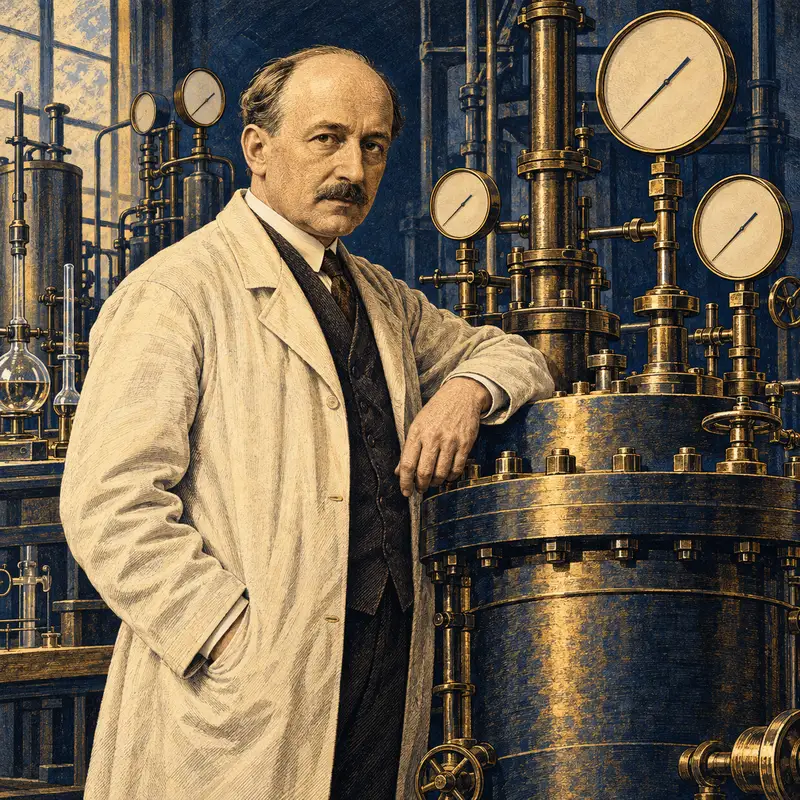
About the chemist
Friedrich Bergius
1884-1949 · Germany · Nobel Chemistry 1931
Coal hydrogenation to liquid fuel