Biography · Chemist no. 52 of 350
Friedrich Bergius: The Chemist Who Turned Coal into Liquid Fuel
Introduction
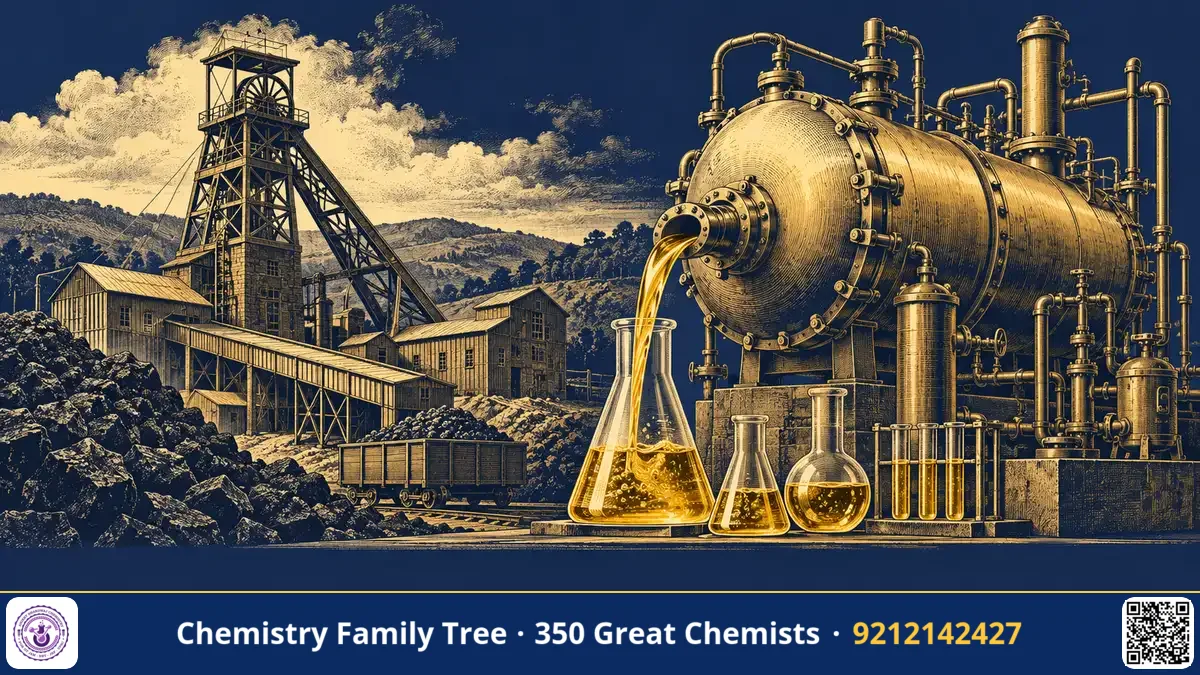
Friedrich Karl Rudolf Bergius (1884-1949) was a German chemist and industrial researcher who developed the high-pressure hydrogenation of coal, a way of making petrol and diesel from a solid fuel. He also devised a method to convert wood into sugar. In 1931 he shared the Nobel Prize in Chemistry with Carl Bosch. Legacy in one line: he showed that high-pressure chemistry can turn coal into liquid fuel, and his ideas live on in oil refining and biofuel research.
Early Life & Family
Bergius was born on 11 October 1884 at Goldschmieden, near Breslau (now Wrocław in Poland), then part of Germany. His father, Heinrich Bergius, owned a chemical factory, so the boy grew up close to industrial chemistry. This early exposure to a working chemical plant made him comfortable with the combination of science and industry.
Education & Mentors
He studied chemistry at the Universities of Breslau and Leipzig, receiving his doctorate at Leipzig in 1907. After this he gained experience in leading physical chemistry laboratories: with Walther Nernst in Berlin, with Fritz Haber at Karlsruhe, and with Max Bodenstein in Hannover. Haber and Nernst were studying chemical equilibria at high pressure, work closely related to ammonia synthesis. Bergius learned how to design apparatus for high pressure and temperature, a skill that shaped his career. He qualified as a lecturer (Habilitation) at the Technical University of Hannover around 1909.
Career Timeline
| Year | Event |
|---|---|
| 1884 | Born near Breslau, Germany |
| 1907 | Doctorate at Leipzig |
| 1907-1909 | Works with Nernst, Haber and Bodenstein on high-pressure chemistry |
| 1909-1910 | Sets up a private laboratory near Hannover |
| 1913 | Publishes work on artificial coalification; patents coal hydrogenation |
| 1920s | Develops industrial methods; works on wood saccharification with concentrated hydrochloric acid |
| 1925 | IG Farben takes up coal hydrogenation, using the Bergius work and the high-pressure experience of BASF |
| 1931 | Nobel Prize in Chemistry (shared with Carl Bosch) |
| 1930s-1940s | Wartime years in Germany; coal hydrogenation plants supply fuel |
| After 1945 | Leaves Germany and later works as an adviser abroad |
| 1949 | Dies in Buenos Aires, Argentina, on 30 March |
Major Scientific Contributions
- Coal hydrogenation: direct conversion of coal into liquid hydrocarbons by heating with hydrogen at high pressure. The companion article on the Bergius process gives the chemistry.
- Artificial coalification (1913): showed that cellulose heated under pressure with water gives a coal-like product, imitating the natural formation of coal.
- Wood saccharification: breaking down cellulose by hydrolysis with concentrated hydrochloric acid to give sugars (the Bergius-Rheinau process).
- High-pressure laboratory methods: design of autoclaves and techniques that influenced other high-pressure syntheses.
Awards, Honours & Nobel Prize
Bergius received the Nobel Prize in Chemistry in 1931, together with Carl Bosch, "in recognition of their contributions to the invention and development of chemical high pressure methods." Unlike Bosch, he did not lead a large chemical company, and his inventions were developed commercially largely by others.
Personality, Struggles & Lesser-Known Facts
- An independent inventor. Instead of starting in a large firm, Bergius built his own laboratory near Hannover and tried for years to turn his process into a business.
- Financial difficulties. Developing a high-pressure process was expensive and risky. The First World War and the economic troubles of Germany in the early 1920s made it hard to fund the work, and large companies later took over the development.
- Credit shared. In the 1920s the large company IG Farben developed the process further with the engineering experience of Bosch's group, so the industrial success belongs to many hands.
- Importance in wartime. Synthetic fuel from coal hydrogenation became strategically important for Germany in the Second World War, which makes his legacy a complicated one.
- Life after the war. After 1945 he left Germany and worked abroad, spending his last years in Argentina, where he died in 1949.
Legacy & Influence on Modern Chemistry
Bergius's coal hydrogenation led to the field of hydrocracking, now central to petroleum refining. Indian refineries use hydrocrackers and hydrotreaters to convert heavy oil into diesel and to remove sulphur to meet cleaner fuel norms. His wood hydrolysis work is an early example of turning biomass into chemicals, and it echoes today in India's second-generation ethanol projects. The Bergius process is still studied as a way for coal-rich countries to reduce oil imports, although it is expensive and carbon-intensive. Together with the work of Haber and Bosch, it made high-pressure industrial chemistry a standard discipline.
For students, the chemical idea behind his work is easy to remember. Coal is poor in hydrogen, with an H : C ratio near 0.8, while petrol is rich in hydrogen, with a ratio near 1.8 to 2. Bergius supplied the missing hydrogen under pressure, split the large coal molecules by heat, and removed sulphur, nitrogen and oxygen as H₂S, NH₃ and H₂O. The same three ideas, cracking, hydrogen addition and removal of heteroatoms, appear in every modern hydrocracker. Exam questions often ask you to compare the Bergius process with the Fischer-Tropsch process, so learn that Bergius works directly on coal, while Fischer-Tropsch first converts coal into a mixture of CO and H₂ (syngas) and then builds hydrocarbons from it using an iron or cobalt catalyst.
The story of Bergius also reminds us that scientific credit and commercial success do not always go together. His Nobel Prize recognised that practical engineering of chemical reactions deserves as much respect as pure theory.
Lessons for Students
- Learn from the best labs. Bergius trained with Nernst, Haber and Bodenstein.
- Solve a national problem. His work addressed energy supply.
- Protect and plan your invention. Patents and finance matter as much as ideas.
- Think about ethics and impact. Technologies can serve peace and war alike.
Quick Facts Box
- Born: 11 October 1884, Goldschmieden near Breslau, Germany
- Died: 30 March 1949, Buenos Aires, Argentina
- Nationality: German
- Field: Industrial and high-pressure chemistry
- Famous for: Coal hydrogenation (Bergius process); wood saccharification
- Nobel: Chemistry, 1931 (shared with Carl Bosch)
FAQ
What did Bergius share with Carl Bosch?
The 1931 Nobel Prize in Chemistry for the invention and development of chemical high-pressure methods.
Where was Bergius born?
Near Breslau, which is now the Polish city of Wrocław.
Did Bergius work for a big company?
He mostly worked independently; IG Farben later developed his process on a large scale.
Where did he spend his last years?
In Argentina, where he died in 1949.
Published by ABC Chemistry — IIT-JAM | CSIR-NET | GATE Chemistry Coaching. Visit abcchemistry.com
About the chemist
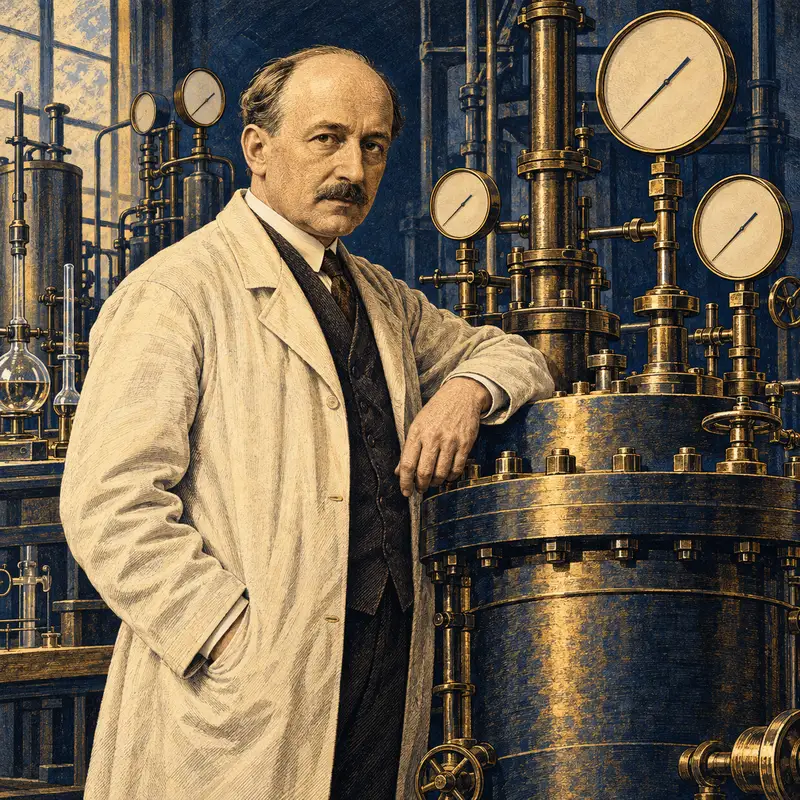
Friedrich Bergius
1884-1949 · Germany · Nobel Chemistry 1931
Coal hydrogenation to liquid fuel