The discovery, explained · Chemist no. 11 of 350
Berzelius and the Language of Chemistry: Symbols, Atomic Weights and Catalysis
When you write NaCl, Fe₂O₃ or H₂SO₄, you are using a system of notation created by the Swedish chemist Jöns Jacob Berzelius around 1813-1814. Berzelius did more than invent symbols. He determined the atomic weights of almost all the elements known in his time with an accuracy never seen before, discovered several new elements, and introduced the terms catalysis and isomerism. In many ways, he built the working language and the measurement standards of early nineteenth-century chemistry. This post explains his main ideas and what you need for exams.
The Scientific Problem Before the Discovery
After Lavoisier and Dalton, chemistry had good ideas but a messy practice. Dalton used circles with dots and lines to represent atoms, which were hard to print and impossible to use for large molecules. Atomic weights were often based on poor analyses and on wrong assumptions about formulae. Proust's law of definite proportions had been disputed by Claude Louis Berthollet, who believed that compounds could have variable composition. Chemists needed reliable numbers to prove that atoms combine in fixed ratios. They also lacked a simple notation that could be written quickly, in any language, and that showed the number of atoms in a compound.
The Discovery: Berzelius's Work Step by Step
- Improving laboratory methods. Berzelius pioneered many tools: the use of the blowpipe in mineral analysis, filter paper washed to leave little ash, the wash bottle, rubber tubing and the desiccator. Precision in weighing and a careful method of analysis were his hallmarks.
- Testing the law of definite proportions. From about 1807 he carried out thousands of careful analyses of oxides, sulphides and salts. His results strongly supported Proust and Dalton and showed that compounds have fixed composition.
- Atomic weight tables (1814, 1818, 1826). He published tables of atomic weights of nearly all the elements known at the time. He used oxygen as a standard, with O = 100 in his early tables. Many values were very close to modern ones, although some were wrong because of mistakes in formulae, such as the formula for water or for silica.
- Chemical symbols (1813-1814). He proposed that each element be represented by the first letter of its Latin (or Greek) name, adding a second letter when two elements begin with the same letter.
- New elements. Together with Wilhelm Hisinger he discovered cerium (1803), and by himself selenium (1817) and thorium (1828). He isolated silicon (1823), and also zirconium and tantalum in impure form.
- Terms for new ideas. In 1830 he introduced the concept of isomerism and in 1835 the concept of catalysis. He also named allotropy in 1841.
The Chemistry Behind It
The system of symbols
| Symbol | Element | Origin of symbol |
|---|---|---|
| Na | Sodium | Latin natrium |
| K | Potassium | Latin kalium |
| Fe | Iron | Latin ferrum |
| Cu | Copper | Latin cuprum |
| Ag | Silver | Latin argentum |
| Au | Gold | Latin aurum |
| Pb | Lead | Latin plumbum |
| Hg | Mercury | Greek-Latin hydrargyrum |
| W | Tungsten | German Wolfram |
Berzelius also showed how numbers could indicate how many atoms are present. He first wrote them as superscripts (like H²O), and the modern practice of subscripts (H₂O) came later.
The meaning of atomic weights
If compounds contain atoms in fixed ratios, then the percentage composition determines the ratio of atomic weights. For example, if an analysis of an oxide gives the mass of an element that combines with 16 parts of oxygen, then the atomic weight of the element follows once the formula is known. Berzelius's tables allowed the formula and the weights to be checked against each other.
Catalysis
In 1835 Berzelius collected many observations: platinum causes hydrogen and oxygen to combine, dilute acids convert starch to sugar, and diastase (an enzyme) helps in fermentation. He suggested that certain substances can start or accelerate chemical changes by their mere presence. He called this the "catalytic force" and the process "catalysis" (from the Greek meaning "to loosen down").
The modern definition: a catalyst is a substance that increases the rate of a reaction without itself being consumed, by providing an alternative path of lower activation energy.
k = A e^(−Ea/RT)     (Arrhenius equation)
Catalyst: lowers Ea, so k increases
A catalyst does not change ΔH, ΔG, or the equilibrium constant. It speeds up the forward and reverse reactions equally and allows equilibrium to be reached faster.
Isomerism
Berzelius noticed that tartaric acid and racemic acid have the same composition but different properties, as do silver fulminate and silver cyanate. He called such compounds "isomeric" (from Greek, meaning "equal parts"). Isomers have the same molecular formula but different structures or arrangement of atoms.
Dualism and its limits
Berzelius's theory of electrochemical dualism said that every compound consists of a positive part and a negative part, held by electrical attraction. This worked well for salts and for inorganic compounds, but it failed for organic compounds such as chloroacetic acid, where an electronegative chlorine atom can replace an electropositive hydrogen without a big change in properties.
Applications Today
- Universal notation. Chemical symbols and formulae are used in every language around the world. Indian students write them in school and research in the same way as chemists in Sweden or Japan.
- Industrial catalysis. Most chemical industries use catalysts: iron in the Haber process for NH₃, V₂O₅ in the contact process for H₂SO₄, platinum in the Ostwald process for HNO₃, and nickel in hydrogenation of vegetable oils.
N₂ + 3H₂ ⇌ 2NH₃    (Fe catalyst)
2SO₂ + O₂ ⇌ 2SO₃    (V₂O₅ catalyst)
- Vehicle emission control. Catalytic converters containing platinum, palladium and rhodium convert CO, NO and unburnt hydrocarbons to CO₂, N₂ and H₂O. These are used in Indian vehicles to meet emission standards.
- Biochemistry. Enzymes are biological catalysts, and a large part of pharmaceutical and food industry depends on them.
- Elements he discovered. Selenium is used in solar cells and photocopying, thorium in nuclear research, and silicon is the main material in electronics.
Exam Corner
- Berzelius introduced modern chemical symbols (1813-1814); he discovered cerium, selenium and thorium and isolated silicon.
- Catalysis was named by Berzelius in 1835; isomerism in 1830; allotropy in 1841.
- A catalyst lowers activation energy, does not change ΔH, ΔG or K, and is not consumed in the net reaction.
- Promoters improve catalysts (Mo in Fe catalyst for ammonia), and poisons deactivate them (CO or sulphur compounds on Pt or Ni).
- Symbols from Latin names: Na, K, Fe, Cu, Ag, Au, Pb, Sn, Sb, Hg. Tungsten (W) is from Wolfram.
Common Misconceptions
- "A catalyst takes no part in the reaction." It does take part, forming intermediates, but it is regenerated at the end.
- "A catalyst can make a non-spontaneous reaction happen." It cannot. It only changes the rate, not the thermodynamics.
- "Berzelius's symbols were the same as Dalton's." Dalton used circles and drawings; Berzelius used letters, which are the ancestors of today's symbols.
Quick Revision Box
- Berzelius gave letter symbols for elements (1813-1814).
- He determined accurate atomic weights of about 45 elements and supported the law of definite proportions.
- Discovered Ce (1803, with Hisinger), Se (1817), Th (1828); isolated Si (1823).
- Coined catalysis (1835), isomerism (1830), allotropy (1841).
- Catalyst: lowers Ea; no change in ΔG, ΔH or K.
- Electrochemical dualism worked for inorganic but not organic compounds.
FAQ
Why do some elements have symbols that do not match their English names?
Following Berzelius, symbols come from the Latin or other original names, for example Na from natrium, K from kalium, Fe from ferrum.
What did Berzelius mean by catalysis?
He used it for the way certain substances cause or speed up chemical changes without apparently being used up, as when platinum helps hydrogen and oxygen to combine.
Which elements did Berzelius discover?
Cerium, selenium and thorium. He was also the first to isolate silicon, and he identified several other elements.
What is isomerism?
It is the phenomenon of different compounds having the same molecular formula but different structures and properties, such as butane and isobutane.
Published by ABC Chemistry — IIT-JAM | CSIR-NET | GATE Chemistry Coaching. Visit abcchemistry.com
About the chemist
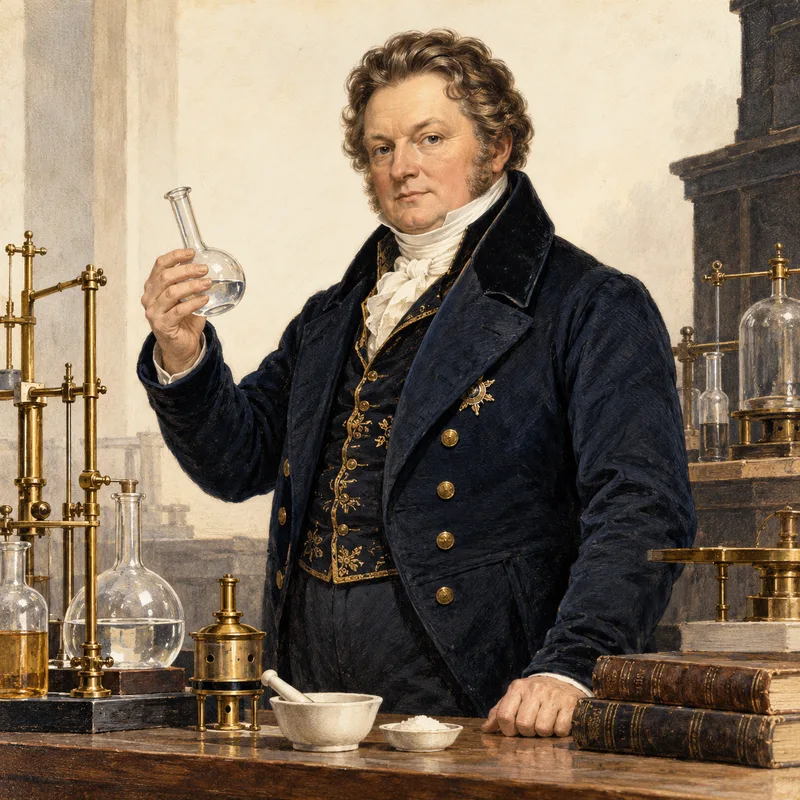
Jöns Jacob Berzelius
1779-1848 · Sweden
Atomic weights; modern chemical notation