Biography · Chemist no. 11 of 350
Jöns Jacob Berzelius: The Life of the Great Swedish Chemist
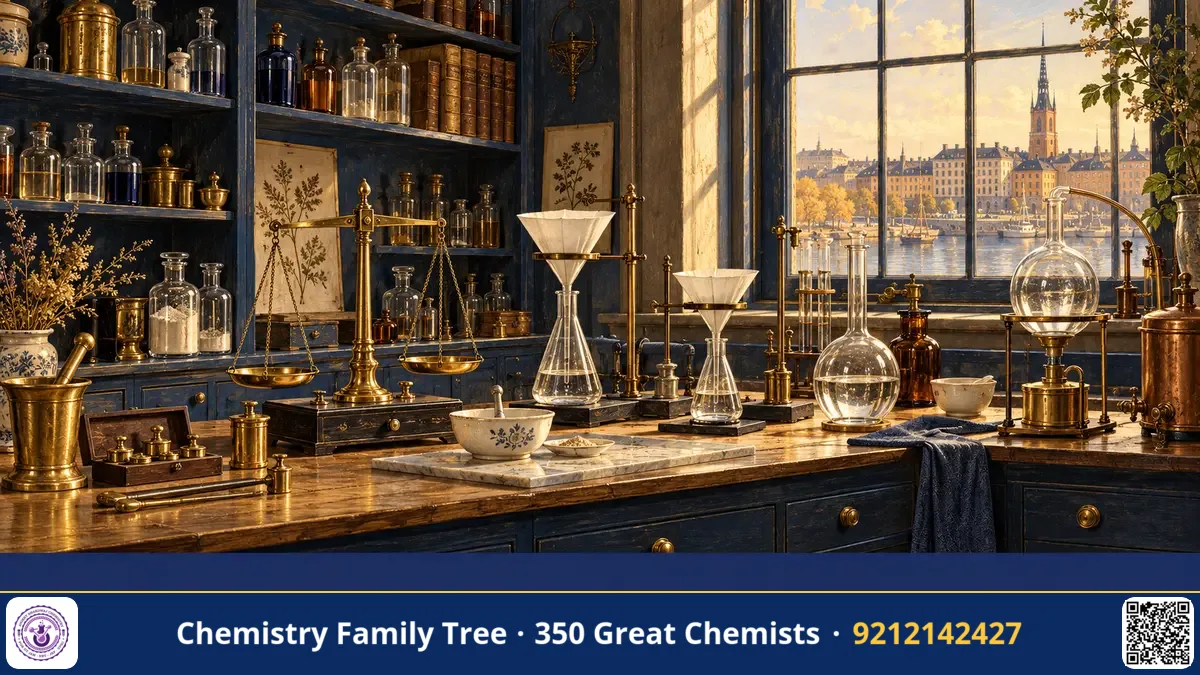
Jöns Jacob Berzelius (1779-1848) was a Swedish chemist who dominated European chemistry in the first half of the nineteenth century. He introduced the modern chemical symbols, determined accurate atomic weights, discovered cerium, selenium and thorium, isolated silicon, and gave chemistry words such as catalysis and isomerism. He also trained a generation of important chemists, including Friedrich Wöhler. His legacy in one line: he gave chemistry its language and its numbers.
Early Life and Family
Berzelius was born on 20 August 1779 in the village of Väversunda in Östergötland, Sweden. His father, Samuel Berzelius, was a schoolmaster, and his mother was Elisabeth Dorotea Sjösteen. His father died when Jöns was still a small child, and his mother died a few years later. He was then raised by relatives, including a stepfather and later an uncle. His childhood was not easy, and he had to work to pay for his education, sometimes as a private tutor. Despite this, he developed a love of nature and collected plants and insects. He took advice and support from relatives and teachers throughout his life.
Education and Mentors
- He studied at the school in Linköping, where he developed an interest in natural science.
- In 1796 he entered Uppsala University to study medicine, supporting himself by tutoring. At Uppsala, he found chemistry exciting, and he learned much of it by doing experiments on his own, since the course had few practical classes. One of the teachers he worked with there was the chemist Johan Afzelius.
- He worked as a physician in the mineral water springs at Medevi in 1800, and wrote his doctoral thesis on the effects of galvanic electricity on patients. He received his medical degree in 1802.
- In Stockholm, he found a lifelong colleague in Wilhelm Hisinger, a wealthy mine owner, with whom he did chemical research, including the analysis of minerals.
Career Timeline
| Year | Event |
|---|---|
| 1779 | Born at Väversunda, Östergötland on 20 August |
| 1802 | Takes a medical degree at Uppsala; becomes assistant at the Stockholm medical school |
| 1803 | Discovers cerium with Hisinger |
| 1807 | Becomes professor of medicine and pharmacy at the Karolinska Institute in Stockholm |
| 1808 | Elected to the Royal Swedish Academy of Sciences |
| 1813-1814 | Proposes modern chemical symbols and publishes a first atomic weight table |
| 1817 | Discovers selenium |
| 1818 | Becomes permanent secretary of the Royal Swedish Academy of Sciences |
| 1823 | Isolates silicon; Wöhler comes to work in his laboratory |
| 1828 | Discovers thorium |
| 1835 | Marries Elisabeth Poppius; made a baron in the same year; introduces the term catalysis |
| 1848 | Dies in Stockholm on 7 August |
Major Scientific Contributions
Symbols and formulae. His letter-based symbols and formulae are used today in all chemistry. See our discovery post on Berzelius for the details of the system.
Atomic weights. He carried out a long series of careful analyses that gave the atomic weights of about 45 elements, and showed that the law of definite proportions holds also for inorganic compounds.
New elements. Cerium (1803), selenium (1817) and thorium (1828) were discovered by him and his colleagues. He named cerium after the asteroid Ceres, selenium after the Moon (Greek selene) and thorium after the Norse god Thor. He also isolated silicon, zirconium and tantalum in impure form, and his student Johan August Arfwedson discovered lithium in 1817 in his laboratory.
Concepts. He coined isomerism, catalysis and allotropy, and developed the theory of electrochemical dualism. He also suggested the term "protein" to Gerardus Mulder in 1838, from the Greek word proteios, meaning primary.
Textbooks and annual reports. His textbook, Lärbok i Kemien, was translated into several languages and was the standard text of the time. His annual reviews of chemistry (Jahresbericht) summarised every year's progress for readers across Europe.
Laboratory methods. He developed or improved many standard tools of analytical chemistry, from the blowpipe to the wash bottle and the use of filter paper.
Awards, Honours and Nobel Prize
- Member of the Royal Swedish Academy of Sciences (1808), and its permanent secretary from 1818 until his death.
- Foreign Member of the Royal Society of London (1813) and honoured by academies across Europe.
- Made a baron (Friherre) by the King of Sweden in 1835, in connection with his marriage.
- No Nobel Prize, as the prize began in 1901, 53 years after his death. His name is remembered today in the mineral berzelianite, a copper selenide.
Personality, Struggles and Lesser-Known Facts
- A modest laboratory. Visitors from other countries were surprised that this great chemist worked in a small, simple laboratory in his apartment in Stockholm, which was also a kitchen. He had few assistants and trained students one by one.
- Teacher of Wöhler. Friedrich Wöhler came to Stockholm in 1823 and worked in Berzelius's laboratory. Their friendship and correspondence lasted until Berzelius's death, and Wöhler translated his textbook into German.
- A strong critic. Berzelius was known for his sharp, direct criticism of new ideas that did not fit his own theories, including the idea of substitution in organic chemistry. His opposition may have slowed some developments, though many of his criticisms were thoughtful.
- Late marriage. He married at the age of 56 to Elisabeth Poppius, daughter of a senior Swedish official. The couple had no children.
- A traveller. He visited laboratories in Britain, France and Germany and met Davy, Gay-Lussac, Dalton and others, which helped to spread his methods.
- Failing health and a wide correspondence. In his later years, he suffered from gout and other ailments, but continued to write letters to chemists across Europe, as well as the yearly reports.
Legacy and Influence on Modern Chemistry
Berzelius established standards of accuracy in analysis, and a generation of chemists trained in his methods. His system of notation is used in every textbook, and the terms catalysis and isomerism remain central to chemistry. His atomic weights, though later corrected, helped Mendeleev and others to find periodic relationships. His electrochemical theory influenced the development of ideas about ionic bonding, while its failure in organic chemistry encouraged new theories of valence and structure by Kekulé, Frankland and others. Students trained by Berzelius, including Wöhler, Mitscherlich and Mosander, carried his spirit of careful measurement into many universities.
Lessons for Students
- Precision matters. Better analyses gave him the better numbers and better laws.
- Use a common language. A clear notation helps people from different countries to work together.
- Be open to new ideas. His fixed ideas sometimes delayed new theories, a warning for all scientists.
- Documentation helps science. His annual reports kept a whole community informed.
- Teach and mentor. The students he trained did as much for chemistry as his own discoveries.
Quick Facts Box
- Born: 20 August 1779, Väversunda, Östergötland, Sweden
- Died: 7 August 1848, Stockholm, Sweden
- Nationality: Swedish
- Field: Analytical and inorganic chemistry
- Famous for: Chemical symbols, atomic weights, discovery of Ce, Se, Th, isolation of Si, term catalysis
- Nobel Prize: None (lived before 1901)
FAQ
Why is Berzelius important in chemistry?
He created the modern system of chemical symbols, measured accurate atomic weights, discovered new elements and introduced key terms such as catalysis and isomerism.
Which students did Berzelius train?
The best known is Friedrich Wöhler. Others include Eilhard Mitscherlich, Carl Gustaf Mosander and Heinrich Rose.
Did Berzelius discover silicon?
He was the first to prepare silicon in a relatively pure form, in 1823, by heating potassium with potassium fluorosilicate. Davy and Gay-Lussac had made impure forms earlier.
How are the names cerium and selenium related to astronomy?
Cerium is named after the asteroid Ceres and selenium after the Moon, from the Greek word selene.
Published by ABC Chemistry — IIT-JAM | CSIR-NET | GATE Chemistry Coaching. Visit abcchemistry.com
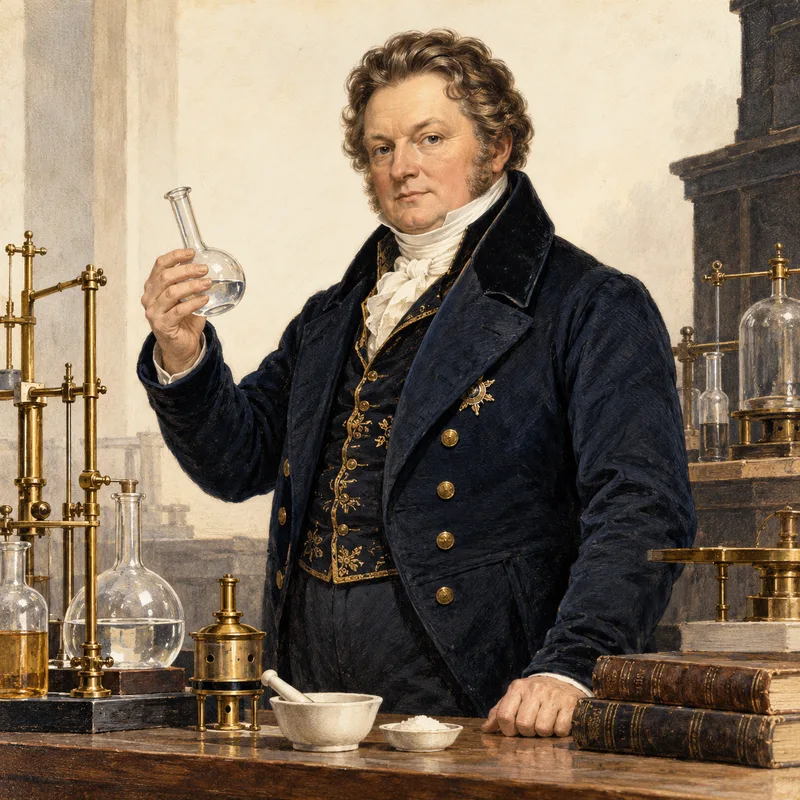
About the chemist
Jöns Jacob Berzelius
1779-1848 · Sweden
Atomic weights; modern chemical notation