The discovery, explained · Chemist no. 6 of 350
Boyle's Law: How Robert Boyle Measured the "Spring of the Air"

When you press the plunger of a closed syringe, the air inside gets compressed and pushes back. When you release it, the plunger springs out. In the 1650s, Robert Boyle studied this effect with great care and showed that, at constant temperature, the volume of a fixed amount of gas is inversely proportional to its pressure. This is Boyle's law, the first of the quantitative gas laws and one of the earliest mathematical laws in chemistry. Boyle also built a better air pump, performed vacuum experiments and, in his book The Sceptical Chymist, argued that chemistry should rest on experiment and not on tradition. This post explains the experiments, the maths and the exam points.
The Scientific Problem Before the Discovery
In the early 1600s, many thinkers still followed Aristotle's ideas, including the claim that "nature abhors a vacuum". In 1643 Evangelista Torricelli filled a glass tube with mercury and inverted it in a dish, and the column fell to about 760 mm, leaving an empty space above it. He proposed that the mercury was held up by the weight of the atmosphere. Otto von Guericke in Germany had built an early air pump and shown the power of the vacuum with the famous Magdeburg hemispheres. But the nature of air itself was unclear: Is air elastic? Does it have weight? How does its volume change with pressure? Boyle wanted answers based on measurement.
The Discovery: Experiments Step by Step
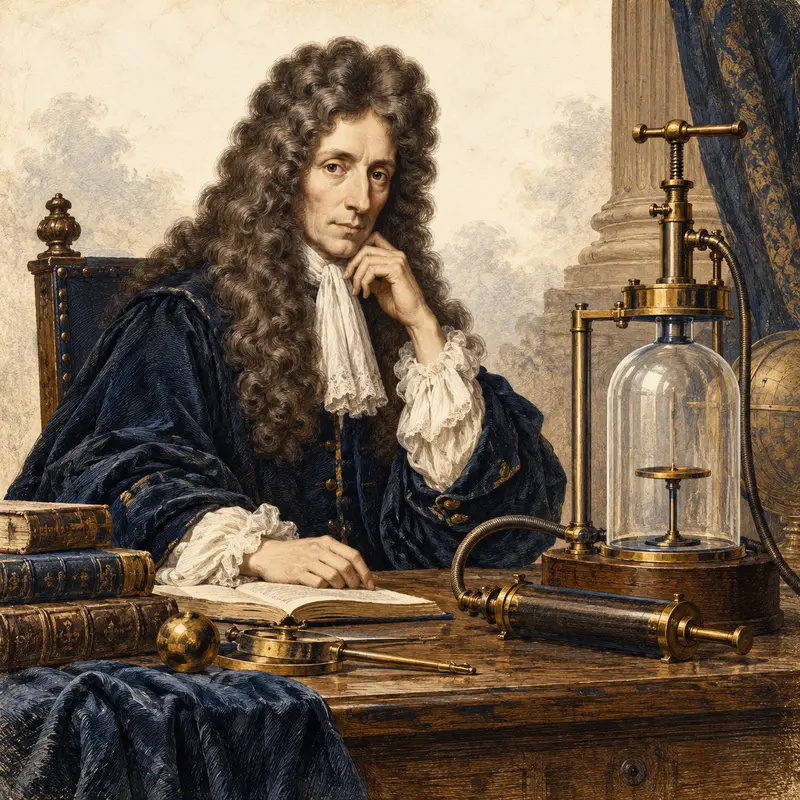
- Building the air pump (about 1659). With his assistant Robert Hooke, Boyle built an improved air pump with a large glass receiver and a piston pump to remove air from it.
- Experiments in a partial vacuum. They showed that a candle flame goes out, a small animal cannot survive, and the sound of a bell becomes fainter as the air is removed. They also showed that a barometer's mercury column dropped as air was pumped out. These results were published in 1660 in New Experiments Physico-Mechanicall, Touching the Spring of the Air and its Effects.
- Criticism and reply. A critic, Franciscus Linus, argued that the mercury column was held up by an invisible thread, and not by air pressure. To reply, Boyle designed a new experiment, published in 1662 as an appendix to the second edition of his book.
- The J-tube experiment. Boyle took a long glass tube bent in a J-shape, with the short arm closed and the long arm open. He poured a little mercury into it, trapping a sample of air in the short arm. He then poured more mercury into the long arm, measuring the height difference between the two mercury levels and the length of the trapped air column.
- Result. When the pressure was doubled, the volume of the trapped air was halved. When it was tripled, the volume became one third. Within the limits of his measurement, the product of pressure and volume stayed constant.
The total pressure on the trapped air was the atmospheric pressure (about 760 mm Hg, or roughly 29 inches of mercury in his units) plus the extra height of mercury in the long arm. Boyle also tested pressures less than atmospheric by using a deep vessel of mercury and a tube with a closed upper end, again getting the inverse relation. In continental Europe, the same law is often called Mariotte's law after Edme Mariotte, who published it independently in 1676.
The Chemistry Behind It
Statement and formula
At constant temperature, the volume of a fixed mass (fixed moles) of gas is inversely proportional to its pressure.
V ∝ 1/P   (n, T constant)
PV = k
P₁V₁ = P₂V₂
Worked example
A gas occupies 2.0 L at 1.0 atm. What volume will it occupy at 4.0 atm at the same temperature?
V₂ = P₁V₁ / P₂ = (1.0 × 2.0) / 4.0 = 0.50 L
Graphs of Boyle's law
| Graph | Shape |
|---|---|
| P vs V (at constant T) | Rectangular hyperbola (isotherm) |
| P vs 1/V | Straight line passing through the origin |
| PV vs P | Straight line parallel to the P axis |
| Higher temperature isotherm | Lies farther from the axes |
Explanation from the kinetic theory
Gas pressure arises from collisions of molecules with the walls. If the volume is halved at constant temperature, the molecules hit the walls twice as often (the average kinetic energy is unchanged), and so the pressure doubles.
Where the law fails
Real gases follow Boyle's law at low pressure and high temperature. At high pressure, molecular volume becomes important, and at low temperature intermolecular attractions matter. Deviations are measured by the compressibility factor Z = PV/nRT, which equals 1 for an ideal gas. The van der Waals equation corrects for these effects:
(P + an²/V²)(V − nb) = nRT
Boyle's other ideas
In The Sceptical Chymist (1661), Boyle criticised both the Aristotelian four elements and the alchemists' three principles (salt, sulphur and mercury). He suggested that an element should be defined as a substance that cannot be broken down into simpler substances by experiment, a definition that Lavoisier developed more than a century later. He explained matter in terms of tiny particles ("corpuscles") whose motion and arrangement explain properties.
Applications Today
- Breathing. When your diaphragm moves down, the lung volume increases, the pressure falls and air flows in.
- Syringes and pumps. Medical syringes and bicycle pumps work through changes in volume and pressure.
- Scuba diving. A diver who ascends quickly with a lungful of air at depth risks lung injury, because the air expands as the external pressure falls. Divers are trained to exhale continuously while rising.
- Aircraft and altitude. Sealed bags of chips expand and puff up during flights as the cabin pressure drops.
- Industry. Compressed gas cylinders, such as LPG and oxygen cylinders supplied across India, depend on gas compression. Engineers use Boyle's law for pneumatic systems and air compressors.
Exam Corner
- Boyle's law: P₁V₁ = P₂V₂ at constant T and n. Know the graphs, including P-1/V and PV-P.
- The density of a gas at constant temperature is directly proportional to its pressure (d = PM/RT).
- Boyle's law is a special case of the ideal gas equation PV = nRT.
- Compressibility factor Z = PV/nRT; Z less than 1 shows dominance of attractive forces, Z greater than 1 shows dominance of repulsive forces.
- The Boyle temperature is the temperature at which a real gas follows Boyle's law over a wide range of pressure; for a van der Waals gas, T_B = a/(Rb).
Common Misconceptions
- "PV is always constant." It is constant only for a fixed amount of gas at constant temperature. If temperature changes, PV changes (see Charles's law and the ideal gas law).
- "Boyle's law is exact for all gases." It is only an approximation for real gases, which deviate at high pressure and low temperature.
- "Boyle discovered that gases have weight or pressure." Torricelli and Pascal's work on air pressure came earlier. Boyle's key step was the quantitative pressure-volume relation and the study of air's elasticity.
Quick Revision Box
- Boyle's law (1662): at constant T and n, P ∝ 1/V, so PV = constant.
- Experiment: J-shaped glass tube with mercury trapping air in the short arm.
- Book: New Experiments Physico-Mechanicall (1660); The Sceptical Chymist (1661).
- Isotherm: rectangular hyperbola on a P-V graph.
- Also called Mariotte's law in parts of Europe.
- Assistant: Robert Hooke; air pump built in about 1659.
FAQ
What is Boyle's law in simple words?
If you squeeze a fixed amount of gas into a smaller space without changing its temperature, its pressure rises in the same proportion. Half the volume gives double the pressure.
Why is it called Mariotte's law in some countries?
The French physicist Edme Mariotte published the same relation independently in 1676, so it is often called Boyle-Mariotte law in Europe.
Who helped Boyle with his experiments?
Robert Hooke, who became famous in his own right, helped build the air pump and carried out many experiments at Oxford.
Is Boyle's law valid for real gases?
Only approximately. It works well at low pressure and high temperature but fails at high pressure and low temperature, where molecular size and attractions matter.
Published by ABC Chemistry — IIT-JAM | CSIR-NET | GATE Chemistry Coaching. Visit abcchemistry.com
About the chemist
Robert Boyle
1627-1691 · Ireland/England
Boyle's law; The Sceptical Chymist