Biography · Chemist no. 6 of 350
Robert Boyle: The Life of the Sceptical Chymist
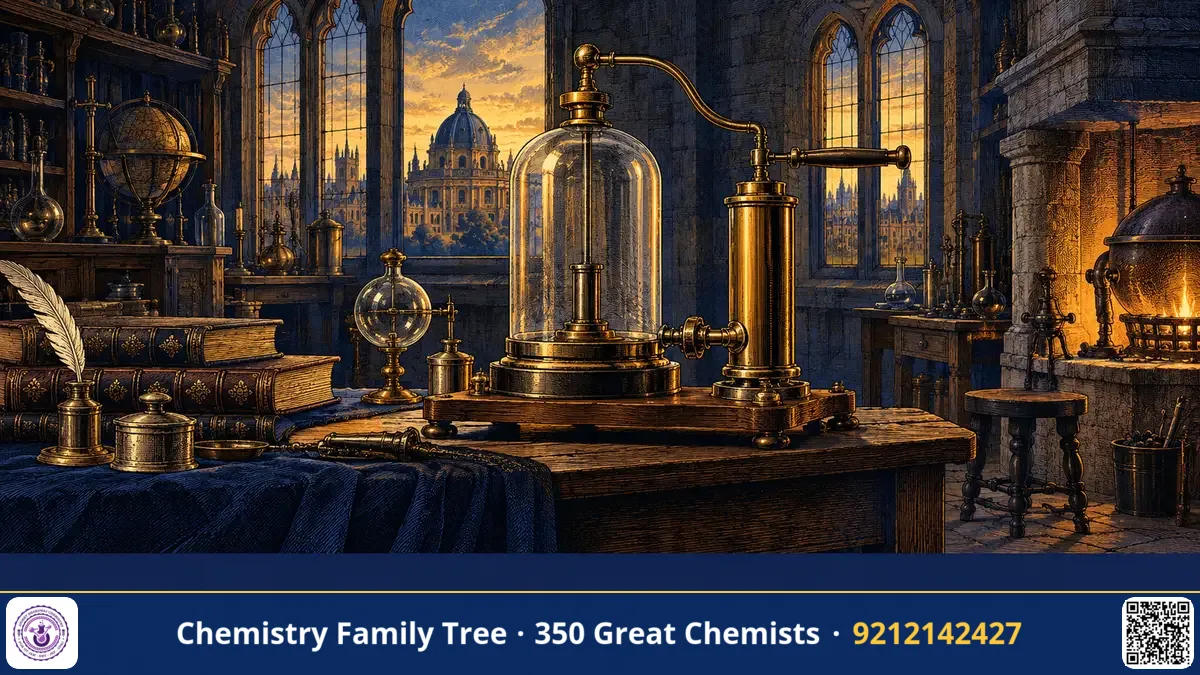
Robert Boyle (1627-1691) was an Anglo-Irish natural philosopher, chemist and physicist, famous for Boyle's law and for his book The Sceptical Chymist. He is often called one of the founders of modern chemistry because he insisted that chemical claims should be tested by experiment and that elements should be defined by what can be shown in the laboratory. His legacy in one line: he made experiment, measurement and open reporting the normal way of doing chemistry.
Early Life and Family
Robert Boyle was born on 25 January 1627 at Lismore Castle in County Waterford, Ireland. He was the seventh son and fourteenth child of Richard Boyle, the 1st Earl of Cork, one of the richest men in the British Isles at that time. His mother, Catherine Fenton, died when he was a small child. As a boy, he was sent away for nursing and early schooling, as was usual in noble families. He was a thoughtful and studious child, who learnt French and Latin early. Because of his family's wealth and position, he could devote his life to study without needing a salary.
Education and Mentors
- Eton College, where he was sent at about the age of eight, and where he was a keen reader.
- Private tutor and travel on the Continent. From about 1639 he travelled with a tutor and his brother to France, Switzerland and Italy. He spent time in Geneva and in Florence, where he studied the works of Galileo, who had died in 1642 near Florence.
- Home studies at Stalbridge. After returning to England around 1644, he lived at Stalbridge, an estate in Dorset left to him by his father, and devoted himself to writing and chemical work.
- The "Invisible College". In the 1640s he met a circle of scholars interested in the "new philosophy" based on experiment, including Samuel Hartlib. This group was a forerunner of the Royal Society.
Boyle had no formal university degree, but he was one of the most widely read people of his age.
Career Timeline
| Year | Event |
|---|---|
| 1627 | Born at Lismore Castle, County Waterford, Ireland on 25 January |
| 1639-1644 | Travels in France, Switzerland and Italy |
| 1654 | Moves to Oxford and sets up a laboratory |
| 1659 | Builds an improved air pump with Robert Hooke |
| 1660 | Publishes New Experiments Physico-Mechanicall, Touching the Spring of the Air; a founder of the Royal Society |
| 1661 | Publishes The Sceptical Chymist |
| 1662 | Publishes the pressure-volume law of gases in the second edition of his air book |
| 1668 | Moves to London, living with his sister Katherine, Lady Ranelagh |
| 1680 | Elected President of the Royal Society but declines because of his scruples over taking the oath |
| 1691 | Dies in London on 31 December |
Major Scientific Contributions
Boyle's law. At constant temperature, the pressure and volume of a fixed amount of gas are inversely related: P₁V₁ = P₂V₂. Our discovery post gives full details of the J-tube experiment, graphs and numericals.
The Sceptical Chymist. Written as a dialogue, it attacked the Aristotelian four elements and the alchemists' "tria prima" (salt, sulphur, mercury). He suggested that elements are simple bodies from which compounds are made and into which they can be resolved, and he supported a corpuscular (particle) view of matter.
Experiments with air and the vacuum. He showed that air is needed for combustion, for sound transmission and for animal life, and that air has elasticity ("spring").
Chemical analysis. He used flame tests and chemical reactions to identify substances and introduced simple tests with plant extracts. He used syrup of violets, which turns red with acids and green with alkalis, as an early indicator, and he is credited with systematising the use of such indicators.
Phosphorus. Around 1680 he developed a method to prepare phosphorus from urine (after Hennig Brand's earlier discovery) and studied its properties. Boyle's assistant Ambrose Godfrey Hanckwitz later helped to manufacture it.
Awards, Honours and Nobel Prize
The Nobel Prize did not exist in Boyle's time. His honours were of a different kind. He was a founder member of the Royal Society (1660), which now has a long history of honouring scientists, and its fellows elected him as president in 1680; he declined the position because he did not wish to take the required oath. He is also reported to have refused a peerage so that he could continue his studies. His reputation grew so great that he was widely seen as the leading English experimental philosopher of his day.
Personality, Struggles and Lesser-Known Facts
- Never married. He remained single and lived the later part of his life in Pall Mall in London with his sister Katherine, Lady Ranelagh, who was herself an influential intellectual.
- Poor health. Throughout his life he suffered from weak eyesight, poor general health and other ailments, and he wrote a book on medical remedies.
- Deeply religious. Boyle was a devout Christian who believed that studying nature revealed God's design. In his will he gave money for the Boyle Lectures, which were designed to defend Christianity.
- Charity and missions. He supported the translation of the Bible into several languages, and funded missionary efforts. He was a governor of a missionary society.
- Open reporting of failures. His writing style is detailed and cautious. He described his methods and even his failed experiments, which helped other scientists to repeat his work. This style of writing influenced scientific papers.
- Interest in alchemy. Like Newton, Boyle was interested in alchemy and in the idea of transmuting metals, even though he criticised the alchemists' theories.
Legacy and Influence on Modern Chemistry
Boyle's greatest influence was on the method of chemistry. He promoted the idea that facts should be tested by experiment, that results should be reported in detail and that explanations should be simple and based on matter in motion. Lavoisier, in his Traité, gave credit to the experimental definition of element as developed from Boyle's ideas. The gas laws of Charles, Gay-Lussac and Avogadro and later the kinetic theory all built on his work on air. Boyle's law is still taught as the first gas law to every student of chemistry or physics in India and across the world. The Boyle Medal in Ireland, awarded for scientific excellence, commemorates his name. His name also lives on in the Boyle Lectures, which are still held today.
Lessons for Students
- Doubt, then test. Do not accept an idea only because it is old or popular.
- Keep honest records. Write down procedures and results so that others can repeat them.
- Work with good colleagues. Hooke's skill with instruments made the air pump possible.
- Respond to critics with experiments. The J-tube was a reply to Linus.
- Use your resources for knowledge and for others. He used his wealth for research and for charity.
Quick Facts Box
- Born: 25 January 1627, Lismore Castle, County Waterford, Ireland
- Died: 31 December 1691, London, England
- Nationality: Anglo-Irish
- Field: Chemistry, physics, natural philosophy
- Famous for: Boyle's law, The Sceptical Chymist, air pump experiments
- Nobel: Not applicable (lived before the prizes began in 1901)
FAQ
Why is Robert Boyle called the father of modern chemistry?
Because he promoted experiment and measurement over mere tradition, questioned the ancient theory of elements and put forward a particle view of matter. Lavoisier is also called by this title, for different reasons.
Did Boyle work alone on the air pump?
No. Robert Hooke built and improved the instrument with him and carried out many of the experiments at Oxford.
What is The Sceptical Chymist?
It is a book published in 1661, written as a conversation between several characters, that questioned the old ideas of four elements and three principles and encouraged experimental chemistry.
Why did Boyle refuse to be president of the Royal Society?
He had scruples about taking the oath required for the office and so he declined it when he was elected in 1680.
Published by ABC Chemistry — IIT-JAM | CSIR-NET | GATE Chemistry Coaching. Visit abcchemistry.com
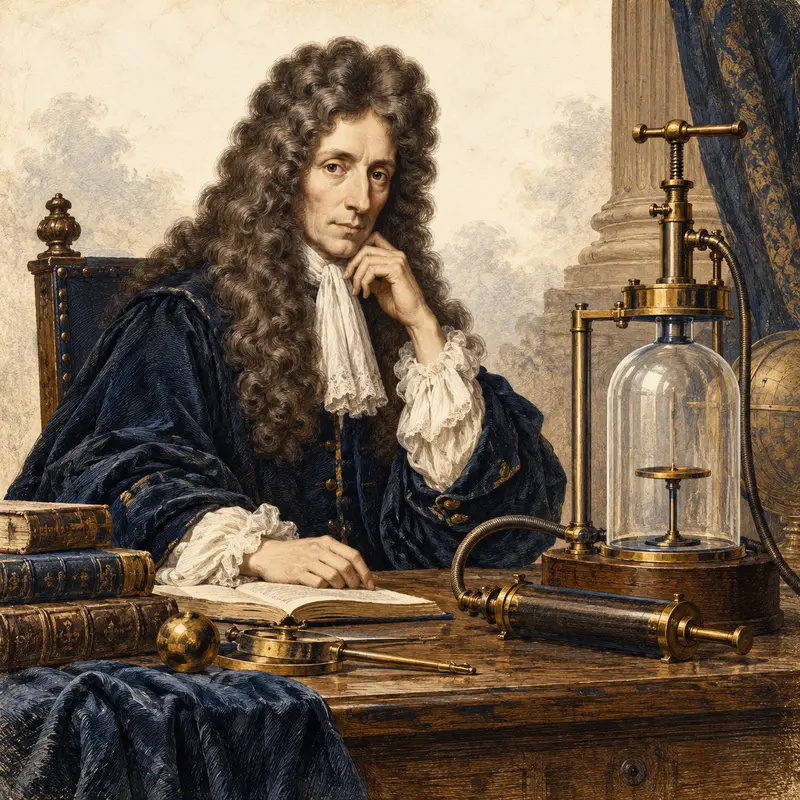
About the chemist
Robert Boyle
1627-1691 · Ireland/England
Boyle's law; The Sceptical Chymist