The discovery, explained · Chemist no. 41 of 350
Brønsted-Lowry Theory: When an Acid Becomes a Proton Donor
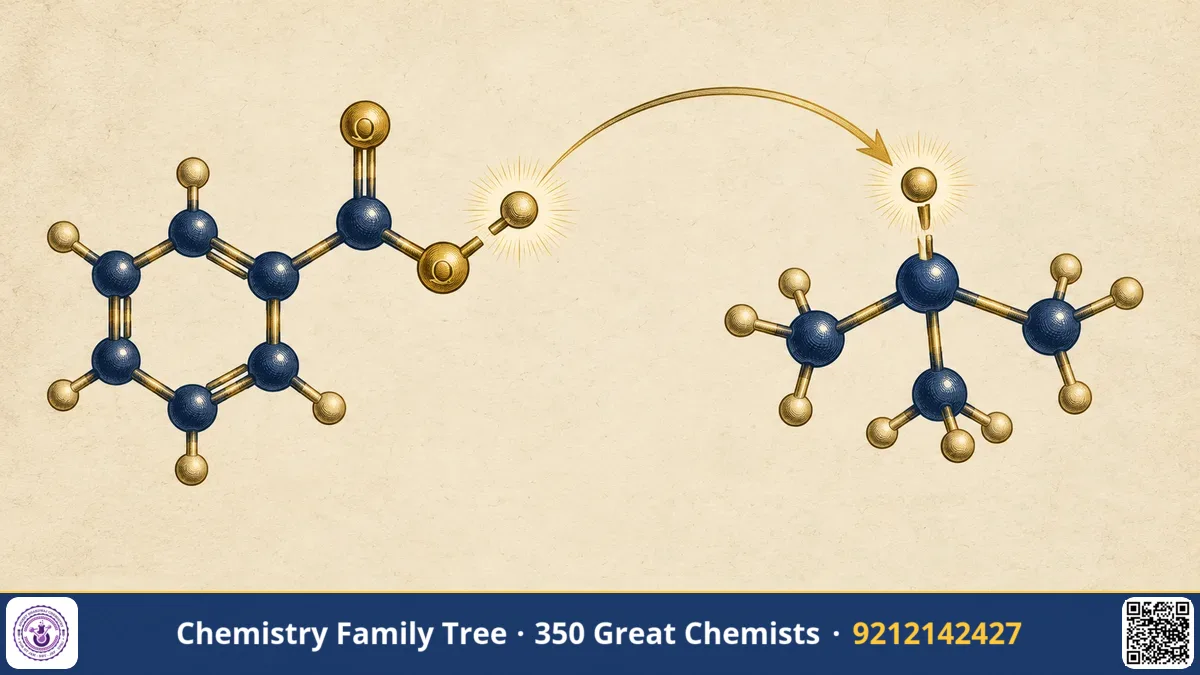
Ask a school student "what is an acid?" and you may hear "something sour that turns blue litmus red." Ask a university student and the answer becomes sharper: "a substance that donates a proton." That crisp definition came in 1923, when the Danish chemist Johannes Nicolaus Brønsted in Copenhagen and the English chemist Thomas Martin Lowry in Cambridge independently proposed the same idea. Their theory removed the need for water as a solvent, explained why some molecules can act as both acid and base, and gave us conjugate acid-base pairs, one of the most useful ideas in chemistry. This article explains the theory in the way it is asked in Class 11-12, B.Sc., IIT-JAM, CSIR-NET and GATE.
The Scientific Problem Before the Discovery
Before 1923 chemists mainly used the Arrhenius definition (1884): an acid gives H⁺ ions in water, and a base gives OH⁻ ions in water. It worked for HCl and NaOH but had clear limits.
- Ammonia (NH₃) has no OH⁻ in its formula, yet it behaves as a base. Chemists had to invent "NH₄OH", which is hardly present in solution.
- The definition was tied to water. It could not explain acid-base reactions in liquid ammonia, acetic acid, or in the gas phase, such as NH₃(g) + HCl(g) → NH₄Cl(s).
- The "free" H⁺ ion in water does not exist alone; a bare proton (radius around 10⁻¹⁵ m) is far too small and reactive. In water it attaches to a water molecule to form H₃O⁺.
Chemists needed a broader, simpler concept based on what actually happens: the movement of a proton.
The Discovery: Step by Step
In 1923 Brønsted published his proposal (in the Dutch journal Recueil des Travaux Chimiques des Pays-Bas), while Lowry published a similar short note in the English journal Chemistry and Industry. Both said:
An acid is a proton (H⁺) donor; a base is a proton acceptor.
Let us follow the logic with examples.
- HCl in water. HCl + H₂O ⇌ H₃O⁺ + Cl⁻. HCl donates a proton, so it is an acid. Water accepts it, so it is a base.
- Ammonia in water. NH₃ + H₂O ⇌ NH₄⁺ + OH⁻. Now water donates a proton and acts as an acid, while NH₃ accepts it and acts as a base.
- Reverse reactions. In the first example, Cl⁻ can accept a proton back and H₃O⁺ can donate one. So after the reaction, the products are also an acid and a base.
This leads to the concept of conjugate pairs: two species that differ by exactly one proton.
Acid₁ + Base₂ ⇌ Base₁ + Acid₂

HCl   + H₂O ⇌ Cl⁻  + H₃O⁺
NH₃   + H₂O ⇌ NH₄⁺ + OH⁻
Here HCl/Cl⁻ and H₃O⁺/H₂O are conjugate pairs. The conjugate base is what remains when an acid loses a proton; the conjugate acid is what forms when a base gains one.
The Chemistry Behind It
Strength and conjugate relationship
A strong acid has a very weak conjugate base, and a strong base has a very weak conjugate acid. HCl is strong, so Cl⁻ is hardly basic. Acetic acid is weak, so acetate is a moderately strong base. For any conjugate pair in water:
Ka × Kb = Kw = 1.0 × 10⁻¹⁴ (at 298 K)
pKa + pKb = 14
Amphoteric (amphiprotic) species
Species that can both donate and accept a proton are amphiprotic: H₂O, HCO₃⁻, HSO₄⁻, H₂PO₄⁻ and HPO₄²⁻. Water is the classic case, showing autoprotolysis: 2H₂O ⇌ H₃O⁺ + OH⁻.
Reaction direction
The equilibrium always favours the formation of the weaker acid and the weaker base. This helps predict whether a proton transfer will go to completion. For example, CH₃COOH (pKa 4.76) will protonate CO₃²⁻ but not Cl⁻.
Levelling effect
In water, no acid stronger than H₃O⁺ can exist, because stronger acids such as HClO₄, HCl and HNO₃ transfer their proton completely to water. All of them appear equally strong. This is the levelling effect. In a weaker proton acceptor like glacial acetic acid, the differences between them become visible.
Brønsted catalysis law
Brønsted also showed that the rate of acid-catalysed reactions depends on the acid strength of the catalyst: log k = α log Ka + C, where α lies between 0 and 1. This relation is a forerunner of the modern linear free energy relationships such as the Hammett equation. He additionally worked on the effect of ionic strength on rate constants (with N. Bjerrum), expressed as log k = log k₀ + 2A zₐz_b √I.
Comparison with other theories
| Theory | Acid | Base |
|---|---|---|
| Arrhenius | Gives H⁺ in water | Gives OH⁻ in water |
| Brønsted-Lowry | Proton donor | Proton acceptor |
| Lewis | Electron-pair acceptor | Electron-pair donor |
Applications Today
- Buffers: blood is buffered mainly by the H₂CO₃/HCO₃⁻ pair, keeping pH near 7.4.
- Titrations and analytical chemistry: indicator choice and equivalence-point pH calculations depend on conjugate pair behaviour.
- Medicine: drug absorption depends on pKa, because the ionised and unionised forms cross membranes differently. Aspirin, a weak acid, is absorbed in the acidic stomach.
- Industry: acid catalysis in petroleum cracking, esterification and the production of ethyl acetate depends on proton transfer.
- Soil science in India: liming acidic soils and treating alkaline soils with gypsum use acid-base equilibria.
Exam Corner
- Conjugate base of H₂SO₄ is HSO₄⁻; of HSO₄⁻ is SO₄²⁻; conjugate acid of NH₃ is NH₄⁺; conjugate acid of H₂O is H₃O⁺.
- Ka × Kb = Kw for a conjugate pair; pKa + pKb = 14 at 25 °C.
- Amphiprotic species: H₂O, HCO₃⁻, HS⁻, H₂PO₄⁻, NH₃ (in special cases). Note that Cl⁻ and NH₄⁺ are not amphiprotic.
- Strongest acid that can exist in water is H₃O⁺; strongest base is OH⁻ (levelling effect).
- Brønsted-Lowry theory cannot explain acid-base behaviour of BF₃ or AlCl₃, which have no protons; Lewis theory is needed.
Common Misconceptions
- "Brønsted and Lowry worked together." They worked independently in 1923, in different countries.
- "An acid must contain hydrogen and a base must contain OH." Acids need a transferable proton; bases need a lone pair (for example NH₃, or the carbonate ion).
- "A salt is neutral." Salts of weak acids or weak bases hydrolyse. CH₃COONa solution is basic because acetate is the conjugate base of a weak acid.
Quick Revision Box
- Brønsted-Lowry (1923): acid = proton donor; base = proton acceptor.
- Conjugate pair: two species differing by one H⁺.
- Strong acid gives weak conjugate base; Ka × Kb = Kw.
- Amphiprotic: H₂O, HCO₃⁻, HSO₄⁻, H₂PO₄⁻.
- Levelling effect: H₃O⁺ is the strongest acid in water.
- Lewis theory is broader; it covers acids with no protons.
FAQ
What is the main difference between Arrhenius and Brønsted-Lowry theories?
Arrhenius works only in water and needs OH⁻ for bases. Brønsted-Lowry works in any solvent, or in no solvent, and defines bases by proton acceptance.
Is water an acid or a base?
Both. It is amphiprotic and acts according to its partner: a base with HCl and an acid with NH₃.
What is a conjugate acid of a base?
The species formed when the base accepts a proton. For example, NH₄⁺ is the conjugate acid of NH₃.
Why does H₃O⁺ represent H⁺ in water?
A bare proton does not survive in water; it bonds with a water molecule and is further hydrogen-bonded to others, so H₃O⁺ is the standard way of writing the hydrated proton.
Published by ABC Chemistry — IIT-JAM | CSIR-NET | GATE Chemistry Coaching. Visit abcchemistry.com
About the chemist
Johannes Nicolaus Brønsted
1879-1947 · Denmark
Brønsted-Lowry acid-base theory