Biography · Chemist no. 41 of 350
Johannes Nicolaus Brønsted: The Danish Chemist Who Redefined Acids and Bases
Introduction
Johannes Nicolaus Brønsted (1879-1947) was a Danish physical chemist and professor at the University of Copenhagen. Every student who writes "HCl + H₂O → H₃O⁺ + Cl⁻" and labels the conjugate pairs is using his idea. In 1923 he proposed, independently of the Englishman Thomas Lowry, that an acid is a proton donor and a base is a proton acceptor. He also contributed to chemical kinetics, thermodynamics and the separation of isotopes. Legacy in one line: he made the proton the centre of acid-base chemistry.
Early Life & Family
Brønsted was born on 22 February 1879 in Varde, a town in the western part of Jutland, Denmark. He went to school in Denmark and grew up in the period when the Danish scientific community was strong in chemistry, with the Carlsberg Laboratory and the University of Copenhagen as centres of research. Copenhagen would become his lifelong base.
Education & Mentors
Brønsted first trained as a chemical engineer at the Polytechnic Institute in Copenhagen, graduating in 1899. He then turned from engineering towards pure chemistry and took a master's-level degree in chemistry in 1902. Copenhagen's chemistry tradition at the time was shaped by S. M. Jørgensen, the Danish inorganic chemist famous for coordination chemistry (and the opponent of Alfred Werner in the great debate about complex compounds). Brønsted took his doctorate in 1908. In the same year, at the age of only 29, he became professor of inorganic and physical chemistry at the University of Copenhagen.
Career Timeline
| Year | Event |
|---|---|
| 1879 | Born in Varde, Denmark |
| 1899 | Graduates as a chemical engineer, Copenhagen |
| 1902 | Earns chemistry degree |
| 1908 | Doctorate; appointed professor at the University of Copenhagen |
| 1920s | Works with George de Hevesy on partial separation of mercury isotopes by distillation |
| 1922-1923 | Studies of salt effects on reaction rates; proposes the acid-base theory (1923) |
| 1920s-1930s | Research on acid-base catalysis and the Brønsted catalysis law |
| 1930s | Becomes active in Danish public life and science policy |
| 1947 | Elected to the Danish parliament; dies in Copenhagen on 17 December 1947 |
Major Scientific Contributions
- Acid-base theory (1923): acid = proton donor, base = proton acceptor, with the idea of conjugate acid-base pairs. See our article on the Brønsted-Lowry theory for equations and exam points.
- Brønsted catalysis law: relates the rate constant of acid- or base-catalysed reactions to the strength of the catalyst: log k = α log Ka + C.
- Primary kinetic salt effect: with the Danish chemist Niels Bjerrum he helped develop the idea that rates of ionic reactions depend on ionic strength, a result that connects kinetics with Debye-Hückel theory.
- Isotope separation: with George de Hevesy, he partly separated isotopes of mercury, an early demonstration that isotopes of the same element differ in physical properties.
- Physical chemistry teaching: he wrote textbooks and trained a generation of Danish physical chemists in thermodynamics and kinetics.
Awards, Honours & Nobel Prize
Brønsted never won a Nobel Prize. He was nominated several times for the Nobel Prize in Chemistry, but the award did not come, which is a well-known case of a major contributor missing out. He was a member of the Royal Danish Academy of Sciences and Letters and received several honorary degrees and memberships in foreign scientific societies. Today the strongest honour is that his name is written in chemistry textbooks all over the world, including Indian NCERT and university books.
Personality, Struggles & Lesser-Known Facts
- Independent discovery. Brønsted and Lowry published the same acid-base concept in 1923 without knowing of each other's work. Such simultaneous discoveries occur when a field is ripe for a new idea.
- The name problem. Early textbooks sometimes used only "Brønsted's theory". The double name "Brønsted-Lowry" became standard later, fairly crediting both.
- Link to Bohr's Copenhagen. He worked in the same city and period as Niels Bohr, and Copenhagen was a hub for the physical and chemical sciences. Brønsted and Bohr were colleagues in the Danish scientific community.
- Public service. In his later years Brønsted became interested in Danish public affairs. He was elected to the Danish parliament in 1947 but died before he could take his seat.
- A broader mind. Besides research he wrote textbooks in Danish and took an interest in the social role of science.
Legacy & Influence on Modern Chemistry
Brønsted's definition shaped acid-base chemistry for the whole twentieth century. Concepts built on it include buffer design, pKa tables, the Hammett and Taft equations, general acid-base catalysis in enzymes, and superacids. In biochemistry, enzymes such as serine proteases use general acid and general base catalysis, which are direct descendants of Brønsted's catalysis studies. In organic chemistry, we choose bases to deprotonate substrates by comparing pKa values. Even when chemists need the wider Lewis definition, they still go back to the Brønsted-Lowry picture for aqueous and protic systems. The IUPAC Gold Book uses the terms "Brønsted acid" and "Brønsted base" as standard.
Lessons for Students
- Look for the simplest unifying idea. One sentence about protons replaced a set of special rules.
- Move across fields. He combined thermodynamics, kinetics and inorganic chemistry.
- Publish clearly. A short, precise statement of the theory made it easy to adopt.
- Do not measure success only by prizes. His influence is greater than many prize-winners.
Quick Facts Box
- Born: 22 February 1879, Varde, Denmark
- Died: 17 December 1947, Copenhagen
- Nationality: Danish
- Field: Physical and inorganic chemistry
- Famous for: Brønsted-Lowry acid-base theory; Brønsted catalysis law
- Nobel: None (nominated several times)
FAQ
Why is it called the Brønsted-Lowry theory?
Because Johannes Brønsted and Thomas Lowry proposed the same proton-transfer definition independently in 1923.
Did Brønsted win a Nobel Prize?
No. He was nominated, but never received the prize.
Where did Brønsted work?
Almost all of his career was spent at the University of Copenhagen.
What is the Brønsted catalysis law?
It is the linear relation log k = α log Ka + C between catalytic rate constant and acid strength of the catalyst, with 0 < α < 1.
Published by ABC Chemistry — IIT-JAM | CSIR-NET | GATE Chemistry Coaching. Visit abcchemistry.com
About the chemist
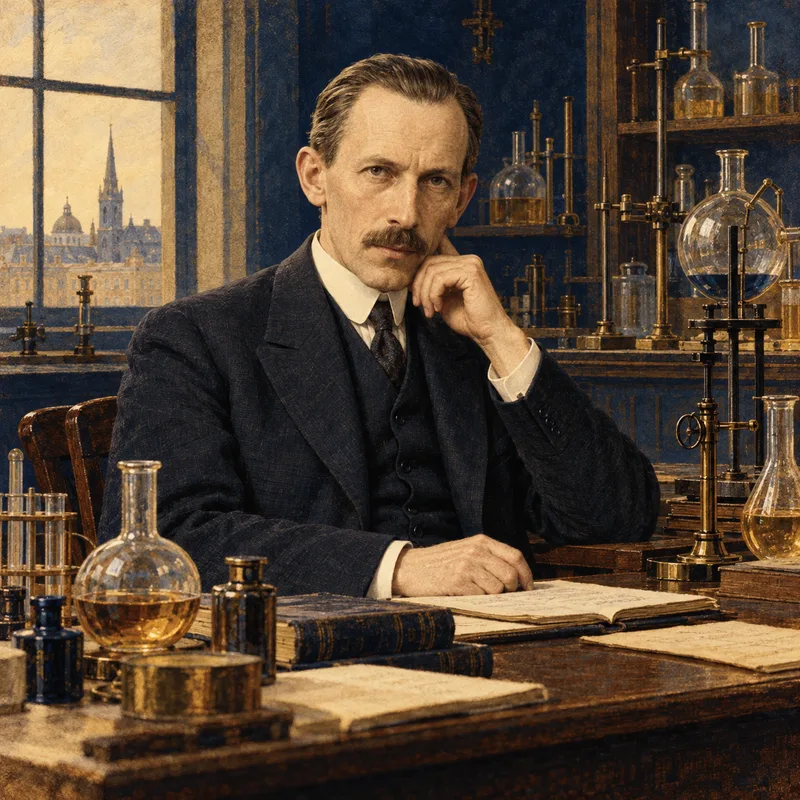
Johannes Nicolaus Brønsted
1879-1947 · Denmark
Brønsted-Lowry acid-base theory