Biography · Chemist no. 330 of 350
Sir C. V. Raman: India's First Science Nobel Laureate
Introduction
Chandrasekhara Venkata Raman (1888–1970) was an Indian physicist who discovered the inelastic scattering of light now known as the Raman effect. He received the Nobel Prize in Physics in 1930, the first Asian and first non-white scientist to win a Nobel Prize in science. Although his prize was in physics, his discovery gave chemistry one of its most important tools, Raman spectroscopy. His legacy in one line: he showed that world-class discovery could come from an Indian laboratory with simple apparatus and great curiosity.
Early Life and Family
Raman was born on 7 November 1888 in Tiruchirappalli (Trichinopoly) in the Madras Presidency. His father, Chandrasekhara Iyer, taught mathematics and physics at a college in Visakhapatnam, where the family moved when Raman was young. The house had books, music and discussion of science. He was a brilliant child who finished school very early. His nephew, the astrophysicist Subrahmanyan Chandrasekhar, also won a Nobel Prize in Physics (1983).
Education and Mentors
Raman entered Presidency College, Madras, at a very young age and took his BA in 1904, winning the gold medal in physics. He completed his MA in 1907 with distinction. A paper on diffraction was published in a British journal while he was still a student. Because of his health and the system of the time, he did not go to Britain for higher studies, and instead took the Indian Finance Service examination, placing first, and joined the Finance Department in Calcutta in 1907. He worked as an accountant but spent his evenings doing research at the Indian Association for the Cultivation of Science (IACS), founded by Mahendralal Sircar, where he was allowed to use the laboratory.
Career Timeline
| Year | Event |
|---|---|
| 1888 | Born in Tiruchirappalli |
| 1907 | MA, Madras; joins the Indian Finance Service in Calcutta |
| 1917 | Leaves government service to become Palit Professor of Physics at Calcutta University |
| 1921 | Visits Britain; on the voyage home is fascinated by the blue colour of the Mediterranean |
| 1924 | Elected Fellow of the Royal Society |
| 1928 | Discovers the Raman effect with K. S. Krishnan (28 February) |
| 1929 | Knighted |
| 1930 | Nobel Prize in Physics |
| 1933 | Moves to the Indian Institute of Science, Bangalore, as Director |
| 1948 | Founds the Raman Research Institute in Bangalore |
| 1954 | Awarded the Bharat Ratna |
| 1970 | Dies in Bangalore on 21 November |
Major Scientific Contributions
Raman effect. The inelastic scattering of light by molecules, which gives vibrational and rotational information. See the companion discovery post for Stokes and anti-Stokes lines and selection rules.
Acoustics and musical instruments. He studied the physics of the violin, the mridangam and the tabla, and explained the harmonic nature of Indian drums.
Optics and crystals. He worked on diffraction of light, the colours of opals and pearls, the structure of diamond and the optical properties of minerals.
Scattering in liquids. He explained that the blue colour of the sea is due mainly to molecular scattering of sunlight by water itself, not just reflection of the sky.
Awards, Honours and Nobel Prize
Raman received the Nobel Prize in Physics in 1930 "for his work on the scattering of light and for the discovery of the effect named after him". He was elected FRS in 1924, knighted in 1929 and received the Bharat Ratna in 1954. He was also awarded the Lenin Peace Prize in 1957. The Nobel Prize was in Physics and not Chemistry, but chemists use his discovery every day.
Personality, Struggles and Lesser-Known Facts
- Evening scientist. For about ten years he worked as a finance officer by day and a researcher at IACS in the evenings and on holidays.
- Self-assured about the Nobel. He is widely reported to have been so confident of winning that he booked tickets to Stockholm months before the announcement. This is a well-known anecdote, though the exact details vary between accounts.
- Simple equipment. The early experiments used sunlight, a telescope and filters. The cost of the apparatus was very small.
- Strong views. He was outspoken and had disagreements with colleagues and administrators, including at the Indian Institute of Science, which he left in 1937 as a director but where he stayed in the physics department for some years more.
- Love of nature. He collected minerals, gems, shells and flowers and kept gardens at his institute.
Legacy and Influence on Modern Chemistry
The Raman effect gave rise to Raman spectroscopy, now used in chemistry, materials science, pharmaceuticals, geology and forensic science. With lasers, Fourier transform methods and nanoparticle enhancement (SERS), the technique has become more powerful than Raman could have imagined. In India, 28 February is celebrated as National Science Day to commemorate his discovery. The Raman Research Institute in Bengaluru continues his research tradition. His students and collaborators, such as K. S. Krishnan, led a generation of Indian physicists.
Lessons for Students
- Ask simple questions about nature. "Why is the sea blue?" led to a Nobel Prize.
- Do not wait for expensive equipment. Careful thought can make up for a lack of resources.
- Work hard in your spare time on what you love, as Raman did at IACS.
- Share credit and train students. Krishnan's role was vital.
Quick Facts Box
- Born: 7 November 1888, Tiruchirappalli, India
- Died: 21 November 1970, Bangalore
- Nationality: Indian
- Field: Physics (optics, light scattering, acoustics)
- Famous for: Raman effect (1928)
- Nobel: Physics, 1930
FAQ
Did C. V. Raman win the Nobel Prize in Chemistry?
No. His Nobel Prize was in Physics, in 1930.
Why is he included among chemists?
His discovery is the basis of Raman spectroscopy, one of the chief methods of molecular structure analysis, and it is part of the chemistry syllabus.
What is National Science Day?
It is celebrated in India on 28 February, the day in 1928 on which the Raman effect was discovered.
Which institution did he found?
The Raman Research Institute in Bangalore, where he worked until his last days.
Published by ABC Chemistry — IIT-JAM | CSIR-NET | GATE Chemistry Coaching. Visit abcchemistry.com
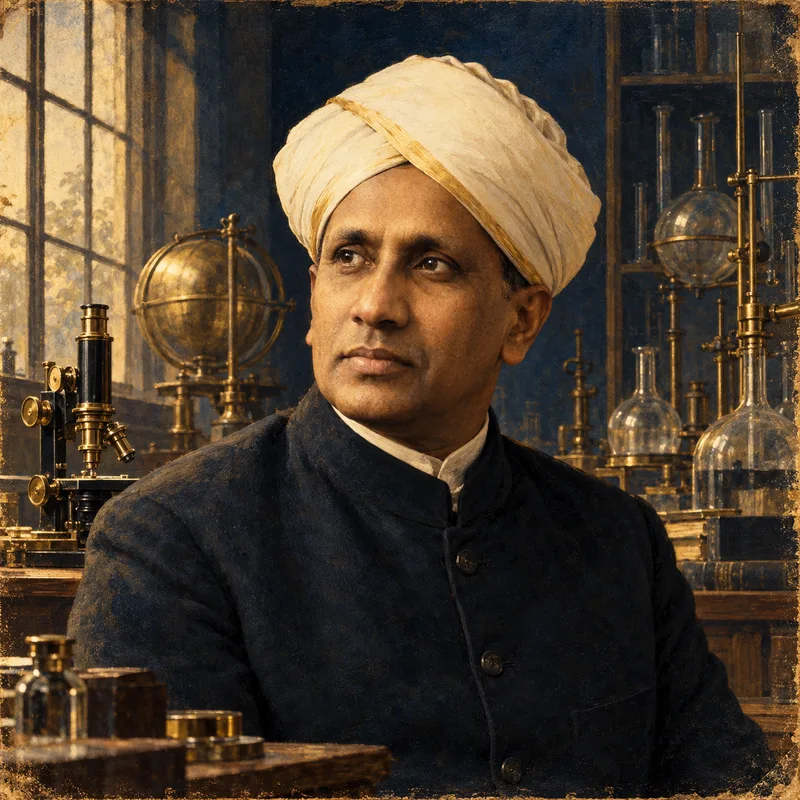
About the chemist
C. V. Raman
1888-1970 · India · Nobel Physics 1930
Raman scattering effect