The discovery, explained · Chemist no. 330 of 350
The Raman Effect: How a Scattered Beam of Light Revealed Molecular Vibrations
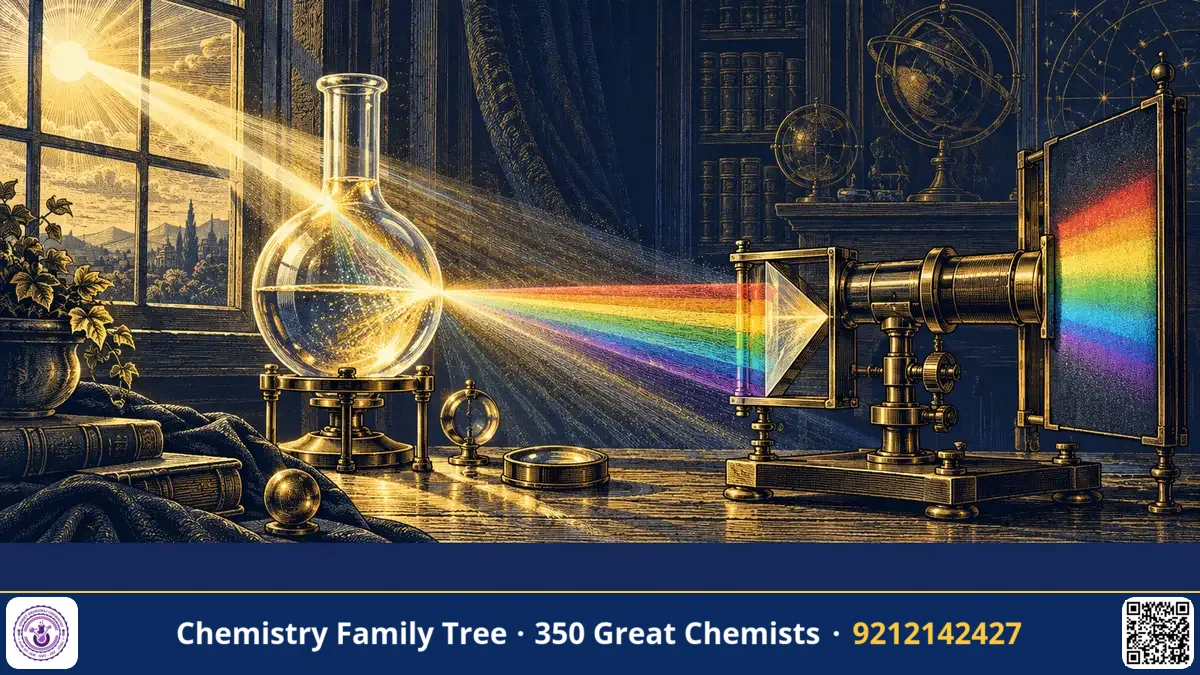
On 28 February 1928, in Calcutta, C. V. Raman and his student K. S. Krishnan observed that when a beam of monochromatic light passes through a transparent liquid, a small part of the scattered light has a different colour from the incident light. This was the Raman effect. It proved, in a very direct way, that light exchanges energy with molecules, and it gave chemists a new way to study molecular vibrations. Raman received the Nobel Prize in Physics in 1930 (not Chemistry) for this work, the first Asian to win a Nobel in science. Yet Raman spectroscopy is a core part of every chemistry syllabus, which is why he belongs on this list. India celebrates 28 February as National Science Day.
The Scientific Problem Before the Discovery
Classical physics explained scattering of light by small particles (Rayleigh scattering, with intensity proportional to 1/λ⁴), which is why the sky is blue. Rayleigh scattering is elastic: the scattered light has the same frequency as the incident light. Raman was interested in why the sea and the sky are blue, and he studied the scattering of light by water and other liquids. In 1923 Arthur Compton had shown that X-rays scattered by electrons change their wavelength. Quantum theory also predicted a similar inelastic scattering for light interacting with molecules, which Adolf Smekal had discussed theoretically in 1923. The question was whether it could be seen with visible light, and how large it would be.
The Discovery: Step by Step
- Step 1: Observation of a "feeble fluorescence". While studying scattering in many purified liquids, Raman and Krishnan noticed a weak glow that did not behave like ordinary fluorescence. It was polarised, and it appeared in every liquid, even in carefully purified ones.
- Step 2: Use of filters. In early experiments, sunlight was focused using a telescope and passed through a blue-violet filter, and the scattered light was viewed through a green filter that normally blocks the primary beam. Light still got through. That was the sign of a changed frequency.
- Step 3: Monochromatic source. Later, a mercury arc lamp and a spectrograph were used, and new sharp lines were recorded beside the mercury lines.
- Step 4: Announcement. The result was announced in 1928 and published in the Indian Journal of Physics. In a short time laboratories around the world confirmed it.
The Chemistry Behind It
When a photon of frequency ν₀ collides with a molecule, most photons scatter elastically (Rayleigh). A small fraction, of the order of one in a million or ten million, exchange energy with the molecule:
Stokes line:      ν = ν₀ − ν_vib   (molecule gains energy, goes v = 0 → 1)
Anti-Stokes line: ν = ν₀ + ν_vib   (molecule loses energy, goes v = 1 → 0)
Raman shift (cm⁻¹) = (1/λ₀) − (1/λ_scattered)
The Raman shift is independent of the exciting wavelength; it equals the vibrational (or rotational) transition energy of the molecule. At room temperature, most molecules are in the ground vibrational state, so Stokes lines are stronger than anti-Stokes lines. The ratio of intensities tells us the temperature.
Selection rule. A vibration is Raman active if it changes the polarisability of the molecule. It is IR active if it changes the dipole moment. For molecules with a centre of symmetry, the rule of mutual exclusion applies: vibrations that are IR active are Raman inactive and vice versa.
| Molecule and mode | IR | Raman |
|---|---|---|
| CO₂ symmetric stretch | Inactive | Active |
| CO₂ asymmetric stretch and bend | Active | Inactive |
| H₂, N₂, O₂ stretch | Inactive | Active |
| H₂O all three modes | Active | Active |
Homonuclear diatomics such as N₂ have no IR spectrum because there is no dipole change, but they have a Raman spectrum because polarisability changes as the bond stretches. The pure rotational Raman selection rule is ΔJ = 0, ±2, in contrast to ΔJ = ±1 for microwave absorption.
Applications Today
- Molecular fingerprinting. Each molecule has a distinct Raman spectrum, useful for identifying chemicals, polymorphs of drugs and minerals.
- Water-based samples. Water is a weak Raman scatterer, so biological samples in water can be studied, unlike IR where water absorbs strongly.
- Lasers and SERS. Lasers made Raman spectroscopy practical. Surface-enhanced Raman scattering on metal nanoparticles can detect very low concentrations.
- Security and quality control. Handheld Raman devices check medicines and detect explosives.
- Art and geology. Pigments in paintings, gemstones and minerals can be identified without damage.
- Carbon materials. The G and D bands of graphene and carbon nanotubes are standard characterisation tools.
Exam Corner
- Raman activity needs a change in polarisability; IR activity needs a change in dipole moment.
- Rule of mutual exclusion holds for centrosymmetric molecules.
- Stokes lines appear at lower frequency than the source; anti-Stokes at higher frequency, and are weaker.
- Raman shift is independent of the exciting wavelength.
- Rotational Raman selection rule: ΔJ = 0, ±2; homonuclear diatomics show pure rotational Raman spectra but no microwave spectra.
Common Misconceptions
- "Raman won the Nobel Prize in Chemistry." No. It was the Nobel Prize in Physics, 1930.
- "Raman scattering is fluorescence." Fluorescence involves absorption into a real excited state and emission later; Raman involves a virtual state and the scattering is almost instantaneous.
- "Raman shift depends on the laser colour." The shift in wavenumbers is a property of the molecule. Only intensity changes with the laser.
Quick Revision Box
- Discovered 28 February 1928 by C. V. Raman and K. S. Krishnan.
- Nobel Prize in Physics, 1930.
- Inelastic scattering: Stokes and anti-Stokes lines.
- Selection rule: change in polarisability.
- Mutual exclusion in centrosymmetric molecules.
- National Science Day in India: 28 February.
FAQ
Who actually saw the effect first?
Raman and Krishnan reported it together in 1928. The Soviet physicists Landsberg and Mandelstam reported a similar effect in crystals at almost the same time. Only Raman received the Nobel Prize.
Why is the effect so weak?
Only a tiny fraction of photons are scattered inelastically, around one in a million, so strong sources and good detectors are needed.
How is Raman different from IR spectroscopy?
IR measures absorption and depends on dipole moment change. Raman measures scattering and depends on polarisability change. They are complementary.
Why is Raman important to chemists if it was Physics?
Because it gives vibrational and rotational information used to determine molecular structure and symmetry.
Published by ABC Chemistry — IIT-JAM | CSIR-NET | GATE Chemistry Coaching. Visit abcchemistry.com

About the chemist
C. V. Raman
1888-1970 · India · Nobel Physics 1930
Raman scattering effect