The discovery, explained · Chemist no. 51 of 350
Carl Bosch and the Industrial Haber-Bosch Process
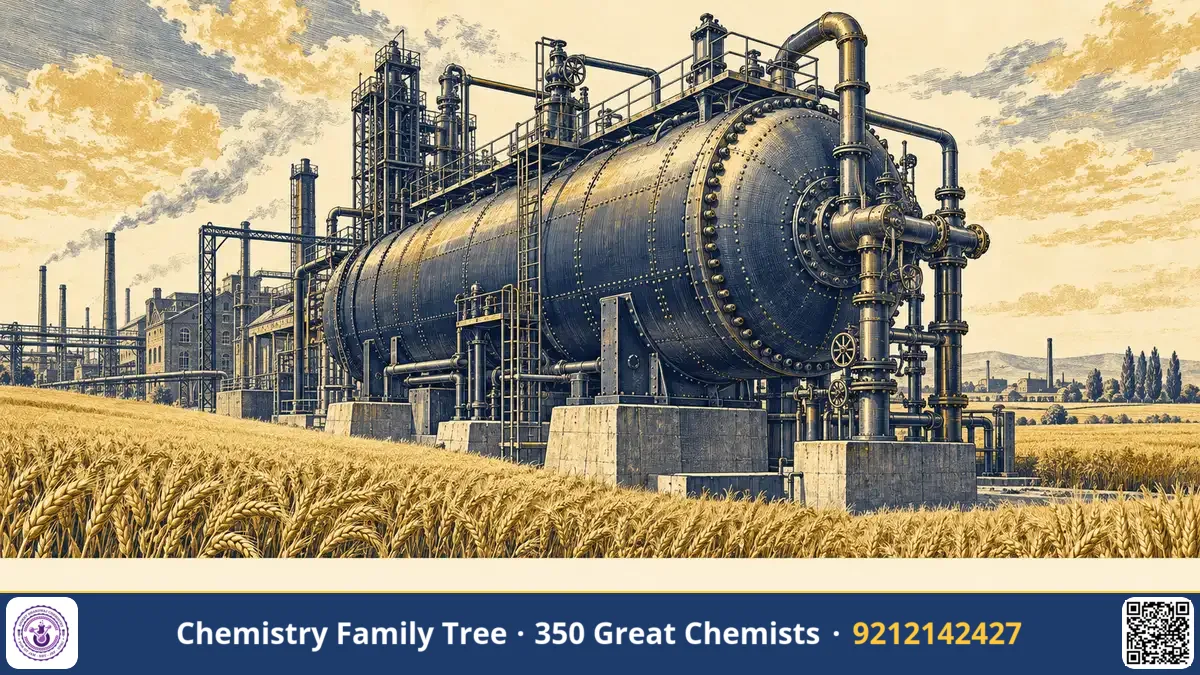
Around half of the nitrogen in your body probably came, at some point, from a factory using the Haber-Bosch process. It is the method that makes ammonia from nitrogen and hydrogen, and it supplies most of the world's nitrogen fertiliser. Fritz Haber showed in 1909 that ammonia could be made on a laboratory table. But it took the engineering genius of Carl Bosch at the German company BASF to turn a table-top experiment into a plant producing thousands of tonnes a year, working at about 200 times atmospheric pressure. Bosch shared the 1931 Nobel Prize in Chemistry with Friedrich Bergius for the invention of chemical high-pressure methods. Here we explain the chemistry and engineering as asked in boards, IIT-JAM, CSIR-NET and GATE.
The Scientific Problem Before the Discovery
Plants need fixed nitrogen (nitrates, ammonium), but the air, which is 78 per cent nitrogen, is useless to them because N≡N is a very strong triple bond (945 kJ/mol). In the 19th century, farmers relied on natural nitrates, mainly Chile saltpetre, and on guano. Sir William Crookes warned in 1898 that the world would soon run out of food unless nitrogen could be fixed from the air. Explosives also needed nitrates, a military concern for Germany.
- Haber worked out the conditions for the equilibrium in Karlsruhe and in 1909 produced liquid ammonia in a small apparatus using an osmium catalyst.
- BASF decided to develop it commercially, but there were serious problems: the pressure (about 200 atm) and temperature (about 500 °C) were enormous for the equipment of that time, the catalysts were rare (osmium, uranium), and nobody had built such reactors.
The Discovery: Step by Step
Step 1: The reaction
N₂(g) + 3H₂(g) ⇌ 2NH₃(g) ΔH° = −92.4 kJ mol⁻¹
Le Chatelier's principle says that high pressure (4 moles → 2 moles) favours ammonia, and low temperature favours it too since the reaction is exothermic. But at low temperature the reaction is far too slow. So a compromise of pressure and temperature, and a good catalyst, is essential.
Step 2: A cheap, durable catalyst
Bosch assigned his colleague Alwin Mittasch to look for a practical catalyst. His team tested thousands of materials in about 20,000 experiments. They found that an iron catalyst, made from magnetite (Fe₃O₄) with small amounts of promoters, was effective: aluminium oxide (Al₂O₃) prevents sintering and potassium oxide (K₂O) increases activity. This catalyst, in modified form, is still used.
Step 3: Solving the steel problem
Early test reactors cracked or burst after a few days. Bosch discovered that hydrogen at high pressure and temperature diffuses into steel and reacts with carbon in it, forming methane (decarburisation), which makes steel brittle:
Fe₃C + 2H₂ → 3Fe + CH₄
His solution was to line the inside of the reactor with a layer of soft, low-carbon iron, which hydrogen cannot easily damage, and to surround it with a strong steel outer wall. Small holes in the outer wall allowed hydrogen diffusing through the lining to escape harmlessly. This double-wall design made reliable high-pressure reactors possible.
Step 4: The full plant
The first plant opened at Oppau, near Ludwigshafen, in September 1913. The process has these stages:
- Hydrogen: originally from water gas (coke and steam): C + H₂O → CO + H₂, followed by the water-gas shift CO + H₂O → CO₂ + H₂. Modern plants use steam reforming of natural gas: CH₄ + H₂O → CO + 3H₂.
- Nitrogen from air.
- Compression of the 1 : 3 N₂/H₂ mixture to about 150-250 atm.
- Reactor at about 400-500 °C over the iron catalyst. Only about 15 per cent of the gas reacts per pass.
- Condensation: cooling liquefies NH₃, which is removed, and unreacted gases are recycled.
With recycling, the overall conversion is very high.
The Chemistry Behind It
Thermodynamics and kinetics
| Factor | Effect on yield | Effect on rate | Choice |
|---|---|---|---|
| High pressure | Increases | Increases | 150-250 atm |
| High temperature | Decreases | Increases | About 450 °C |
| Catalyst | None | Increases | Fe with Al₂O₃, K₂O |
| Removal of NH₃ | Increases | - | Continuous liquefaction |
How the catalyst works
The rate-limiting step is the dissociative adsorption of N₂ on the iron surface, which breaks the N≡N triple bond. Hydrogen also dissociates on iron. Surface nitrogen atoms add hydrogen atoms stepwise to give NH, NH₂ and then NH₃, which desorbs. Potassium donates electron density to iron, helping to weaken the N≡N bond. Poisons such as sulphur compounds, CO and water vapour must be removed from the gas, since they block active sites.
Equilibrium constant
Kp = p(NH₃)² / ( p(N₂) × p(H₂)³ ) Kp = Kc (RT)^Δn, Δn = −2
Kp decreases with temperature, as the reaction is exothermic.
Applications Today
- Fertilisers: ammonia is converted to urea (2NH₃ + CO₂ → NH₂CONH₂ + H₂O), ammonium nitrate, ammonium sulphate and DAP. India is one of the world's biggest consumers of urea, with large plants run by IFFCO, NFL, Chambal Fertilisers and others.
- Nitric acid by the Ostwald process: 4NH₃ + 5O₂ → 4NO + 6H₂O, used in explosives and fertilisers.
- Industrial chemicals: nylon intermediates, dyes, refrigeration and cleaning products.
- Methanol and high-pressure synthesis: Bosch's methods were adapted for methanol synthesis from CO and H₂ (BASF, 1923) and for hydrogenation processes.
- Future fuel: "green ammonia" made with hydrogen from electrolysis powered by renewable energy is being developed as an energy carrier.
Exam Corner
- Haber-Bosch: N₂ + 3H₂ ⇌ 2NH₃, ΔH = −92 kJ/mol; about 200 atm, 450 °C, Fe catalyst with Al₂O₃ and K₂O promoters.
- Promoter: increases the efficiency of a catalyst (K₂O); a poison reduces it (H₂S, CO, As compounds).
- Yield is increased by high pressure, low temperature, removal of NH₃; catalyst only increases rate.
- Kp = Kc(RT)^Δn with Δn = −2 for ammonia synthesis.
- Bosch and Bergius shared the 1931 Nobel Prize in Chemistry; Haber won in 1918 for the synthesis of ammonia.
Common Misconceptions
- "Haber did it all." Haber demonstrated the principle; Bosch and Mittasch made it work at scale.
- "A catalyst raises the yield." It only speeds up the approach to equilibrium.
- "Lower temperature is always better for exothermic reactions." Not in practice; the rate becomes too slow.
Quick Revision Box
- Haber (1909) lab synthesis; Bosch (1913) industrial plant at Oppau.
- Conditions: 150-250 atm, 400-500 °C, iron catalyst with promoters.
- Mittasch discovered the Fe/Al₂O₃/K₂O catalyst after thousands of tests.
- Bosch's reactor: soft iron lining inside a steel shell to prevent hydrogen attack.
- Hydrogen from natural gas steam reforming; nitrogen from air.
- Nobel Prize in Chemistry 1931 (shared with Bergius).
FAQ
Why is the Haber-Bosch process so important?
It supplies the nitrogen fertiliser that helps feed about half of the world's population.
Why is the process run at 450 °C if low temperature favours ammonia?
At lower temperatures the rate is too slow, even with a catalyst, so a compromise is used.
What was Bosch's main engineering innovation?
The lined, double-wall reactor that resisted hydrogen attack on steel.
Where does the hydrogen come from today?
Mostly from steam reforming of natural gas; in India also from naphtha and, increasingly, from coal gasification and electrolysis.
Published by ABC Chemistry — IIT-JAM | CSIR-NET | GATE Chemistry Coaching. Visit abcchemistry.com
About the chemist
Carl Bosch
1874-1940 · Germany · Nobel Chemistry 1931
Industrial Haber-Bosch ammonia process