Biography · Chemist no. 236 of 350
Carl Wilhelm Scheele: The Pharmacist Who Discovered More Than Most Laboratories
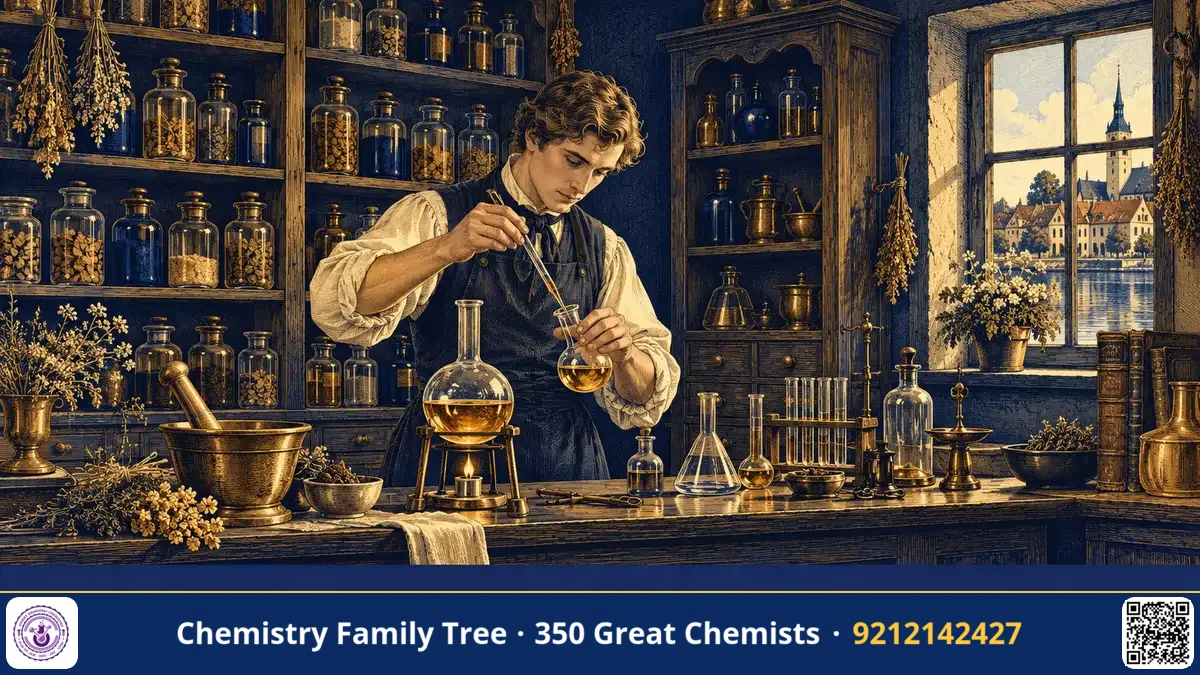
Carl Wilhelm Scheele (1742–1786) is sometimes called "hard-luck Scheele" because others took credit for many of his discoveries, and because he died at only 43. Working in provincial pharmacies with simple apparatus, he prepared oxygen, discovered chlorine, isolated several organic acids and studied many dangerous substances. His one-line legacy: proof that careful, patient experiments matter more than a grand laboratory.
Early Life and Family
Scheele was born on 9 December 1742 in Stralsund, then a Swedish possession in Pomerania on the Baltic coast (now in Germany). He was one of eleven children of Joachim Christian Scheele, a merchant and brewer, and Margaretha Eleonora Warnekros. He was raised in a German-speaking family, which explains why he wrote in a mixture of Swedish and German and why modern sources call him either German-born or Swedish. The family circumstances were modest, and the family could not support a university education.
Education and Mentors
At age 14 he was apprenticed to the pharmacist Martin Anders Bauch in Gothenburg. He spent about eight years there, learning the traditional skills of a pharmacist and doing experiments at night. He read the chemistry books available, including works by Nicolas Lémery, Johann Kunckel, Georg Ernst Stahl, and Caspar Neumann, and repeated experiments himself. Scheele had no university degree and received no formal training in chemistry, which makes his results all the more remarkable. Later he met influential Swedish chemists, notably Torbern Bergman at Uppsala, who encouraged him and helped him get his work published.
Career Timeline
| Year | Event |
|---|---|
| 1742 | Born in Stralsund. |
| 1757 | Apprenticed to a pharmacist in Gothenburg. |
| 1765 | Moves to Malmö to work as an assistant pharmacist. |
| 1768 | Moves to Stockholm and works at a pharmacy there. |
| 1770 | Moves to Uppsala and works in the pharmacy there; meets Torbern Bergman. |
| 1769–1772 | Isolates tartaric acid; carries out experiments on air that lead to the discovery of oxygen. |
| 1775 | Elected to the Royal Swedish Academy of Sciences, an unusual honour for a pharmacist without a degree. |
| 1775 | Moves to Köping, where he takes over a run-down pharmacy. |
| 1777 | Publishes Chemical Treatise on Air and Fire. |
| 1782 | Becomes owner of the Köping pharmacy. |
| 1786 | Dies in Köping on 21 May. |
Major Scientific Contributions
- Oxygen and composition of air: fire air (oxygen) and foul air (nitrogen); explained in detail in our discovery blog.
- Chlorine (1774): MnO₂ + 4HCl → MnCl₂ + Cl₂ + 2H₂O.
- Organic acids: tartaric, citric, lactic, malic, oxalic and gallic acids isolated from natural sources.
- Other discoveries: glycerol, hydrogen cyanide, hydrofluoric acid in detail, arsine, and tungstic acid in scheelite (CaWO₄).
- Methods: use of precipitation as insoluble calcium or lead salts to separate natural acids.
- Pigment: Scheele's green (copper arsenite), a bright green pigment that was popular in the 19th century.
Awards, Honours and Nobel Prize
There was no Nobel Prize in his lifetime. Scheele was elected a member of the Royal Swedish Academy of Sciences in 1775, which was an extraordinary honour for a man with no degree. He later received an offer of an appointment from Frederick II of Prussia, who proposed a position in Berlin, but he declined and preferred to stay in Sweden. The mineral scheelite, an ore of tungsten, is named after him.
Personality, Struggles and Lesser-Known Facts
- Dedicated to the work. He is described as quiet, modest and intensely focused. He lived simply and spent his small income on equipment and materials.
- Danger of tasting. Like many chemists of the time, he is said to have recognised substances by smell and taste. He worked with poisonous materials such as cyanide, arsenic compounds and hydrofluoric acid, and his health suffered. The exact cause of his early death is uncertain; heavy-metal poisoning has been suggested but cannot be confirmed.
- Lost priority. His oxygen work was printed in 1777, after Priestley and Lavoisier had published their own. He also lost credit for other discoveries, such as manganese, to other chemists.
- Marriage at the end. He married the widow of the previous Köping pharmacy owner, Sara Margaretha Pohl, only days before his death, apparently to secure her inheritance of the business. This story appears in standard biographies.
Legacy and Influence on Modern Chemistry
Scheele's results gave Lavoisier and Davy the materials with which to revise chemical theory. His analytical approach to plant acids opened up organic chemistry, because it showed that definite pure compounds could be isolated from natural sources. His careful study of gases, including oxygen and chlorine, supplied evidence that overturned the phlogiston theory, although he never abandoned it himself. Chlorine disinfection, fruit-acid food chemistry and the study of tungsten (used in lamp filaments and in modern hard alloys) are among the later outcomes of his work.
Lessons for Students
- Great science is possible with simple tools. Careful observation and repeated trials matter most.
- Publish promptly. A delay in printing cost him credit for oxygen.
- Safety first. Never taste or smell unknown chemicals. Follow lab safety rules; Scheele's health is a warning.
- Credit does not define value. Your contributions still matter even if someone else gets the headlines.
Quick Facts Box
- Born: 9 December 1742, Stralsund, Swedish Pomerania
- Died: 21 May 1786, Köping, Sweden
- Nationality: Swedish (German-born)
- Field: Pharmacy, inorganic and organic chemistry
- Famous for: Oxygen, chlorine, organic acids, glycerol
- Nobel Prize: None (pre-dates the prize)
FAQ
Did Scheele discover oxygen before Priestley?
His experiments likely came first, but his book appeared in 1777, three years after Priestley's publication of 1774.
Why is he called "hard-luck Scheele"?
Because others often received credit for his discoveries, due to delays in publication and the limited reach of his Swedish-language work.
What is scheelite?
It is the mineral calcium tungstate, CaWO₄, named in his honour. It is an important ore of tungsten.
Did he have a university education?
No. He trained as an apprentice pharmacist and taught himself chemistry through reading and experiments.
Published by ABC Chemistry — IIT-JAM | CSIR-NET | GATE Chemistry Coaching. Visit abcchemistry.com
About the chemist
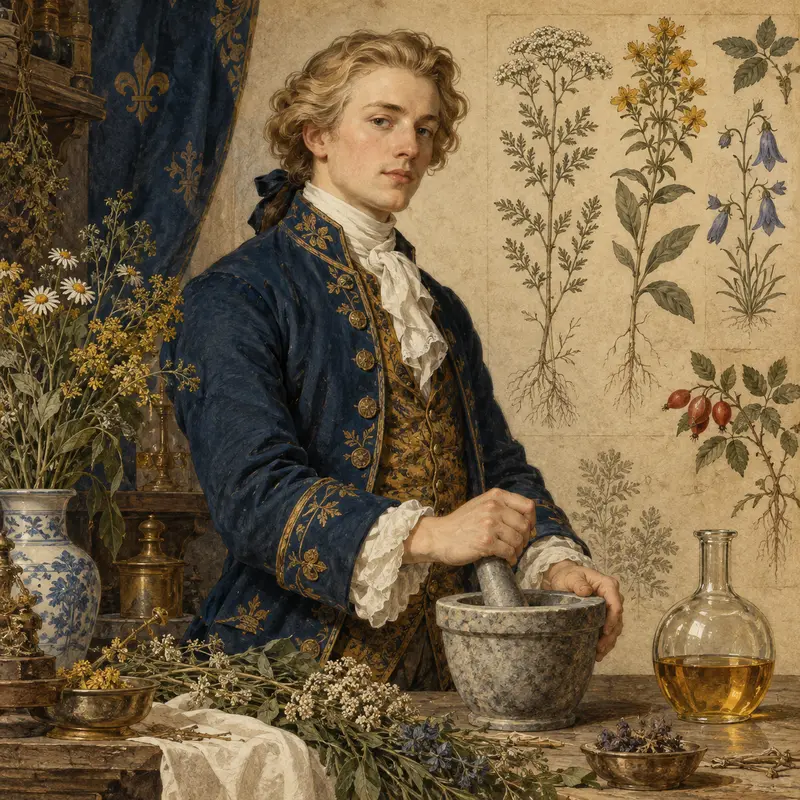
Carl Wilhelm Scheele
1742-1786 · Sweden
Discovered oxygen, chlorine, and tartaric acid