The discovery, explained · Chemist no. 236 of 350
Carl Wilhelm Scheele: Fire Air, Green Gas and a Pharmacy Full of Discoveries
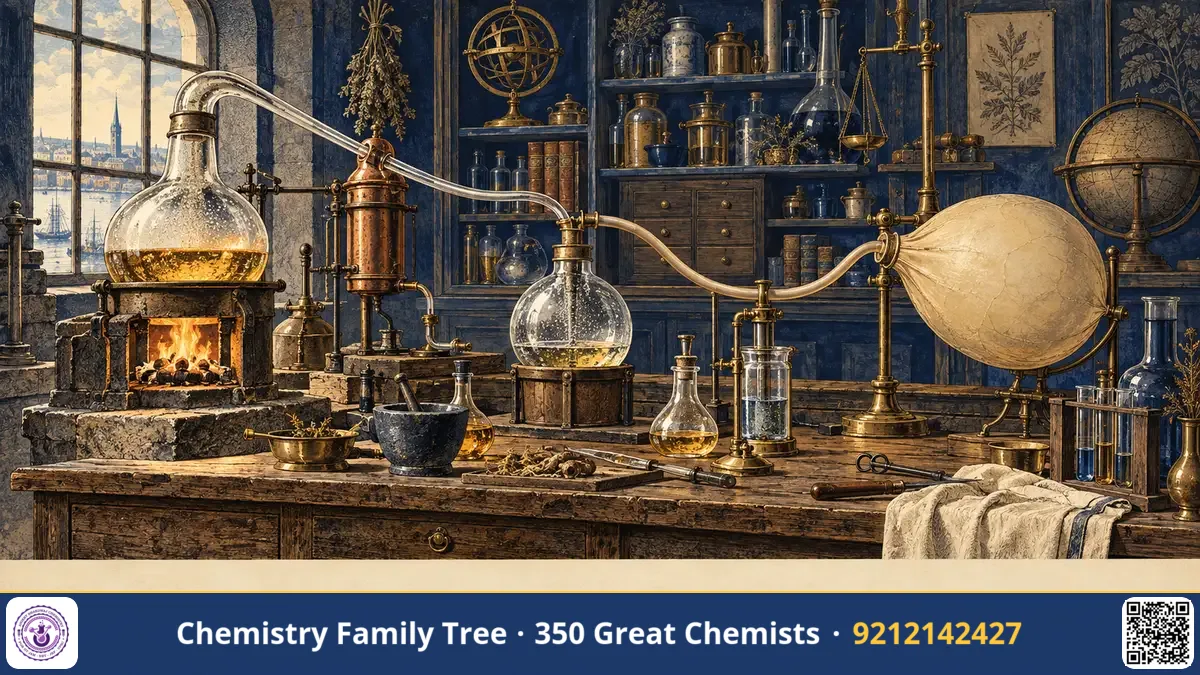
Few chemists have discovered as much with as little equipment as Carl Wilhelm Scheele. Working as a pharmacist in small Swedish towns, he prepared oxygen before Priestley published his results, discovered chlorine, isolated tartaric, citric, lactic, malic and oxalic acids, and found the compounds that led to the identification of manganese, barium and tungsten. He also described hydrogen cyanide, hydrofluoric acid and arsine in careful detail. His one-line legacy: a pharmacist whose hands-on experiments laid the foundations of inorganic and organic chemistry. In this blog we focus on the discoveries most useful to you as a student.
The Scientific Problem Before the Discovery
The dominant theory in the 1770s was phlogiston: combustible substances were thought to contain a fire-matter that was released on burning. The air was thought to be a single element, apart from some gases such as carbon dioxide ("fixed air") described by Joseph Black. There was no reliable explanation of why a flame needs air, why a mouse dies in a closed jar, or why metals gain weight when heated. In organic chemistry, plant and animal materials were thought to be too complex to separate into definite substances. A few fruit acids were known as juices, not as pure compounds. Chemists needed a cleaner experimental approach.
The Discovery: Step by Step
Step 1: Fire air (oxygen), about 1771–1772
Scheele heated several substances, including manganese dioxide with sulfuric acid, nitrates, mercuric oxide and others, and collected the gas in bladders. He found that the gas supported combustion very vigorously and that a part of ordinary air does the same. He called it "fire air" (Feuerluft) and "foul air" for the remaining part, which is mainly nitrogen. He proposed that air consists of these two components, with fire air being about one quarter. His book Chemische Abhandlung von der Luft und dem Feuer (Chemical Treatise on Air and Fire) was printed in 1777, delaying his priority; Priestley published in 1774 and Lavoisier gave the explanation.
2HgO → 2Hg + O₂
2KNO₃ → 2KNO₂ + O₂
Step 2: Chlorine, 1774
While studying the mineral pyrolusite (manganese dioxide), Scheele heated it with hydrochloric acid (then "muriatic acid") and obtained a yellow-green, choking gas that bleached vegetable colours:
MnO₂ + 4HCl → MnCl₂ + Cl₂ + 2H₂O
He called it "dephlogisticated muriatic acid" and believed it to be an oxygen-containing compound. Humphry Davy showed in 1810 that it is an element and named it chlorine, from the Greek chloros, pale green.
Step 3: Organic acids, 1769–1785
He isolated pure tartaric acid from cream of tartar in 1769 (by treating it with chalk and then sulfuric acid), citric acid from lemon juice in 1784, malic acid from apples (1785), lactic acid from sour milk (1780), oxalic acid from sorrel and gallic acid from oak galls. A typical separation precipitates the calcium salt and regenerates the acid:
2C₆H₈O₇ + 3CaCO₃ → Ca₃(C₆H₅O₇)₂ + 3H₂O + 3CO₂
Ca₃(C₆H₅O₇)₂ + 3H₂SO₄ → 2C₆H₈O₇ + 3CaSO₄
Step 4: Other substances
Scheele studied hydrofluoric acid (from fluorspar and sulfuric acid), hydrogen cyanide (Prussic acid), glycerol (found in 1779 while saponifying olive oil with lead oxide), the arsenic-containing pigment now called Scheele's green (copper arsenite), and the poisonous gas arsine. He also identified tungstic acid in the mineral now named scheelite, and he pointed to the existence of barium and manganese, which were isolated by others.
The Chemistry Behind It
- Oxygen: supports combustion because it is a strong oxidising agent: C + O₂ → CO₂; 2Mg + O₂ → 2MgO. Air is about 21% oxygen by volume, close to Scheele's "one quarter" estimate.
- Chlorine: a strong oxidising and bleaching agent: Cl₂ + H₂O ⇌ HCl + HOCl. The hypochlorous acid does the bleaching. In this lab reaction MnO₂ acts as an oxidant: Mn goes from +4 to +2 while Cl⁻ is oxidised to Cl₂.
- Hydrofluoric acid: CaF₂ + H₂SO₄ → CaSO₄ + 2HF. It is a weak acid in water but a strong etchant of glass because it forms SiF₄: SiO₂ + 4HF → SiF₄ + 2H₂O.
- Glycerol and soap: triglyceride + 3NaOH → glycerol + 3 RCOONa. This saponification reaction is described in every organic chemistry course.
- Carboxylic acids: citric acid is a tricarboxylic acid and tartaric acid is a dihydroxy dicarboxylic acid. Their stereochemistry later became central to optical isomerism, studied by Pasteur on tartaric acid.
Applications Today
Chlorine is used for water disinfection across Indian cities and for making PVC, bleaching powder and solvents. Oxygen is used in steel making, in hospitals (a major concern in India during the COVID-19 emergency), and in welding. Citric acid is a food preservative and flavouring made on a large scale by fermentation, lactic acid is used in food and in biodegradable polymers such as polylactic acid, and tartaric acid is used in baking powder and wine making. Glycerol goes into cosmetics, pharmaceuticals and explosives. Scheele's green was widely used as a pigment but is now banned because of arsenic toxicity.
Exam Corner
- Scheele prepared oxygen ("fire air") around 1771–72, before Priestley's 1774 publication; Lavoisier named and explained it.
- Lab preparation of chlorine: MnO₂ + 4HCl → MnCl₂ + Cl₂ + 2H₂O. Scheele discovered it in 1774; Davy proved it to be an element in 1810.
- Glycerol was discovered by Scheele when heating olive oil with litharge (PbO).
- Acids first isolated by Scheele include tartaric, citric, lactic, malic, oxalic and gallic.
- Hydrofluoric acid attacks glass: SiO₂ + 4HF → SiF₄ + 2H₂O. It is a weak acid (pKa about 3.2) yet very dangerous.
Common Misconceptions
- "Priestley discovered oxygen first." Priestley published first, but Scheele's experiments probably came earlier. Many historians credit both.
- "Scheele knew chlorine was an element." He thought it contained oxygen; Davy proved otherwise.
- "A discovery means the person understood it." Scheele explained all his results in terms of phlogiston.
Quick Revision Box
- Scheele (1742–1786), Swedish-German pharmacist-chemist.
- Fire air = oxygen, foul air = nitrogen (c. 1771–72, published 1777).
- Chlorine from MnO₂ + HCl, 1774.
- Isolated tartaric, citric, lactic, malic, oxalic acids; found glycerol.
- Studied HF, HCN, arsine; Scheele's green is copper arsenite.
- Remained a phlogiston supporter.
FAQ
Why did Scheele publish late?
His book was delayed at the printer, and was published in 1777, after Priestley's 1774 paper.
How did he work with so little equipment?
He used simple glassware, retorts, bladders and his pharmacy supplies, with extreme care and patience.
Did Scheele taste the chemicals?
Accounts say he used smell and taste to identify substances, which was common in his day but extremely dangerous. His early death is often linked to exposure to toxic materials, though the exact cause is not certain.
Which elements did he help discover?
He is credited with oxygen and chlorine, and his work contributed to the discovery of manganese, barium, molybdenum and tungsten, which were isolated as metals by others.
Published by ABC Chemistry — IIT-JAM | CSIR-NET | GATE Chemistry Coaching. Visit abcchemistry.com
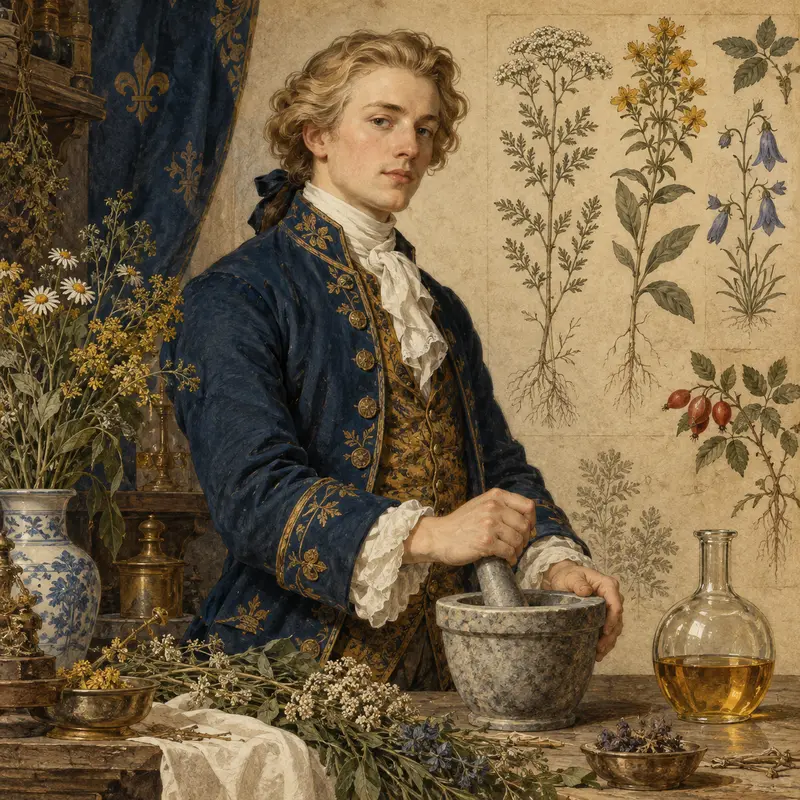
About the chemist
Carl Wilhelm Scheele
1742-1786 · Sweden
Discovered oxygen, chlorine, and tartaric acid