Biography · Chemist no. 220 of 350
Carolyn Bertozzi: The Chemist Who Brought Reaction Chemistry Into Living Cells
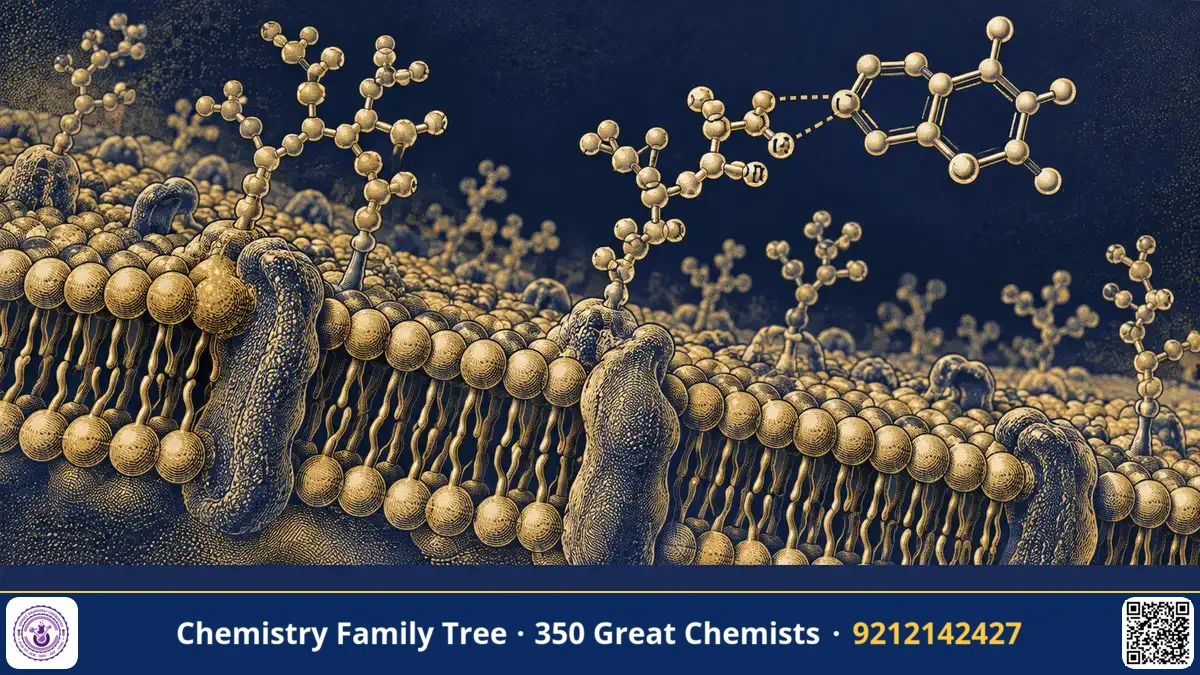
Carolyn Ruth Bertozzi, born in 1966, is an American chemist and the Anne T. and Robert M. Bass Professor of Chemistry at Stanford University. She is the founder of bioorthogonal chemistry and a leader in glycoscience, the study of sugars on cell surfaces. In 2022 she shared the Nobel Prize in Chemistry with Morten Meldal and K. Barry Sharpless. Her legacy in one line: she taught chemists how to react molecules inside living organisms without disturbing life.
Early Life and Family
Bertozzi was born on 10 October 1966 in Boston, Massachusetts, and grew up in the Boston area. Her father, William Bertozzi, was a physicist at the Massachusetts Institute of Technology, so science was part of her childhood conversation. As a girl she was interested in many subjects, including music; she has said that she played in a band as a student. Her path to chemistry was not planned early, and she has described it as a journey of discovery.
Education and Mentors
Bertozzi studied at Harvard University, where an organic chemistry course helped turn her toward chemistry. She graduated with a bachelor's degree in chemistry in 1988. She then did her PhD at the University of California, Berkeley, completing it in 1993 under Mark Bednarski, working on carbohydrate chemistry, specifically on synthetic oligosaccharide mimics related to selectin ligands that guide white blood cells. She continued as a postdoctoral fellow at the University of California, San Francisco, in the laboratory of Steven Rosen, an expert in cell adhesion and glycobiology. This gave her the combination of synthetic chemistry and biology that defined her career.
Career Timeline
| Year | Event |
|---|---|
| 1966 | Born in Boston, Massachusetts |
| 1988 | BA in Chemistry, Harvard University |
| 1993 | PhD, University of California, Berkeley |
| 1993-1995 | Postdoctoral researcher at UCSF with Steven Rosen |
| 1996 | Joins the faculty of UC Berkeley |
| 1999 | Receives a MacArthur Fellowship |
| 2000 | Reports the bioorthogonal Staudinger ligation |
| 2004 | Develops copper-free strain-promoted azide-alkyne cycloaddition |
| 2015 | Moves to Stanford University |
| 2022 | Nobel Prize in Chemistry (shared) |
Major Scientific Contributions
Bioorthogonal chemistry. She coined the term and developed the Staudinger ligation (2000) and copper-free click chemistry using strained cyclooctynes (2004). These allow tagging of biomolecules in living cells and animals. See our discovery post for the equations.
Metabolic labelling of glycans. By feeding cells azido sugars, her laboratory showed how glycans can be visualised, enriched and studied. This has helped uncover the roles of sialic acid, O-GlcNAc and other glycosylations.
Glycobiology of disease. Her group studied how tumour cells cover themselves in sialic-acid-rich glycans that engage Siglec receptors on immune cells, sending a "don't eat me" signal. Her laboratory developed antibody-sialidase conjugates that remove these sugars, a strategy being developed by the company Palleon Pharmaceuticals, which she co-founded.
Tuberculosis and bacterial glycans. Her group studied the unusual cell envelope glycolipids of Mycobacterium tuberculosis, the pathogen that is highly relevant to India, and developed probes for them.
New directions. More recently, her group has worked on lysosome-targeting chimeras (LYTACs) to degrade extracellular proteins, on mucin-domain glycoproteins, and on glycoRNA, a recently reported class of RNA molecules carrying glycans on cell surfaces.
Awards, Honours and Nobel Prize
In 2022 Carolyn Bertozzi, Morten Meldal and K. Barry Sharpless received the Nobel Prize in Chemistry "for the development of click chemistry and bioorthogonal chemistry". She is one of the small number of women to have received the Nobel Prize in Chemistry. Earlier honours include a MacArthur "genius" Fellowship (1999), and election to the US National Academy of Sciences, the National Academy of Medicine and the American Academy of Arts and Sciences.
Personality, Struggles and Lesser-Known Facts
- A musical past. She has said she played in a band as a student and considered music before chemistry won out.
- Family of scientists. Her father was a physicist at MIT, so laboratory talk was familiar at home.
- Speaking about mentoring. She has talked about the challenges for women and for sexual-minority scientists in chemistry, and has supported diversity in her laboratory and in the wider community. She has also spoken about her own experiences as a gay scientist.
- Ideas from other fields. The Staudinger reaction she modified was a century-old reaction, showing the value of old textbook chemistry.
- Sharpless's second prize. Her co-laureate K. Barry Sharpless had already won in 2001, making him one of very few two-time Nobel laureates in any field.
Legacy and Influence on Modern Chemistry
Bertozzi created a bridge between chemistry and biology. Bioorthogonal reactions are used by thousands of laboratories for imaging, proteomics and drug delivery. Her laboratory demonstrated that studying sugars, long viewed as "the hard part" of biochemistry, can be made tractable using chemical tools. She is also a prominent advocate of translating basic research into medicines, co-founding several biotechnology companies. For young scientists, her career shows that a hands-on chemist can open new questions in cell biology.
Lessons for Students
- Combine disciplines. Her work lives between organic chemistry and cell biology.
- Revisit old reactions. The Staudinger reaction was discovered in 1919 and was reborn as a bioorthogonal tool.
- Identify clear design rules. Defining what a bioorthogonal reaction must achieve guided years of invention.
- Persist with difficult topics. Glycans were considered too complex; she made them accessible.
- Support others. She emphasises inclusive laboratories where talented people from every background can thrive.
Quick Facts Box
- Born: 10 October 1966, Boston, Massachusetts, USA
- Died: Living
- Nationality: American
- Field: Chemical biology, glycoscience
- Famous for: Bioorthogonal chemistry, Staudinger ligation, copper-free click chemistry
- Nobel: Chemistry 2022 (with Meldal and Sharpless)
FAQ
Where does Carolyn Bertozzi work?
She is a professor at Stanford University, California, and was previously a professor at UC Berkeley.
What did she discover?
She developed bioorthogonal reactions that proceed inside living systems, including the Staudinger ligation and copper-free strain-promoted click chemistry.
Who shared the 2022 Chemistry Nobel with her?
Morten Meldal and K. Barry Sharpless. Sharpless thereby became one of the few people to win two Nobel Prizes in Chemistry.
What is a good first topic to study from her work?
Start with 1,3-dipolar cycloadditions and the Staudinger reaction, then read about ring strain in cycloalkynes.
Published by ABC Chemistry — IIT-JAM | CSIR-NET | GATE Chemistry Coaching. Visit abcchemistry.com
About the chemist
Carolyn Bertozzi
1966- · United States · Nobel Chemistry 2022
Bioorthogonal chemistry