The discovery, explained · Chemist no. 220 of 350
Bioorthogonal Chemistry: How Carolyn Bertozzi Made Chemistry Work Inside Living Cells
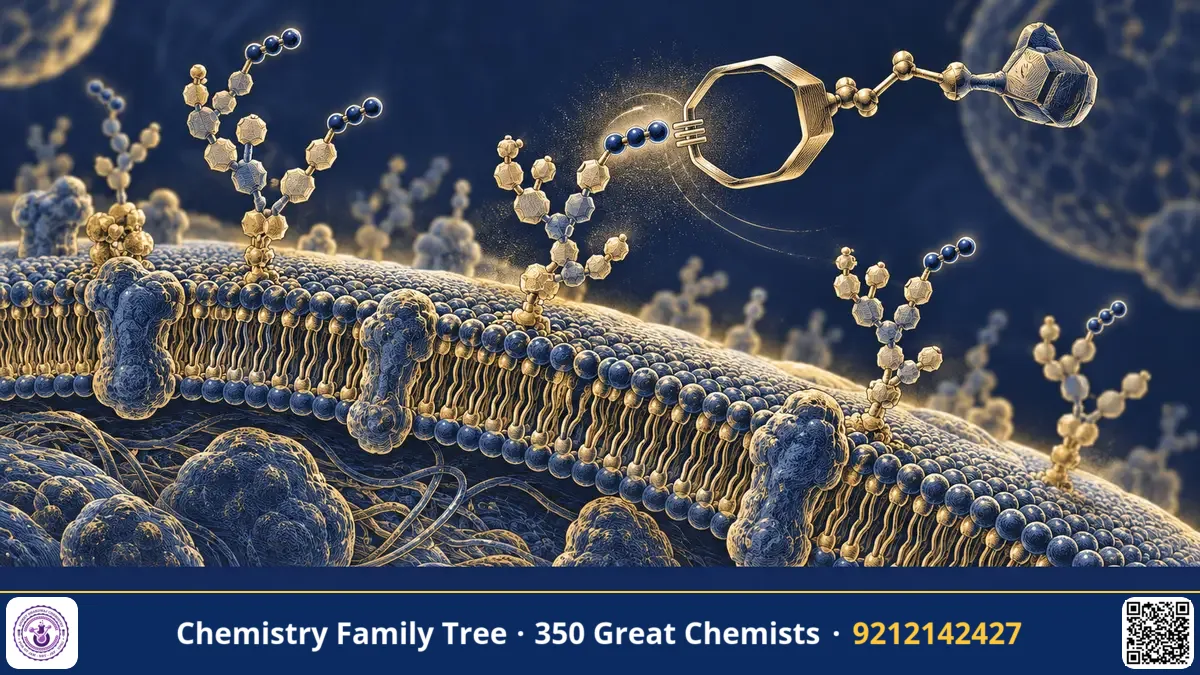
Can a chemist carry out a reaction inside a living cell, or even inside a living animal, without disturbing life itself? Carolyn Bertozzi answered yes. Starting in the late 1990s, she developed reactions that proceed selectively between two artificial functional groups in the middle of water, proteins, sugars, lipids and thousands of other reactive molecules, without harming the cell. She named this concept bioorthogonal chemistry. In 2022, Bertozzi shared the Nobel Prize in Chemistry with Morten Meldal and K. Barry Sharpless "for the development of click chemistry and bioorthogonal chemistry".
This discovery lets scientists see, track and target biomolecules, especially cell-surface sugars called glycans, in their natural environment. This post explains the problem, the reactions, the key mechanism and the exam points.
The Scientific Problem Before the Discovery
Proteins and nucleic acids are encoded by genes, so biologists can tag them with fluorescent proteins such as GFP. Glycans, the carbohydrate chains attached to proteins and lipids, are not directly encoded by a gene. They are built by many enzymes, are structurally varied, and cannot be tagged by genetic tricks. Yet glycans are important: they take part in cell recognition, immune response, inflammation and cancer metastasis.
Chemists could label biomolecules in a test tube, for example by reacting amines with activated esters. But in a living system, a reagent that reacts with amines would react with thousands of proteins, and the reaction would also need to proceed in water, at 37 degrees C, at neutral pH, at very low concentration, and without toxic by-products. The requirements for a bioorthogonal reaction are strict:
- The two reacting groups must be inert to all native functional groups.
- They must react quickly at physiological conditions and low concentration.
- Reagents and products must be non-toxic.
- The groups must be small enough not to disturb the biology.
The Discovery / Experiment
Step 1: The chemical reporter strategy. Bertozzi first used the cell's own biosynthesis to deliver a small chemical handle. Cells were fed a modified sugar, N-azidoacetylmannosamine (acetylated, Ac4ManNAz). The cell converts it into the corresponding sialic acid and displays it on cell-surface glycans. The azide group (–N3) is tiny, stable and absent from natural biology, so it works as a "reporter".
Step 2: The Staudinger ligation (2000). She modified the classical Staudinger reaction between an azide and a triarylphosphine. In the standard reaction, the aza-ylide intermediate is hydrolysed to an amine and phosphine oxide. Bertozzi placed an ester trap on one aryl ring so that the nucleophilic nitrogen of the aza-ylide attacks it intramolecularly, forming a stable amide bond.
R-N3 + Ph2P-Ar(CO2Me)  →  aza-ylide  →  R-NH-C(=O)-Ar-P(=O)Ph2
(azide)   (phosphine)                    (stable amide-linked conjugate)
This worked on living cells and even in mice, showing that azides on glycans could be tagged with a phosphine bearing a probe. However, phosphines are slowly oxidised by air and the reaction is rather slow.
Step 3: Strain-promoted azide-alkyne cycloaddition, SPAAC (2004). The Huisgen 1,3-dipolar cycloaddition of an azide and an alkyne gives a triazole, but it needs heat or, in the click version of Meldal and Sharpless, a copper(I) catalyst, which is toxic to cells. Bertozzi realised that ring strain could replace the copper. In a cyclooctyne, the C-C≡C angle is bent far from the ideal 180 degrees, about 160 degrees, storing strain energy that is released in the transition state.
R-N3 + cyclooctyne → triazole (no catalyst, 37 °C, water)
Her group designed more reactive cyclooctynes (for example difluorinated cyclooctyne DIFO, and later dibenzocyclooctynes) and used them to image glycans in living cells and in zebrafish. Other groups' bioorthogonal reactions, such as the tetrazine ligation with trans-cyclooctene (inverse electron-demand Diels-Alder), followed.
The Chemistry Behind It
1,3-Dipolar cycloaddition. The azide is a 1,3-dipole (four electrons over three atoms), the alkyne is the dipolarophile, and the reaction is a [3+2] pericyclic process. Uncatalysed reactions of unstrained alkynes give a mixture of 1,4- and 1,5-triazoles; the copper-catalysed version gives only the 1,4-isomer. SPAAC gives a mixture of regioisomers but needs no metal.
| Reaction | Partners | Needs metal? | Key point |
|---|---|---|---|
| CuAAC (click) | Azide + terminal alkyne | Cu(I) | Fast; copper toxic to cells |
| Staudinger ligation | Azide + phosphine | No | First bioorthogonal reaction; slow |
| SPAAC | Azide + cyclooctyne | No | Driven by ring strain |
The azide is a good bioorthogonal group because it is small, is a soft electrophile/dipole that does not react with hard biological nucleophiles such as amines and thiols under physiological conditions, and is metabolically stable.
Applications Today
- Imaging glycans. Live-cell and whole-organism fluorescence imaging of sugars, lipids and proteins.
- Drug delivery and antibody-drug conjugates. Bioorthogonal reactions attach drugs to antibodies at specific sites, and "pretargeting" strategies are being tested in clinical settings.
- Proteomics. Metabolic labelling followed by click enrichment identifies newly made proteins or glycoproteins.
- Cancer research. Bertozzi's later work on sialic-acid-rich glycans (Siglec ligands) led to antibody-enzyme conjugates that remove immune-suppressing sugars from tumour cells.
- Materials and polymer science. Click and strain-promoted reactions build hydrogels and functional polymers, including in Indian research laboratories that work on biomaterials.
Exam Corner
- Bioorthogonal reactions proceed in living systems without interfering with native biochemistry.
- Staudinger reaction: R-N3 + PPh3 + H2O → R-NH2 + O=PPh3 + N2.
- Huisgen cycloaddition is a [3+2] pericyclic reaction giving 1,2,3-triazoles; CuAAC gives 1,4-disubstituted triazoles.
- Cyclooctyne is the smallest stable cycloalkyne; its strain accelerates cycloaddition.
- Nobel Prize in Chemistry 2022: Bertozzi, Meldal, Sharpless.
Common Misconceptions
- "Click chemistry and bioorthogonal chemistry are the same." Click chemistry is a broad philosophy of simple, high-yield, modular reactions; bioorthogonal reactions are a subset that must also work in living systems.
- "SPAAC is regiospecific." It generally gives both regioisomeric triazoles.
- "Azides are always dangerous." Small organic azides can be explosive, but the azido sugars and probes used in biology are handled at tiny scale.
Quick Revision Box
- Concept coined by Bertozzi: bioorthogonal chemistry.
- Reporter: azide introduced via Ac4ManNAz into cell-surface sialic acids.
- 2000: Staudinger ligation in living cells.
- 2004: Copper-free strain-promoted azide-alkyne cycloaddition (SPAAC).
- Driving force: release of ring strain in cyclooctyne.
- Nobel Prize 2022 with Meldal and Sharpless.
FAQ
What does bioorthogonal mean?
Orthogonal means "not interfering". A bioorthogonal reaction takes place between two groups that ignore everything else in a biological system.
Why is copper a problem for living cells?
Copper(I) generates reactive oxygen species and is toxic, so copper-catalysed click reactions are limited for live-cell work. SPAAC avoids this.
What is a glycan?
A glycan is a carbohydrate chain, such as an oligosaccharide, usually attached to a protein (glycoprotein) or lipid (glycolipid).
Is this topic useful for GATE and NET?
Yes. Cycloadditions, Staudinger reaction, click chemistry and strain are standard organic topics, and the 2022 Nobel Prize is a common general-awareness item.
Published by ABC Chemistry — IIT-JAM | CSIR-NET | GATE Chemistry Coaching. Visit abcchemistry.com
About the chemist
Carolyn Bertozzi
1966- · United States · Nobel Chemistry 2022
Bioorthogonal chemistry