Biography · Chemist no. 249 of 350
Charles Adolphe Wurtz (1817-1884): Teacher, Discoverer and Champion of Atoms
Introduction
Charles Adolphe Wurtz was a French chemist from Alsace, remembered by every organic chemistry student for the Wurtz reaction. He also discovered the alkylamines, ethylene glycol, ethylene oxide and the aldol reaction, trained many leading chemists in Paris, and led the argument for the atomic theory in France. His legacy in one line: a discoverer and teacher who built a school of modern organic chemistry in Paris.
Early Life and Family
Wurtz was born on 26 November 1817 at Wolfsheim, near Strasbourg, in Alsace. His father was a Lutheran pastor, and the family was religious and educated. Alsace had both French and German culture, and Wurtz grew up able to work in both languages, which helped him to follow chemistry in German universities and bring it to France. He went to school in Strasbourg and, as the son of a clergyman, was brought up in a serious and orderly home.
Education and Mentors
Wurtz studied medicine at Strasbourg and received his medical doctorate in 1843, with a thesis on albumin and fibrin. By then he was already attracted to chemistry. He worked with Justus von Liebig at Giessen in 1842, in the laboratory that trained many of the leading chemists of Europe. Back in France, he joined Jean-Baptiste Dumas in Paris as a preparator in 1844, then became his assistant at the Ecole de Medecine, and Dumas remained his protector for many years. Another important influence was Antoine Jerome Balard and the circle at the Sorbonne.
Career Timeline
| Year | Event |
|---|---|
| 1817 | Born at Wolfsheim, near Strasbourg |
| 1843 | Medical doctorate, Strasbourg |
| 1844 | Joins Dumas in Paris as assistant |
| 1849 | Discovers methylamine and ethylamine |
| 1853 | Becomes professor at the Paris Faculty of Medicine, succeeding Orfila |
| 1855 | Describes the Wurtz reaction |
| 1856 | Prepares ethylene glycol |
| 1858 | Takes part in founding the Societe chimique de Paris |
| 1867 | Elected to the Academie des Sciences |
| 1869 | Publishes "Histoire des doctrines chimiques" |
| 1872 | Reports the aldol reaction |
| 1875 | Moves to the chair of organic chemistry at the Sorbonne |
| 1879 | Publishes "La theorie atomique" |
| 1881 | Becomes senator for life |
| 1884 | Dies in Paris on 12 May |
Major Scientific Contributions
- Amines: Preparation of methylamine and ethylamine from cyanates, showing that organic bases are derivatives of ammonia.
- Wurtz reaction (1855): Coupling of alkyl halides with sodium to make alkanes: 2 R-X + 2 Na gives R-R + 2 NaX.
- Glycols and ethylene oxide: The first dihydric alcohol, ethylene glycol, which supported Gerhardt's type theory and the idea of polyvalent alcohols.
- Aldol reaction (1872): One of the key carbon-carbon bond forming reactions.
- Vapour density of phosphorus pentachloride: His work on the vapour density of PCl5 at different temperatures showed dissociation of the vapour, a subject of lively debate with Cahours.
- Textbooks and dictionary: He edited the "Dictionnaire de chimie pure et appliquee", a large encyclopedia of the subject, and wrote on the history of the subject.
2 CH3CH2Br + 2 Na -> CH3CH2CH2CH3 + 2 NaBr
PCl5 <=> PCl3 + Cl2     (dissociation on heating; studied via vapour density)
Awards, Honours and Nobel Prize
Wurtz was elected to the Academie des Sciences in 1867 and became a member of many foreign academies. He served as Dean of the Faculty of Medicine in Paris from 1866 to 1875, was a co-founder of the Societe chimique de Paris in 1858, and was made a senator for life in 1881. He died before the Nobel Prize existed.
Personality, Struggles and Lesser-Known Facts
- In the preface of his "Histoire des doctrines chimiques" (1869) he opened with the sentence "La chimie est une science francaise. Elle fut constituee par Lavoisier d'immortelle memoire." This was meant as pride in French chemistry but was widely criticised abroad, particularly in Germany, and the sentence is still quoted as an example of national pride in science.
- After 1871, when Alsace passed to Germany, he supported students and scholars from the lost province.
- He had a famous and well-attended private laboratory where the best students of Paris worked, among them Charles Friedel, who later worked with James Crafts on the Friedel-Crafts reaction, and Armand Gautier.
- In 1875 he left the deanship of the medical faculty and moved to the chair of organic chemistry at the Sorbonne.
- He was one of the first prominent chemists in France to teach the atomic theory in his lectures, and he fought against the opposition of Berthelot and Sainte-Claire Deville to atoms.
Legacy and Influence on Modern Chemistry
Wurtz's school in Paris brought the structural ideas of Kekule, Couper and Butlerov into French chemistry. His students, including Friedel, Henninger and Armand Gautier, spread his approach. The Wurtz reaction led to modern organometallic and coupling chemistry, from Grignard reagents to palladium-catalysed couplings such as Suzuki and Negishi, which are descendants of the idea of joining two carbon fragments. Ethylene glycol is today a product of enormous scale, essential for polyester and antifreeze. In the laboratory, the aldol reaction is a core tool of synthesis.
Lessons for Students
- Learn from many places. Wurtz studied in Strasbourg, Giessen and Paris and joined their strengths.
- Teach and build a school. His students carried his work further than he could himself.
- Defend new ideas with clear writing. His books explained atomic theory in simple language.
- Be careful with pride. A strong statement about national science brought him criticism, and the lesson is that science belongs to all.
Quick Facts Box
- Born: 26 November 1817, Wolfsheim, near Strasbourg, Alsace
- Died: 12 May 1884, Paris
- Nationality: French
- Field: Organic chemistry
- Famous for: Wurtz reaction; ethylene glycol; aldol reaction; alkylamines
- Nobel Prize: None (died before the prizes began)
FAQ
What is Wurtz best known for?
For the Wurtz reaction, the sodium-mediated coupling of alkyl halides, and for discovering ethylene glycol and the aldol reaction.
Who were Wurtz's famous students?
Charles Friedel, of the Friedel-Crafts reaction, and Armand Gautier were among those who worked in his laboratory.
Why is Wurtz linked with atomic theory?
He was a leading supporter of atoms in France and wrote "La theorie atomique" in 1879 to explain the idea to a wide audience.
Did Wurtz receive a Nobel Prize?
No. He died in 1884, before Nobel Prizes began in 1901.
Published by ABC Chemistry — IIT-JAM | CSIR-NET | GATE Chemistry Coaching. Visit abcchemistry.com
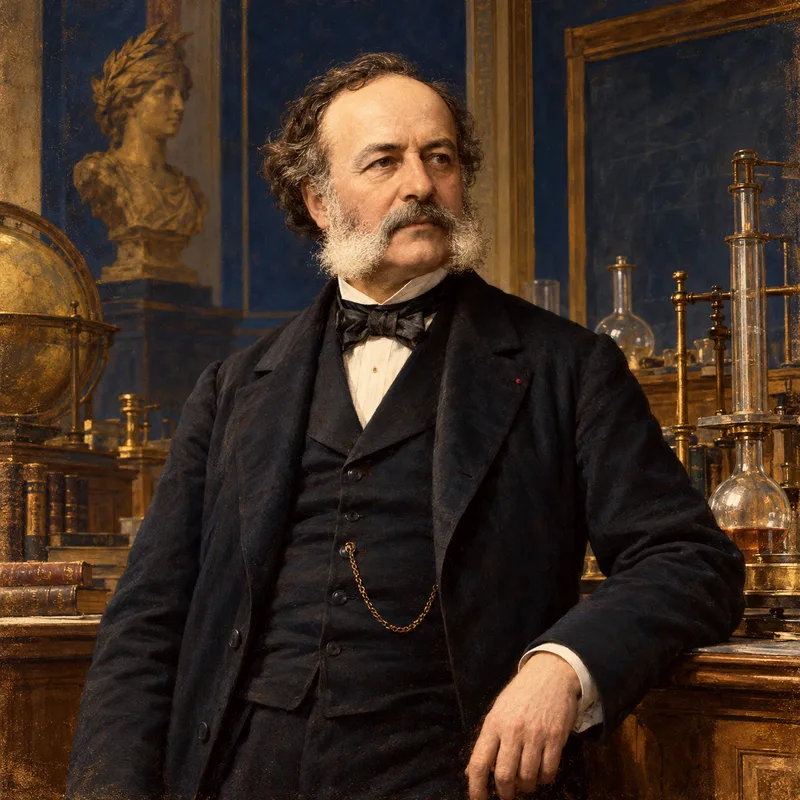
About the chemist
Charles Adolphe Wurtz
1817-1884 · France
Wurtz reaction; discovered ethylene glycol