The discovery, explained · Chemist no. 249 of 350
Wurtz's Discoveries: From Coupling Alkyl Halides to Ethylene Glycol and Aldol
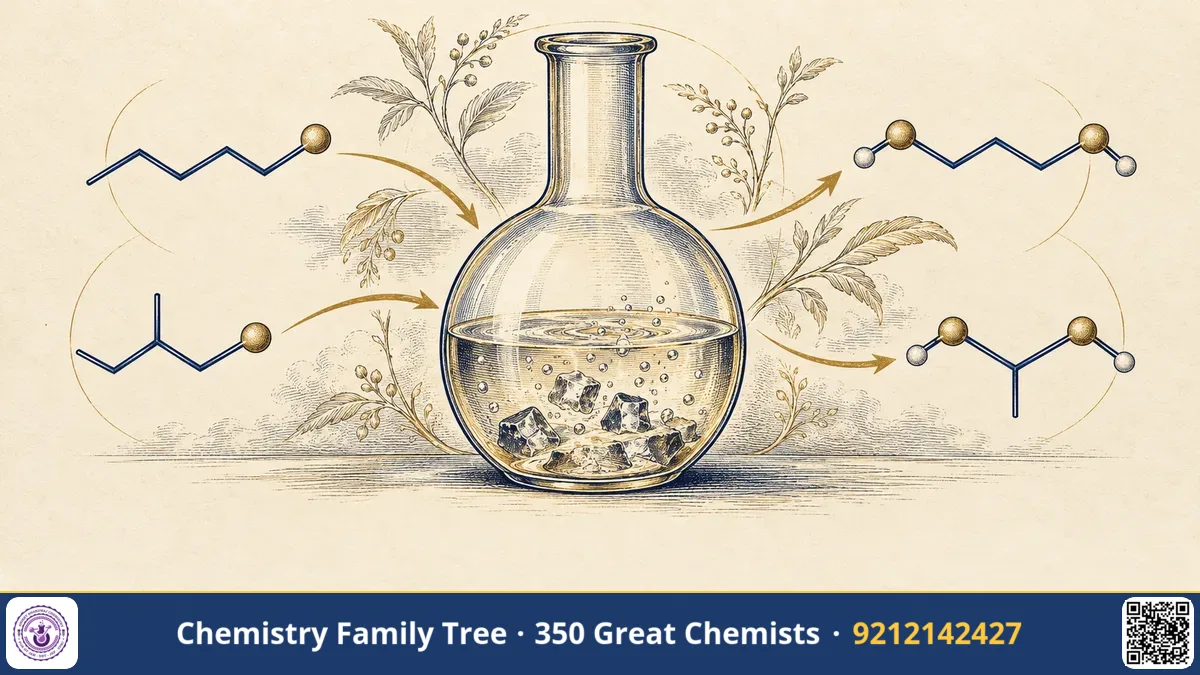
The Wurtz reaction, in which two alkyl halides join in the presence of sodium metal to form a longer alkane, is one of the first named reactions that students meet in organic chemistry. It was described in 1855 by Charles Adolphe Wurtz (1817-1884), a French chemist from Alsace. But Wurtz did much more. He discovered the alkylamines (1849), prepared ethylene glycol (1856) and ethylene oxide (1859), discovered the aldol reaction (1872) at the same time as Alexander Borodin, and became one of the strongest voices for the atomic theory in France. This post explains these discoveries one by one, with the mechanism and the points that are asked in exams.
The Scientific Problem Before the Discovery
In the 1840s organic chemistry was a collection of compounds with no clear system for building them. Radical theory said that groups like ethyl or methyl were units, but nobody had isolated a free radical, and it was not known how to join two such units to make a larger molecule. Ammonia was known as a base, but it was not known if organic bases could be derived from it by replacement of hydrogen.
Another question was about alcohols. Ethanol, a monohydric alcohol, was well known, and glycerol (with three OH groups) was known from fats. Was there a compound with two OH groups? Gerhardt's type theory predicted that such compounds should exist, and if they did, they would be a strong support for the new thinking.
The Discovery / Experiment
1. Alkylamines (1849)
Wurtz heated alkyl isocyanates and cyanates with potassium hydroxide and found volatile bases with a smell like ammonia, which he identified as methylamine and ethylamine. These are ammonia in which one hydrogen is replaced by an alkyl group.
CH3NCO + 2 KOH  ->  CH3NH2 + K2CO3
NH3  ->  CH3NH2 (primary), (CH3)2NH (secondary), (CH3)3N (tertiary)
This showed that ammonia could be seen as a type from which organic bases are derived. A few years later August Hofmann, who worked on the same subject, developed the methods for making amines of all classes.
2. The Wurtz reaction (1855)
Wurtz treated an alkyl halide, such as ethyl iodide, with sodium metal in dry ether. A reaction took place, giving a gaseous hydrocarbon. Working with iodides, he obtained butane from ethyl iodide.
2 R-X + 2 Na  --(dry ether)-->  R-R + 2 NaX
2 CH3CH2Br + 2 Na  ->  CH3CH2CH2CH3 + 2 NaBr
He called the product a "radical" at first, taking it for a free radical, because it contained two ethyl groups. But the measured molecular weight showed that the substance was butane, a dimer.
3. Ethylene glycol and ethylene oxide (1856, 1859)
- Wurtz treated ethylene dibromide (or iodide) with silver acetate to form the diacetate.
- Hydrolysis of the diacetate with potassium hydroxide gave a sweet, viscous liquid with two hydroxyl groups, which he called glycol, since it was between ethanol and glycerol.
- In 1859 he prepared ethylene oxide from ethylene chlorohydrin with potassium hydroxide, and showed that it adds water to form glycol.
BrCH2CH2Br + 2 CH3COOAg -> CH3COOCH2CH2OCOCH3 + 2 AgBr
CH3COOCH2CH2OCOCH3 + 2 KOH -> HOCH2CH2OH + 2 CH3COOK
ClCH2CH2OH + KOH -> (CH2CH2)O + KCl + H2O        (ethylene oxide)
(CH2CH2)O + H2O -> HOCH2CH2OH
4. The aldol reaction (1872)
Wurtz found that acetaldehyde, on treatment with a dilute acid or base, formed a new compound that was both an aldehyde and an alcohol. He named it aldol (aldehyde + alcohol). Borodin, the Russian chemist and composer, reported the same reaction at the same time.
2 CH3CHO  --(dil. NaOH, cold)-->  CH3CH(OH)CH2CHO      (3-hydroxybutanal, aldol)
CH3CH(OH)CH2CHO  --(heat)-->  CH3CH=CHCHO + H2O        (crotonaldehyde)
The Chemistry Behind It
Wurtz reaction mechanism
Two pathways are written. In the first, sodium transfers an electron to the alkyl halide to give an alkyl radical, which is then reduced to an alkyl sodium (R-Na+). The carbanion then attacks another alkyl halide in an SN2 reaction.
R-X + 2 Na -> R-Na + NaX             (organosodium, carbanion character)
R-Na + R-X -> R-R + NaX              (SN2 coupling)
The second pathway is a radical coupling of two alkyl radicals. Both ideas are accepted, and the exact path depends on conditions.
Limitations: Only primary alkyl halides give good yield. Secondary and tertiary halides undergo elimination (the strongly basic organosodium removes a beta proton) to give alkenes. A mixture of two different alkyl halides gives three alkanes (R-R, R'-R' and R-R'), difficult to separate, so the method is mainly used for symmetrical alkanes with an even number of carbon atoms. Methane cannot be made by it.
The related Wurtz-Fittig reaction (Fittig, 1864) couples an aryl halide with an alkyl halide and sodium to give an alkylbenzene:
C6H5Br + CH3Br + 2 Na -> C6H5CH3 + 2 NaBr
Aldol mechanism
Base removes an alpha proton from acetaldehyde to give an enolate, which attacks the carbonyl carbon of a second acetaldehyde molecule. Protonation gives the beta-hydroxy aldehyde. On heating, dehydration (E1cB) gives the alpha,beta-unsaturated aldehyde.
Applications Today
- Ethylene glycol: Made industrially by hydration of ethylene oxide, which is made by air oxidation of ethylene over silver catalyst. It is used as antifreeze in car radiators and to make PET (polyester) bottles and fibre, a very large industry in India.
- Ethylene oxide: Raw material for surfactants, polyethylene glycols and ethanolamines, and used to sterilise heat-sensitive medical devices.
- Aldol chemistry: A basic tool to form carbon-carbon bonds in the laboratory and in nature, as in biosynthesis of sugars (aldolase enzyme in glycolysis).
- Amines: Core of drugs, dyes and agrochemicals; the Wurtz route started the study.
- Wurtz coupling: Used in specialised synthesis, including preparation of small rings such as bicyclobutane type compounds by intramolecular coupling.
Exam Corner
- Wurtz reaction: 2 R-X + 2 Na in dry ether gives R-R; it cannot give methane; it gives even-numbered alkanes from one halide.
- Mixing CH3Cl and C2H5Cl gives ethane, propane and butane.
- Tertiary halides give alkenes by elimination rather than coupling.
- Intramolecular Wurtz: 1,3-dibromopropane + Na (or Zn) gives cyclopropane; 1,4-dibromobutane gives cyclobutane.
- Aldol: acetaldehyde + dilute NaOH gives 3-hydroxybutanal; heating gives but-2-enal.
Common Misconceptions
- "Water can be used as the solvent for the Wurtz reaction." No. Sodium reacts violently with water, so the solvent must be dry ether.
- "The Wurtz reaction is a good way to make unsymmetrical alkanes." It gives a mixture, so it is not.
- "Wurtz discovered the aldol reaction alone." Borodin reported it independently in the same period.
Quick Revision Box
- Charles Adolphe Wurtz (1817-1884), French chemist, born in Alsace.
- 1849: methylamine and ethylamine; 1855: Wurtz reaction.
- 1856: ethylene glycol; 1859: ethylene oxide.
- 1872: aldol reaction, with Borodin.
- Wurtz: 2R-X + 2Na (dry ether) gives R-R + 2NaX.
- Wurtz-Fittig: Ar-X + R-X + 2Na gives Ar-R.
FAQ
What is the Wurtz reaction used for?
For preparing symmetrical higher alkanes from primary alkyl halides and sodium in dry ether, and for making small rings by intramolecular coupling.
Why is dry ether used?
Sodium reacts with water and alcohols, and organosodium compounds would be destroyed by moisture, so the solvent must be dry and unreactive.
Why is glycol called glycol?
Wurtz chose the name since the compound, with two OH groups, was between alcohol (one OH) and glycerol (three OH).
What is the difference between the Wurtz and Wurtz-Fittig reactions?
Wurtz couples two alkyl halides; Wurtz-Fittig couples an aryl halide with an alkyl halide to make an alkylbenzene.
Published by ABC Chemistry — IIT-JAM | CSIR-NET | GATE Chemistry Coaching. Visit abcchemistry.com
About the chemist
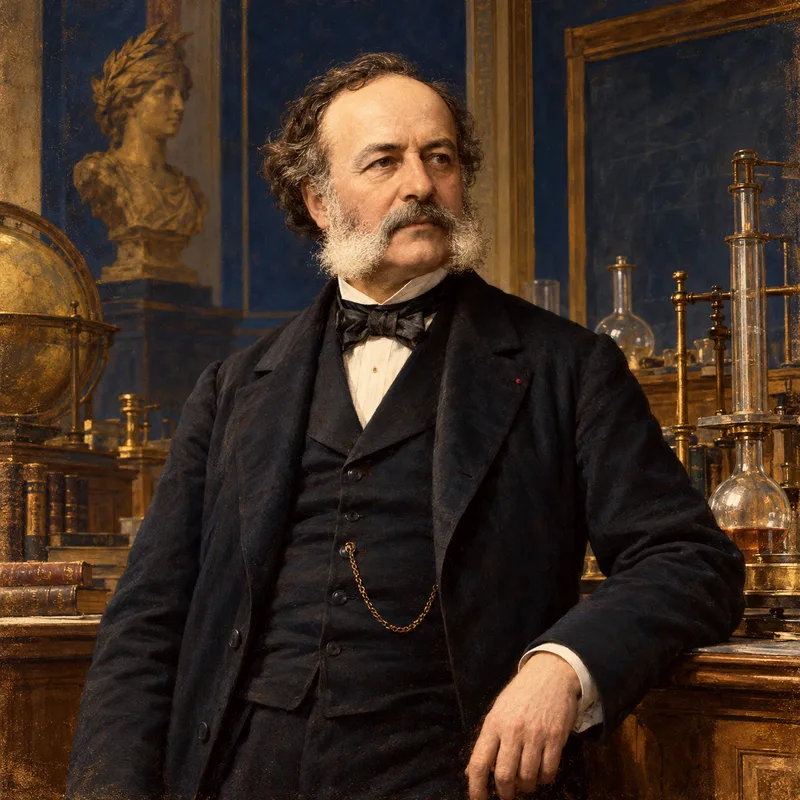
Charles Adolphe Wurtz
1817-1884 · France
Wurtz reaction; discovered ethylene glycol