Biography · Chemist no. 304 of 350
Charles Coulson (1910–1974): The Mathematician Who Explained the Chemical Bond
Charles Alfred Coulson was a British applied mathematician and theoretical chemist who became one of the most influential teachers of chemical bonding in the twentieth century. He held chairs at King's College London and Oxford, wrote the classic book "Valence" (1952), and shaped the way molecular orbital theory is taught around the world. He was also a deeply religious man and a tireless worker for aid to developing countries. His legacy in one line: he made the quantum theory of the chemical bond understandable to chemists.
Early Life and Family
Coulson was born on 13 December 1910 in Dudley, Worcestershire, England. His father was a principal of a technical college, so education was valued at home. The family was Methodist, and religion remained central to Coulson's life. He showed an extraordinary talent for mathematics at an early age. He attended Clifton College in Bristol, where he won a scholarship to Cambridge.
Education and Mentors
Coulson studied mathematics at Trinity College, Cambridge, graduating with the highest distinction. He then turned to research, working under John Lennard-Jones, the founder of the Cambridge school of theoretical chemistry, who was applying molecular orbital ideas to molecules such as O₂. Coulson took his PhD in 1936 and developed the first calculations of the electronic structure of small molecules and of the hydrogen molecule ion, and he applied group theory and numerical methods to bonding. He also learned much from the work of Hückel, Pauling and Mulliken, whom he met and corresponded with.
Career Timeline
| Year | Event |
|---|---|
| 1910 | Born in Dudley, England |
| 1936 | PhD at Cambridge under Lennard-Jones |
| 1938 | Lecturer in mathematics at University College, Dundee (then part of the University of St Andrews) |
| 1947 | Professor of theoretical physics at King's College London |
| 1952 | Publishes "Valence"; moves to Oxford as Rouse Ball Professor of Mathematics |
| 1954 | Elected Fellow of the Royal Society |
| 1972 | Becomes first holder of the Oxford chair of Theoretical Chemistry |
| 1974 | Dies in Oxford on 7 January |
Major Scientific Contributions
Molecular orbital theory and the bond. Coulson refined the MO method, calculated the electronic energies of molecules such as H₂ and H₂⁺, and compared them with experiment. With Inga Fischer in 1949 he produced the Coulson–Fischer wavefunction for H₂, bridging the VB and MO pictures.
Bond order and charge density. Building on Hückel theory, he defined the mobile (pi) bond order, the pi-electron charge distribution and the free valence index. These measures link calculation to bond lengths and chemical reactivity in aromatic hydrocarbons. See the companion discovery article for the formulas.
Hydrogen bonding and electron density. He studied the nature of the hydrogen bond, showing that it has an electrostatic character along with some covalent contribution, and argued for the importance of looking at electron density.
Textbooks. "Valence" (1952, revised 1961) became the standard text on bonding for universities. His smaller book "Electricity" and works on mathematics for chemists were also widely used. His clear, non-mathematical style was deliberate.
Awards, Honours and Nobel Prize
Coulson never received a Nobel Prize, although his name is mentioned among the great theoretical chemists. He was elected a Fellow of the Royal Society in 1954 and was recognised by learned societies in several countries. Precise lists of other medals and honorary degrees are omitted here to avoid errors. Those who knew him remembered his honours as less important to him than his teaching and public service.
Personality, Struggles and Lesser-Known Facts
- Faith and science together. Coulson was a Methodist lay preacher and wrote and lectured widely on the relationship between science and religion, including the book "Science and Christian Belief" (1955). He argued against a "God of the gaps".
- Humanitarian work. He was active in Oxfam and in aid organisations and was concerned about poverty and world development. He travelled widely and encouraged students from developing countries.
- Wartime stance. He was a pacifist and a conscientious objector during the Second World War, and continued to teach mathematics during this period.
- Brilliant lecturer. Students described him as modest, generous with time and eager to turn a difficult idea into a simple picture. He encouraged many young researchers, including some who became leaders in the field.
- Pioneer of computing. He recognised early that electronic computers would transform quantum chemistry and arranged for calculations on early machines.
Legacy and Influence on Modern Chemistry
Coulson created a school of theoretical chemistry at Oxford, and his students and collaborators included Roy McWeeny and others who spread his methods. The Coulson–Fischer idea is revived today in modern valence bond theory and generalised VB methods. His bond order and charge density are standard outputs of computational chemistry programs. Perhaps most important, he showed that one can respect both mathematics and chemical intuition. The Oxford chair of theoretical chemistry, first held by him, keeps his tradition alive.
Lessons for Students
- Explain simply. If you can explain a hard idea in plain language, you understand it well. Coulson was famous for exactly this.
- Combine theories. VB and MO looked like competitors, and Coulson showed they are partners.
- Use your knowledge for society. A scientist can also care about poverty, peace and ethics.
- Learn mathematics. Strong maths opens the door to GATE, NET and research in physical and theoretical chemistry.
Quick Facts Box
- Born: 13 December 1910, Dudley, England
- Died: 7 January 1974, Oxford, England
- Nationality: British
- Field: Theoretical chemistry, applied mathematics
- Famous for: Book "Valence", bond order, Coulson–Fischer wavefunction
- Nobel: None (FRS 1954)
FAQ
What is Charles Coulson best known for?
He is best known for his book "Valence", for developing the concept of bond order in conjugated molecules and for the Coulson–Fischer wavefunction of H₂.
Was he a chemist or a mathematician?
Both. He trained as a mathematician, held professorships in theoretical physics and mathematics, and finally held the first Oxford chair in theoretical chemistry.
Did Coulson win a Nobel Prize?
No, though he is widely respected. His fellow theoretical chemists such as Mulliken (1966) and Hoffmann (1981) did receive Nobel Prizes.
Why should an Indian chemistry student read about him?
Because the MO diagrams, bond orders and magnetic properties in the JAM, NET and GATE syllabus are explained in the tradition he established.
Published by ABC Chemistry — IIT-JAM | CSIR-NET | GATE Chemistry Coaching. Visit abcchemistry.com
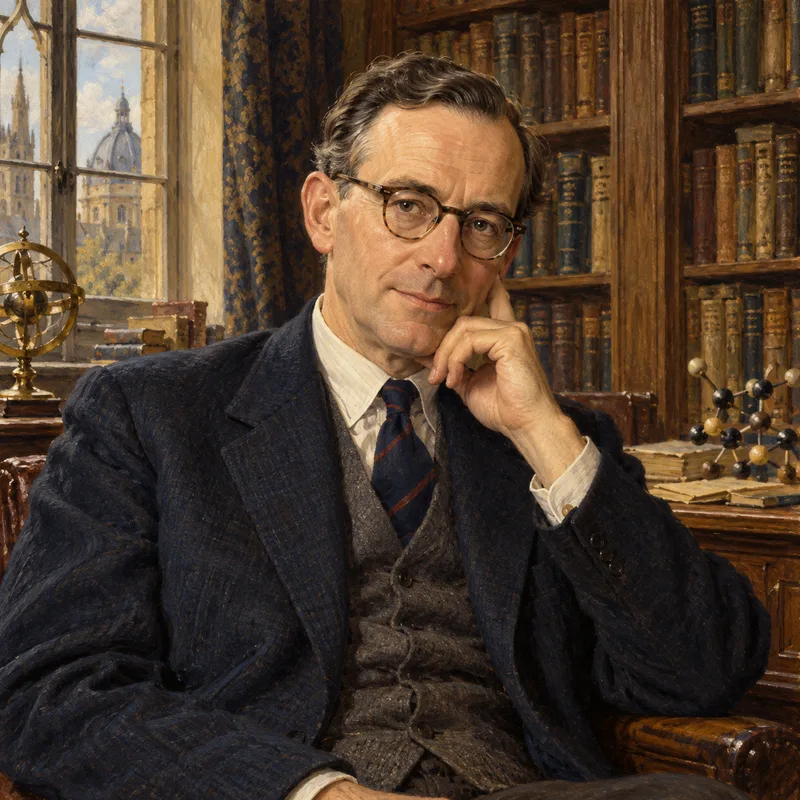
About the chemist
Charles Coulson
1910-1974 · United Kingdom
Molecular orbital theory; valence theory