The discovery, explained · Chemist no. 304 of 350
Charles Coulson and the Language of Molecular Orbitals: Bond Order, Charge and Beyond
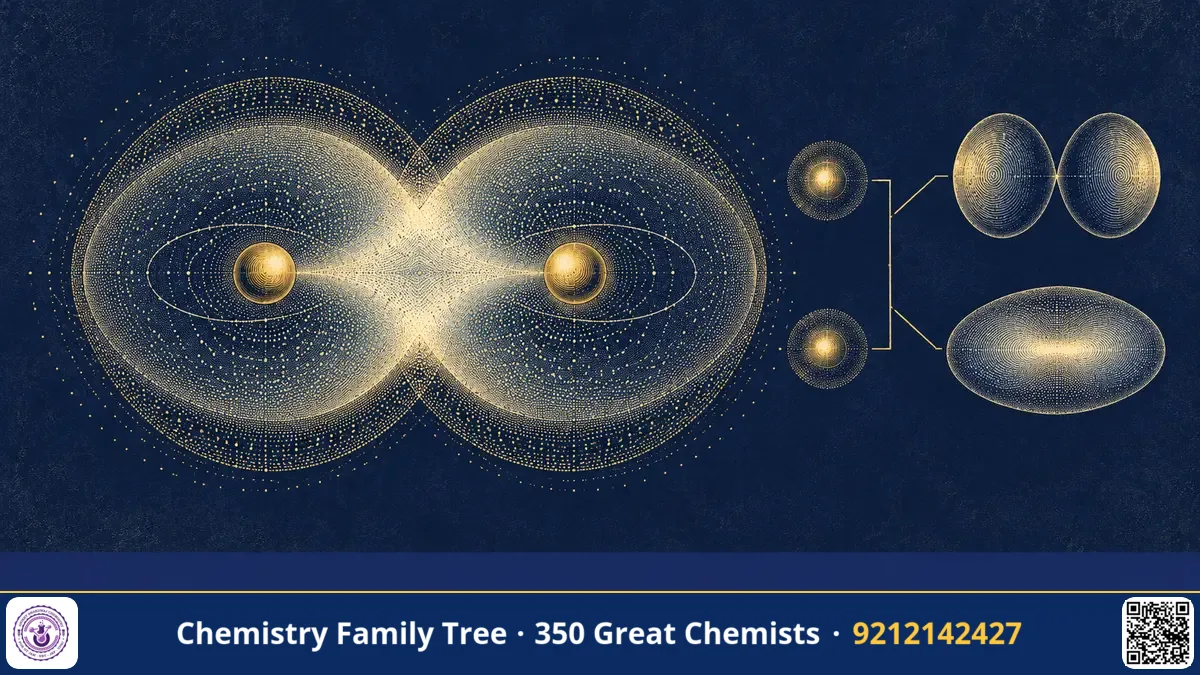
When you draw the molecular orbital diagram of O₂ and say "bond order = 2", you are using a language that Charles Alfred Coulson did more than almost anyone to make clear. Coulson was a British theoretical chemist and mathematician who turned the difficult mathematics of quantum mechanics into tools that working chemists could use. He extended the simple molecular orbital ideas of Hückel, introduced the quantitative idea of bond order for conjugated molecules, improved the wavefunction for the hydrogen molecule, and wrote the book "Valence" (1952), which taught a generation of chemists how bonds really work. This article explains the core ideas in a way that is directly useful for IIT-JAM, CSIR-NET and GATE.
The Scientific Problem Before the Discovery
After the Schrödinger equation appeared in 1926, chemists hoped it could explain the chemical bond. Two competing approaches emerged for the simplest molecule, H₂.
- Valence Bond (VB) theory of Heitler and London (1927): a bond is formed by pairing electrons whose atomic wavefunctions overlap.
- Molecular Orbital (MO) theory of Hund, Mulliken and Lennard-Jones: electrons occupy orbitals spread over the whole molecule.
Each method had its strengths and weaknesses. The simple VB wavefunction for H₂ gave a bond energy of about 3.2 eV against the experimental 4.75 eV, and the simplest MO wavefunction was poor at large internuclear distance because it wrongly predicted that H₂ dissociates partly into ions. Many chemists regarded the two methods as rivals. Moreover, there was no clear numerical way to say "how much double bond character" a bond in benzene or naphthalene has.
The Discovery and Contributions: Step by Step
Step 1: Reconciling MO and VB (Coulson–Fischer, 1949)
The simple MO wavefunction for H₂ is σg(1)σg(2), where σg = (1sA + 1sB)/√2. Expanding it gives a covalent part and an ionic part with equal weight:
Ψ(MO) ∝ [1sA(1)1sB(2) + 1sB(1)1sA(2)]  +  [1sA(1)1sA(2) + 1sB(1)1sB(2)]
              covalent                              ionic
The Heitler–London VB function contains only the covalent part. The truth lies in between. Coulson and Inga Fischer showed in 1949 that if you let the atomic orbitals distort slightly, each orbital being mostly on one atom but with a small "tail" on the other, you get a wavefunction that is better than both and that describes correct dissociation into two neutral hydrogen atoms. This showed that VB and MO are not opposed; they are two starting points for the same exact answer, and including configuration interaction improves MO to the VB limit.
Step 2: Bond order in conjugated molecules (1939)
Using Hückel's simple pi-electron method, Coulson defined the mobile bond order (pi bond order) between two bonded atoms r and s:
p(rs) = Σ n(j) · c(jr) · c(js)
Here n(j) is the number of electrons in molecular orbital j (0, 1 or 2) and c(jr) is the coefficient of atom r in that orbital. For ethene, p = 1. For benzene, p = 2/3 for every bond. The total bond order (sigma plus pi) is therefore 1 + 2/3 ≈ 1.67. In naphthalene, the 1–2 bond has p ≈ 0.725, whereas the 2–3 bond has p ≈ 0.603. Experiment confirms that the 1–2 bond (about 136 pm) is shorter than the 2–3 bond (about 142 pm). Coulson also showed that bond length decreases smoothly as bond order increases, a relation that is still used to predict bond lengths.
Step 3: Charge density and free valence
Coulson defined the pi-electron charge density at atom r as q(r) = Σ n(j) · c(jr)². For alternant hydrocarbons all q(r) = 1, but for heteroatoms such as pyridine or for ions, q(r) varies from carbon to carbon, and this predicts where electrophiles and nucleophiles attack. He also introduced the free valence index, F(r) = √3 − Σ p(rs), which measures the leftover bonding capacity of an atom and predicts radical reactivity.
Step 4: Making bonding clear in simple diatomics
In general chemistry we also use a bond order defined by MO occupation:
Bond order = ½ (Nb − Na)
where Nb is the number of electrons in bonding orbitals and Na in antibonding orbitals. For H₂, BO = ½(2 − 0) = 1. For He₂, BO = ½(2 − 2) = 0, so it does not exist. For O₂ (KK σ2s² σ*2s² σ2pz² π2p⁴ π*2p²), BO = ½(8 − 4) = 2, and the two unpaired electrons in π* explain paramagnetism. This framework, which Coulson's "Valence" explained very carefully, is what you meet in every textbook.
The Chemistry Behind It
The central idea is delocalisation. Electrons spread over the entire molecule have lower kinetic energy, like a particle in a larger box. Coulson's bond order captures how many electron pairs are effectively shared between two atoms. The more shared, the shorter and stronger the bond, and the higher the stretching frequency in IR spectra.
| Molecule | Bond order (MO) | Bond length (approx.) | Magnetism |
|---|---|---|---|
| N₂ | 3 | 110 pm | Diamagnetic |
| O₂ | 2 | 121 pm | Paramagnetic |
| O₂⁻ (superoxide) | 1.5 | about 134 pm | Paramagnetic |
| F₂ | 1 | 142 pm | Diamagnetic |
| H₂⁺ | 0.5 | 106 pm | Paramagnetic |
Coulson also contributed to the study of hydrogen bonding, the theory of the diffuse charge distribution in molecules and the early use of computers for quantum chemistry. He wrote on the shape of molecular orbitals and showed that electron density maps, not just energies, matter in chemistry.
Applications Today
- Predicting reactivity: Charge density and frontier orbital coefficients guide electrophilic aromatic substitution and radical reactions.
- Bond length estimation: Correlating bond order with length helps in structure assignments of polycyclic aromatic compounds and fullerenes.
- Computational chemistry: Modern software such as Gaussian, GAMESS and ORCA reports Mulliken and Mayer bond orders, which are direct descendants of Coulson's idea.
- Materials: Band structures of graphene and conducting polymers like polyacetylene use the same orbital mathematics.
- Education in India: The MO diagram approach for homonuclear diatomics in Class 11 NCERT and B.Sc. syllabi is an everyday use of this thinking.
Exam Corner: 5 Likely Points
- Calculate bond order and magnetic behaviour for N₂, O₂, O₂⁺, O₂⁻, O₂²⁻, NO, CO, B₂ and C₂ using MO theory.
- Order of bond length: O₂⁺ < O₂ < O₂⁻ < O₂²⁻; the order of bond order is the reverse.
- State the difference between VB and MO descriptions of H₂ (covalent only versus covalent plus ionic).
- Pi bond order of each C–C bond in benzene is 2/3 by the Hückel method; total bond order 1.5 by the resonance picture (Kekulé average).
- The mixing of 2s and 2p (s-p mixing) reverses the order of σ2p and π2p for B₂, C₂ and N₂ (and below).
Common Misconceptions
- "Higher bond order always means higher reactivity or lower reactivity." Bond order tells you about bond strength and length; reactivity also depends on orbital energies and charge.
- "VB and MO give different answers in principle." With full configuration interaction they converge. Differences arise only in simple approximations.
- "Bond order must be a whole number." It can be fractional (0.5, 1.5, 2.5) and in conjugated systems takes non-integer values.
Quick Revision Box
- Bond order (diatomic MO) = ½(Nb − Na).
- Hückel pi bond order: p(rs) = Σ n(j) c(jr) c(js); benzene = 2/3 per bond.
- Charge density: q(r) = Σ n(j) c(jr)².
- Coulson–Fischer (1949): H₂ wavefunction bridging VB and MO.
- Simple MO wavefunction for H₂ = 50% covalent + 50% ionic; simple VB = covalent only.
- Higher bond order gives shorter bond and higher bond energy.
FAQ
Why is the bond order of He₂ zero?
Two electrons occupy σ1s and two occupy σ*1s. Bonding and antibonding effects cancel, so BO = ½(2 − 2) = 0.
What is the pi bond order in benzene?
Using the Hückel method, each C–C pi bond order is 2/3, and the total bond order is about 1.67 when sigma is added.
What is the Coulson–Fischer wavefunction?
It is a VB-type wavefunction for H₂ in which each electron occupies an orbital that is mainly on one nucleus but slightly delocalised onto the other. It gives better energies than simple VB or MO functions.
Why do chemists still use these ideas?
They give fast, intuitive predictions of bond lengths, magnetism and reactivity, and they form the basis of the output of modern computational programs.
Published by ABC Chemistry — IIT-JAM | CSIR-NET | GATE Chemistry Coaching. Visit abcchemistry.com

About the chemist
Charles Coulson
1910-1974 · United Kingdom
Molecular orbital theory; valence theory